Blog

  • Perplexity Optimisation: How to Become a Cited Source

    Perplexity Optimisation: How to Become a Cited Source

    Do not treat Perplexity like Google. It does not work by simply ranking pages. It combines information from multiple sources and then provides answers, with inline citations for each source. If you want your brand to appear in those citations, you need to understand the mechanism behind source selection.

    This guide simply breaks down how Perplexity picks sources, how to make a page citable, and how to build a Generative Engine Optimization strategy that actually works in 2026. Let’s get started!

    How Perplexity Picks Its Sources?

    Think of Perplexity as an answer engine. When a user asks a query, the system reads relevant content from its index and live webpages. It then retrieves an answer summary with proper citations.

    This picking process is not as simple as it sounds. It follows a pattern based on four key signals.
    Diagram of the four signals Perplexity uses to pick sources: recency, structure, citations and community discussion

    • Recency
    • Clarity
    • Density
    • Community Discussion

    Signal 1: Content Recency

    Perplexity’s top priority is fresh and updated content. If a user inquires about AI tools, SEO changes, or digital marketing trends, the answer engine will prioritise pages published or refresh within the last 6 to 12 months or even less.

    A page from 2022 may still rank on Google, but Perplexity will likely not cite it if newer sources exist. This means evergreen content alone is not enough. You need to publish consistently and update existing content regularly.

    Signal 2: Structural Clarity

    Perplexity extracts answers from pages that are easy to parse. This includes pages with

    • Clear H1 and H2 hierarchy
    • Short paragraphs
    • Direct answers placed early in the content
    • Bullet points and tables
    • No cluttered layouts or
    • Zero intrusive pop-ups

    The engine does not reward clever writing. It rewards clarity. If a page is difficult to extract information from, Perplexity will move to the next source.

    Signal 3: Citation Density

    One of the easiest yet trickiest ways to get cited by Perplexity is to earn links from authoritative domains. This is similar to traditional backlinks, but with a twist. Perplexity looks at the citation context to understand how other pages reference your content.

    If multiple sources quote your statistic, link to your research, or name your brand as the origin of a concept, Perplexity treats your page as a primary source. This is why original data and proprietary frameworks are so valuable.

    Signal 4: Community Discussion

    Perplexity crawls forums, Reddit threads, and community platforms. These spaces act as validation layers. If users discuss a topic and reference a specific source, that source gains authority in Perplexity’s model.

    This is a fundamental shift from Google. Google treats forums as content. Perplexity treats them as signals. A well-placed mention in a high-engagement Reddit thread can be more valuable than a backlink from a low-authority blog.

    How Perplexity is Different from Google and ChatGPT

    Perplexity Optimisation sits apart from both traditional SEO and ChatGPT-style LLM brand mentions. You cannot treat them as the same thing. Let’s see things individually.

    Perplexity vs Google

    Factor Perplexity Google
    Core output List of links Synthesised answer with citations
    Ranking Signal Backlinks, content depth, user behaviour Recency, extractability, citation consensus
    User Intent Navigational, informational, transactional Informational, comparative, research-focused
    Click-through Secondary metric (citation is the win) Primary metric
    Content Format Long-form, comprehensive guides Answer-first paragraphs, data blocks

    Google wants to keep users on Google. Perplexity wants to answer the query and send users to the source if they want more. This changes the goal of optimisation.

    Perplexity does not want you to fight for position one. It wants you to earn a place among the three to five cited sources.

    Perplexity vs ChatGPT

    Factor Perplexity ChatGPT
    Core output Synthesised answer with live citations Conversational answer from memory or browsing
    Ranking Signal Retrieval relevance, recency, citation density Training data presence, LLM brand mentions
    User Intent Research-focused, fact-checking, comparative Explanatory, creative, task-based
    Click-through Secondary metric (citation is the win) Not a primary metric
    Content Format Answer-first paragraphs, extractable data blocks Long-form responses, conversational flow

    ChatGPT relies on training data and web browsing (when enabled). Perplexity is a retrieval-augmented generation (RAG) system. It always retrieves live information before generating an answer.

    This is why AI search visibility is more measurable with Perplexity. You can also check our guide AI Search Engines Compared to get a better understanding of different AI generated engines and how they work.

    You can test it. You can query a topic and see whether your brand appears. With ChatGPT, the response is harder to predict because it depends on the model version and context window.

    The 7 Things That Make a Page Citable

    Citation is not an accident. It is a result of specific structural and strategic choices. Here are the seven factors that make a page more likely to be cited by Perplexity.

    Answer-First Structure: Answer Before Explanation

    Perplexity prefers pages that answer the question immediately. /burrying content under ten paragraphs of context is useless. State direct answer in the first 50 to 100 words, then explain.

    This is called the “Answer-First Approach” content structure. It works for both human readers and AI extraction.

    Original Data and Statistics: Be the Primary Source

    Pages with unique numbers are gold. If you conduct original research, publish survey results, or analyse proprietary data, Perplexity has a reason to cite you.

    You cannot fake this. You must create data that does not exist elsewhere. This is part of building topical authority for machine learning.

    Concise Definitions: Say It in One Sentence

    Perplexity often extracts definitions from pages that explain a concept clearly in one or two sentences. Providing a concise definition near the top of your page can increase the likelihood of your content being quoted directly.

    For example: “Perplexity optimisation means structuring content in a way that increases the likelihood of Perplexity citing it as a source.”

    Schema Markup: Tell AI What Your Content Means

    Structured data and schema for AI parsing is no longer optional. Use FAQPage, Article, Organisation, and Speakable schema where relevant. This helps Perplexity understand the structure of your content and extract the right elements.

    High-Authority Citations: Get Cited by Credible Sources

    Your page needs to be referenced elsewhere. This is one of the Digital PR strategies for AI visibility. When industry publications, research aggregators, and high-authority blogs reference your content, Perplexity treats it as a credibility signal.

    A single link from a .edu or .gov domain often carries more weight than dozens of links from low-authority sites.

    Entity Consistency: Help AI Connect the Dots

    Perplexity uses Entity SEO for AI engines to understand who you are and what you cover. Your brand name, author names, and key topics should be consistent across your website, social profiles, and third-party platforms.

    Create an “About” page that works as your portfolio. Link to your authors’ LinkedIn profiles. Use consistent naming conventions everywhere.

    Crawlability for AI Bots: Let Perplexity Access Your Site

    Do not block PerplexityBot. Review your robots.txt file and ensure the crawler can access your pages without restriction. The same applies to GPTBot, ClaudeBot, and Google-Extended.

    Blocking these bots is a common mistake. Brands often block AI crawlers to protect content, then wonder why they are invisible in AI search results.

    The Role of Reddit and Forums

    Perplexity treats community platforms as contextual data sources. Reddit threads, Quora answers, and niche forums provide real-world perspectives that traditional web pages often lack.

    Reddit and forums matter because

    • They contain natural language questions and answers
    • They reflect genuine user sentiment
    • They are frequently updated
    • They provide consensus signals

    When Perplexity receives a query, it may pull from a Reddit thread where users discuss the exact problem. If your brand or content is mentioned in that thread, you gain indirect visibility.

    How to Check Whether Perplexity Cites You Today

    You cannot improve what you cannot measure. Here is a simple process to audit your current AI search visibility.

    Step 1: Run Direct Queries

    Open Perplexity and search for:

    “What is [your topic]?”

    “Best [your category] in 2026”

    “[Your brand name] review”

    “[Your brand name] statistics”

    Note if Perplexity picking up your brand in the answer or the citations.

    Step 2: Check Referral Traffic

    Go to Google Analytics. Look for referral traffic from perplexity.ai. Perplexity referrals are often recorded as direct or uncategorised traffic, so tagging your links with UTM parameters is essential for accurate tracking.

    Step 3: Check Content’s Extractability

    Pick one of your existing blog. Paste the URL into Perplexity and give command to “summarise this page in three bullet points.”

    If the summary is accurate and includes your key points, you are on the right track and your page is extractable. If the summary is vague or misses the core answer, rebuild your structure.

    Step 4: Monitor Brand Mentions

    Use monitoring tools such as Google Alerts, Brand24, or Mention and track your brand conversations. Prioritise Reddit, Quora, and industry forums because Perplexity treats these discussions as authority signals.

    How to Build a Citable Content Strategy

    Once you understand the Perplexity citation mechanism, the next step is its implementation. here is how you can do it.

    • Create a citation asset – content built for AI referencing: clear answer, original data, concise definition, quotable framework.
    • Refresh content regularly – update key pages every 90 days to signal freshness.
    • Optimise for zero-click searches – brand visibility matters more than clicks; a citation is a win.
    • Build semantic depth – cover the full concept cluster so Perplexity sees your site as comprehensive.

    Ready for Perplexity Optimisation?

    Perplexity Optimisation is still new in the trends. Most brands have not adapted. That gap is your opportunity.

    Its citation mechanism is clear. Perplexity favours recent, well-structured, heavily-cited pages backed by community validation. Brands that publish original data and build forum presence will dominate AI search. But that is not your problem to solve. Prox is here to handle it for you.

    Prox Digital Agency helps businesses become cited sources. We specialise in Generative Engine Optimization (GEO), citable content creation, and AI search visibility measurement across Perplexity, ChatGPT, and Gemini.

    The brands that get cited are not always the biggest. They are the clearest and most data-rich. Contact our expert team and build for the mechanism starting today.

    FAQ

    What is Perplexity Optimisation and why does it matter in 2026?

    Perplexity Optimization is the practice of structuring content to increase the likelihood of being cited as a source in Perplexity AI’s generated answers. It matters because Perplexity is rapidly becoming a primary research tool for professionals, and citation drives both brand visibility and referral traffic.

    Is Perplexity AI better than ChatGPT?

    Both are for different purposes. Perplexity AI is better for real-time, citation-backed research, while ChatGPT is stronger for creative writing, brainstorming, and conversational depth.

    How do I get my brand cited by Perplexity?

    To get cited by Perplexity, publish original research, earn citations from high-authority domains, and maintain an active presence in community discussions so the AI recognises your brand as a trusted source.

    What type of content do AI search engines prefer to cite?

    AI search engines prefer content with original research, unique statistics, quotable definitions, and an answer-first structure that state the core answer in the first 50 to 100 words.

    Does social media presence influence AI search results?

    Yes. Positive mentions on Reddit, LinkedIn, and X act as validation signals—Perplexity crawls these platforms to measure trust, and brands with active community presence are more likely to be cited.
  • Prox Digital Agency Expands Its Generative Engine Optimisation Practice for Global Businesses

    Prox Digital Agency Expands Its Generative Engine Optimisation Practice for Global Businesses

    LONDON, United Kingdom — Prox Digital Agency today announced the expansion of its Generative Engine Optimisation (GEO) practice to support businesses across international markets as AI increasingly changes how people discover, evaluate and choose brands. Prox has set out its wider view of the shift in its guide to generative engine optimisation.

    Following its global expansion beyond the UK, Prox is extending its GEO capabilities to clients across the United States, the Middle East, Australia and beyond, bringing a more structured approach to visibility across emerging AI-driven discovery platforms. The agency has also published a breakdown of how SEO and GEO differ.

    The expansion comes at a time when search behaviour is evolving beyond the traditional results page. Consumers and business buyers are increasingly turning to AI platforms to ask for recommendations, compare solutions and understand complex topics before visiting a company’s website.

    For businesses, this creates a new visibility challenge.

    A brand can perform well in traditional search while remaining absent from AI-generated answers if its information, entities, authority and content are not clearly understood or surfaced by the systems generating those responses.

    Search is no longer only about where your website ranks,” said Ali Zafar Azad, Founder and CEO of Prox Digital Agency. “The question businesses now need to ask is much bigger: when someone asks an AI platform about your industry, your product or the problem you solve, does your brand become part of the answer?

    Prox’s expanded GEO practice focuses on preparing brands for this new layer of digital discovery by strengthening how they are understood, structured and represented across the web.

    The expanded GEO practice is built around four core areas:

    • Entity Optimisation means establishing clear and consistent information around a brand, its expertise, people, products and services.
    • Structured Data and Technical Readiness is like improving how digital information is organised and interpreted by search technologies and AI-driven systems.
    • Citation-Focused Content is about creating authoritative, structured content designed to answer relevant questions and strengthen a brand’s potential to be referenced across AI-generated experiences.
    • AI Visibility Monitoring emphasis on tracking how and where brands appear across emerging AI-driven search and discovery environments as the technology continues to evolve.

    “We are moving from a world where businesses compete primarily for positions and being visible on a search results page is no longer the entire picture,” Azad said. “Brands also need to understand how they appear inside the answers people receive.”

    Proof in Practice

    Prox Digital Agency’s GEO framework has already been applied in the market, including its recent work with Ruya Bank, detailed in This Week: Prox Digital Agency’s Ruya Bank SEO and GEO Success Story. That engagement reflects the same principles now being extended to the agency’s wider international client base, part of a broader move detailed in Prox’s global expansion announcement.

    The Framework

    Prox Digital Agency’s GEO methodology follows four stages:

    • Audit & Entity Mapping: Assess how a brand currently appears (or fails to appear) across AI search platforms, and map its entities, associations, and existing citations.
    • Structural Foundation: Implement schema markup and structured data so AI crawlers can accurately parse and represent the brand.
    • Content for Citation: Develop content assets specifically designed to be referenced, quoted, and surfaced by generative engines, not only ranked by traditional search algorithms.
    • Ongoing Visibility Tracking: Monitor presence across ChatGPT, Perplexity, Gemini, and AI Overviews on a continuous basis, refining the approach as these platforms and their retrieval methods evolve.

    This structure mirrors the discipline the agency already applies to traditional SEO, adapted for how generative engines discover, evaluate, and cite sources. Businesses interested in the full methodology can review Prox’s Generative Engine Optimisation services or explore the agency’s broader GEO hub for further detail.

    About Prox Digital Agency

    Prox Digital Agency is a digital growth partner with a growing global presence across the United States, United Kingdom, Australia, Dubai and international markets. Having served more than 500 brands, Prox works at the intersection of strategy, creativity, technology, artificial intelligence and business growth. Read more about the agency’s generative engine optimisation services.

    Its services span Digital Marketing, Search Engine Optimisation (SEO), Generative Engine Optimisation (GEO), Digital Transformation, Web Design and Development, Mobile App Design and Development, MVP and Product Design, and Creative Branding.

    Media Contact

    Media Relations
    Prox Digital Agency
    contact@proxdigitalagency.co.uk
    +44 20 4525 7801

    Explore Prox Digital Agency:
    www.proxdigitalagency.com

    Learn more about Prox’s approach to Generative Engine Optimisation and how the agency is preparing businesses for the next era of AI-driven discovery.

  • How to Choose a Professional SEO Company: 10 Questions to Ask

    How to Choose a Professional SEO Company: 10 Questions to Ask

    The problem is that they all sound the same on a sales call. They all promise sustainable growth, rankings, traffic, and synergy. But when the results never land, you are the one left holding the bill.

    That is why choosing the right partner matters so much. Your website is your hardest-working employee. It never pauses. Handing it over to the wrong agency is like giving your best salesperson a bad script and a broken phone.

    Well, this guide is about how you can differentiate the best from the average ones on the list. You do not need to be an SEO expert to hire one. You just need to ask smarter questions. Here is the exact checklist we recommend before you sign anything in 2026.

    The 10 Essential Questions to Ask Before You Hire an SEO Company

    Here is the core of your vetting process. Ask these questions on a call or via email. Take notes.
    Diagram listing ten questions to ask before hiring a professional SEO company

    Question 1: Can You Show Verifiable Results in My Industry?

    First things first. Always ask for verifiable case studies or references relevant to your niche.

    SEO varies by niche. A company that ranks plumbers in London might struggle with a SaaS startup in California.

    Therefore, look for proof such as screenshots of Google Analytics or GSC. A professional agency will happily show you privacy-protected data. Identify red flags if they get defensive or hesitant.

    Question 2: How Do You Adapt to AI and Google Algorithm Shifts?

    That’s one of the main questions in 2026. They should mention AI Overviews, Core Updates, and user intent to answer AI adaptation and algorithm shifts. Our SEO vs GEO guide explains how AI search changes the work.

    Google launched major updates in 2024 and 2025 targeting low-quality AI content. Recent core updates have reshaped rankings across a wide range of sectors. In 2026, success means becoming a trusted source that AI platforms cite. And that’s the only metric of success in this digital landscape.

    Your agency should not be scared of AI. They should embrace it. Ask how they use AI for research or content briefs. But make sure a human is still writing and editing your content because Google still values first-hand experience over AI written descriptions.

    Question 3: What Does Your Link Building Strategy Look Like?

    A professional agency’s link building strategy should involve digital PR, outreach, and quality content. Not buying links.

    Backlinks are still a top ranking factor. But buying 1,000 links from a “PBN” (Private Blog Network) will get you penalised before you think.

    A good link strategy is slow and involves creating data studies, reaching out to journalists, and earning links naturally. Ask them to explain exactly how they get links. If they say “we have a private network,” run.

    Question 4: How Do You Report on ROI and Ranking?

    If they are experts, they will answer, ‘We track leads, calls, and sales, not just keyword positions.’

    Rankings are a vanity metric. You cannot pay rent with a #1 ranking if no one clicks or buys.

    Prox Digital Agency reports on:

    • Organic traffic that converts.
    • Phone call tracking.
    • Form submissions.
    • Revenue generated from organic search.

    We connect your SEO efforts to your bank account, not just a graph going up.

    Question 5: Who Will Actually Be Working on My Dashboard?

    They must provide you with a dedicated team or a named point of contact who will be working on your accounts and business dashboard.

    Large agencies often sell you on a senior strategist, then hand the work to an intern. Ask for names. Ask who writes the content. Ask who builds the links. A bespoke agency like Prox Digital SEO Agency gives you direct access to the experts and team.

    Before signing anything, it is worth asking what an SEO agency actually does on a daily basis for your business, if the answer is vague, that is a red flag.

    Question 6: How Do You Handle Technical SEO and Site Health?

    Do not skip this question. A professional agency that can handle SEO and GEO will talk about Core Web Vitals, crawling, and site architecture. Where a rebuild is involved, our SEO website migration checklist shows what a competent agency should be doing.

    Crawlability is one of the major elements of technical SEO and site health. Your web content might be the best, but if Googlebot is unable to crawl your website properly, your chances of ranking are significantly reduced.

    It’s simple yet challenging. A professional audit should check:

    • Page Speed: Is the site loading in under 2.5 seconds?
    • Mobile Usability: Does the site work perfectly on a phone?
    • Indexation: Are the right pages being crawled?
    • Schema Markup: Is structured data helping Google understand the page?

    If the agency only talks about “content” and “links” and ignores technical health, they are missing half the job.

    An agency is missing half of the job if it’s not talking about the technical health of your website. Choose wisely.

    Question 7: What Are Your Contract Terms and Exit Clauses?

    Check if they’re sharing fair terms. Ideally, month-to-month or a 30-day notice period.

    We know SEO takes time. Still, you should never feel trapped. Be cautious of agencies that demand year-long commitments without defined performance goals. Six months is generally enough time to see meaningful movement. After that, if you’re not satisfied, a trustworthy agency should respect your decision to leave without friction.

    Question 8: How Do You Align SEO with Content Marketing?

    They should treat SEO and content marketing as one connected strategy. Content is the fuel. SEO is the engine. A good agency understands that you need both running together.

    Ask how they choose topics. Do they use keyword research? Do they analyze search intent? Do they optimize old blog posts?

    SEO and content experts prioritise refreshing old content, removing dead pages, and writing new content that targets bottom-of-funnel keywords.

    Question 9: What Tools and Proprietary Tech Do You Use?

    Industry standards include Ahrefs, Semrush, Screaming Frog, and Google Search Console. An agency that understands both basic and advanced industry tools is the one you should go for.

    You don’t need them to have secret software, but they must have professional tools.

    If an agency says they use “free tools only,” they are not serious about data. SEO is data-driven. They need to track rankings, analyse competitors, and audit sites at scale.

    Question 10: Why Should I Choose Prox Digital Agency For SEO Over a Freelancer?

    A freelancer does tasks. Prox Digital builds growth systems.

    Here’s the explanation. Freelancers can be good. Some write well. Some handle technical fixes. But one person rarely does everything SEO demands.

    With Prox Digital Agency, you get:

    • A Strategist to plan the campaign.
    • A Writer to create content that ranks and converts.
    • A Developer to fix technical issues.
    • A Link Builder to earn authority.

    But the real difference is reliability. A freelancer gets sick, goes on holiday or might disappear when you need them most.

    Prox Digital Agency runs like a machine. If one team member is out, another steps in. Your campaign never stops. Deadlines are met and they make sure that the reports arrive on time.

    Red Flags: 4 Signs of a Bad SEO Agency

    Let’s talk about warning signs of a bad SEO agency. If you see any of these, walk away immediately. Google publishes its own guidance on hiring an SEO, including the warning that nobody can guarantee a #1 ranking.
    Diagram of four red flags to watch for when choosing a professional SEO company

    • Guaranteed #1 Rankings
    • No Case Studies
    • Secret Strategies
    • Cheap Prices

    Prox Digital Agency is the Safe Choice for Your SEO

    You have the questions. Now you need the answers. At Prox Digital Agency, we pass every test above. Ask whatever query you have, and we will answer.

    • Transparency: You get login access to your own Google Analytics and Search Console. We hide nothing.
    • Strategy: We believe in a transparent strategy framework. Our expertise lies in blending technical SEO, authority building, and AI-assisted content mapping.
    • Results: Our priority is to focus on leads, sales, and bookings.
    • Flexibility: Prox offers zero aggressive lock-in contracts. We earn your business every month.

    Choosing an SEO partner is a big decision. But it doesn’t have to be extraordinarily challenging. Are you ready to grow? Contact Prox Digital Agency today for a free, no-obligation SEO audit.

    FAQs

    How do I know if an SEO company is professional?

    To check if an SEO agency is professional, first look for transparency in their processes. A legitimate company shares reports, explains strategies, and shows case studies. They avoid guaranteed #1 ranking claims.

    What is a reasonable price for professional SEO services?

    In 2026, expect to pay from roughly £1,000–£1,500 a month for local SEO, and £2,500 or more for competitive national campaigns. If an agency is quoting unnecessarily cheap rates, their quality is likely suffering.

    How long until I see results from a professional SEO company?

    In an SEO process, technical fixes show results in weeks. Significant traffic and lead growth usually take 4 to 6 months, depending on your industry competition.

    Do I need to sign a long-term contract with an SEO agency?

    No. While SEO requires time, reputable agencies offer fair exit clauses, usually 30 days or rolling monthly agreements. Long-term contracts must be avoided specially if you’re working with an agency for the first time.

    Is it better to hire a freelancer SEO or an SEO agency for my business?

    It depends on your business needs. A freelancer is fine for small tasks. An agency is better for growth. When you partner with a professional SEO agency, you get a team of experts instead of relying on one person.

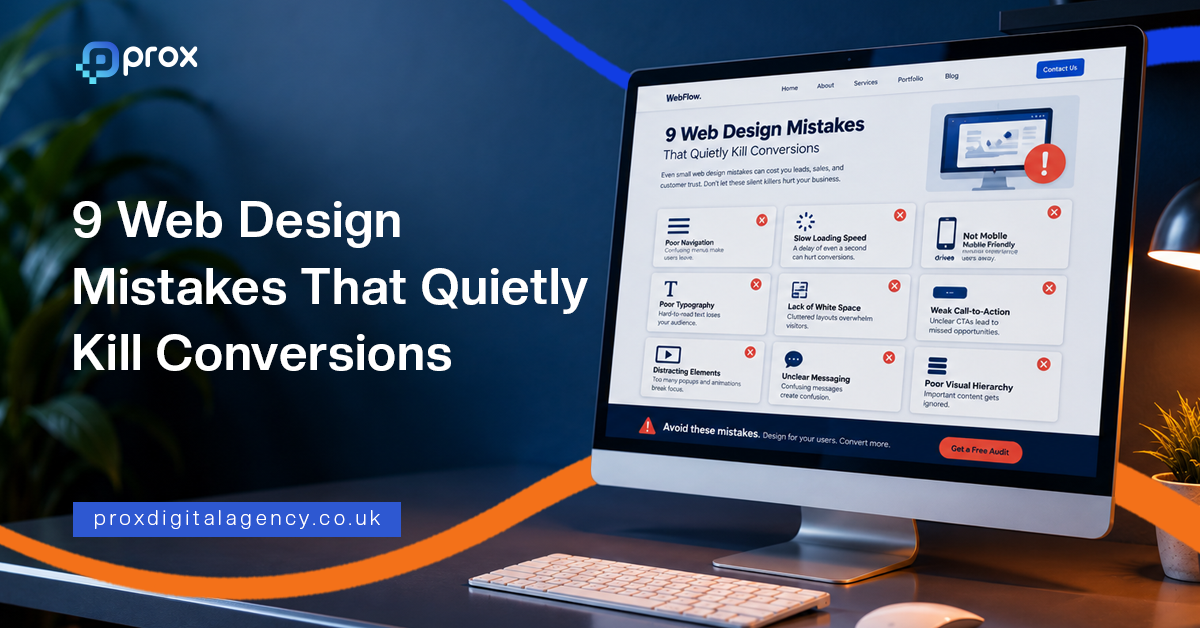
  • 9 Web Design Mistakes That Quietly Kill Conversions

    9 Web Design Mistakes That Quietly Kill Conversions

    The real reason is often simpler yet harder to spot. These conversion killers are mostly small web design mistakes that work quietly in the background. They confuse visitors and add friction where there should be none.

    Nobody complains about these things. Buyers just leave, quietly, without making any purchases.

    At Prox Digital Agency, we audit websites for a living. We see the same conversion killers repeat across industries and geographies. The businesses change. The design mistakes stay the same. To identify these mistakes early, we’ve compiled this playbook for you.

    Here are the nine most common ones. Fix these before you spend another dollar on driving traffic.

    Top 9 Web Design Mistakes That Quietly Kill Conversions

    Mistake #1: Prioritising Aesthetics Over Usability

    Your website is quite beautiful, but it means nothing to visitors as they cannot use it.

    This is the most common trap. Designers chase awards. Business owners chase trends. Clarity gets left behind in the process. Fancy animations and unusual navigation menus confuse first-time visitors.

    The problem:

    A visitor lands on the page. They pause, scan, and when the path forward is not instantly obvious, they hit the back button.

    The quick fix:

    Give your visitors standard layouts. Familiar icons. Clear labels and call-to-actions. Your design should guide them, not impress them. This is a conversion rate optimisation mistake with an easy fix.
    Diagram listing nine web design mistakes that quietly kill conversions

    Mistake #2: Cluttered Layouts That Overwhelm Visitors

    Too much choice kills action.

    Homepages that try to say everything at once, such as five banner sliders, three pop-ups, a live chat widget, social proof notifications, a newsletter sign-up, a video, a “meet the team” section, and whatnot.

    Visitors land on this type of homepage and instantly freeze. This classic UX design mistake, aka ‘Hick’s Law,’ leads to longer decision time, and that usually results in no decision at all.
    Wireframe comparison of a cluttered web page layout against a clean layout with one primary call to action

    Cluttered Layout Signs Clean Layout Signs
    Multiple competing CTAs One primary action per fold
    Auto-playing sliders Static hero section with a single offer
    Dense text blocks Short paragraphs with breathing room
    Everything above the fold Progressive disclosure of information

    The quick fix: Reduce clutter on your pages. Your landing page should focus on one action at a time. Follow our clean layout checklist to fix it. And that’s all it takes.

    Mistake #3: Weak CTA Placement

    Your CTA is your sales door. Do not hide it. This is one of the most common website design errors that hurt sales across every sector.

    The problem:

    A page explains the offer well. It builds a decent case. Then it ends with a link that vaguely says “Submit” or “Learn More.” Nobody gets excited about submitting anything. That’s what a weak CTA looks like.

    The quick fix:

    • Make CTAs specific, for example, “Get Your Free Audit” beats “Click Here.”
    • Make them high-contrast buttons as they beat low-contrast links.
    • Place CTAs where the visitor’s interest peaks, not just at the very bottom of the page.
    • Test different versions. Button colour. Copy. Position. A small lift here allows big changes.

    Mistake #4: Slow Load Times in a 5G World

    In 2026, speed expectations have changed drastically. Many businesses assume fast networks solve slow websites. They do not. Even on 5G, a poorly built site takes time to render. Our breakdown of how Core Web Vitals affect rankings covers which speed metrics Google actually measures. And the buyer’s patience is thinner than ever.

    This is a critical web design mistake because the damage happens before anyone sees your content.

    The problem:

    A widely cited industry benchmark puts the cost of a single extra second of load time at up to a 7% drop in conversions on mobile. Pages that take over three seconds lose more than half their visitors before the first scroll.

    Core Web Vitals remain a ranking signal. But slow loading simply feels unprofessional and signals neglect.

    The quick fix:

    • Compress images to next-gen formats like WebP
    • Use a content delivery network for global audiences
    • Test your site on a throttled connection. That is how many of your visitors experience it.
    • Reduce third-party scripts, especially on mobile

    Mistake #5: Non-Responsive Design

    Responsive design used to mean mobile-friendly. Our complete web design guide sets out the principles behind layouts that hold up across devices.

    Devices have changed. Foldable phones open into tablets. Users browse on smartwatches while commuting. Desktop monitors span ultra-wide resolutions. A site that simply “resizes” is not enough.

    The problem:

    This web design mistake kills conversions by creating hidden friction. Buttons become too small to tap on small viewports. Text columns stretch endlessly on ultrawide screens. Forms break at certain breakpoints.

    The quick fix:

    • Use a responsive CSS framework that auto-scales layouts across all screen sizes.
    • Test on real devices every month or after a certain time to check if they’re still working fine on different devices.

    Mistake #6: Generic AI-Generated Imagery That Destroys Trust

    AI-generated images are everywhere now. Visitors can spot them instantly and are tired of them.

    The problem:

    Generic stock photography has always had a trust problem. Teams smiling at laptops in glass offices. AI tools have flooded the web with images that feel hollow and slightly uncanny.

    This is a new UX design mistake that directly hurts conversions. If your imagery feels fake, visitors may not see your business or brand as authentic.

    The quick fix:

    • Real photos perform better. Always. Your actual team. Your actual workspace. Your actual product being used. Imperfections are fine. Authenticity matters.
    • If you’re using stock or AI-generated imagery, use it sparingly. Blend it with real photos. Avoid the obvious synthetic look.

    Mistake #7: Confusing Navigation and Dead Ends

    Navigation is a promise. It tells visitors they can find what they need. Broken navigation breaks that promise.

    The problem:

    A dropdown menu with too many layers. A missing search bar. Footer links that lead nowhere. Mobile menus that cover half the screen without a clear close button.

    When visitors hit a dead end, they reverse back.

    The quick fix:

    Here is a clean navigation audit checklist:

    • The main menu should be visible without scrolling on the desktop
    • The search bar must be accessible on every page
    • Zero broken links across the site
    • Clear breadcrumbs on inner pages
    • Footer must be organised by logical categories

    Spend an afternoon clicking every link on your site. Fix every 404. The result? Better conversions.

    Mistake #8: Zero Social Proof and Missing Trust Signals

    Visitors do not trust your claims. They trust what others say about you.

    The problem:

    A site without testimonials, reviews, or case studies asks visitors to take a leap of faith. The lack of social proof is a problem, and it quietly kills conversions across every industry.

    The quick fix:

    • Add at least three trust signals near every CTA, such as client testimonials, security badges, or client logos, which work best.
    • Display real-time activity if you have traffic. “59 people viewing this product now” or “Sold 72 in the last 24 hours” builds urgency and trust instantly.

    Mistake #9: Aggressive Pop-Ups, Banners, and Chat Interruptions

    Immediate pop-ups annoy visitors. Chat widgets that launch unsolicited conversations feel invasive. Sticky banners that push content down frustrate users on small screens.

    The problem:

    Most visitors never return after a single bad interruption. Rankings slide too, since Google actively penalises aggressive mobile interstitials.

    The quick fix:

    The fix is not to remove pop-ups entirely.

    • Use them smartly.
    • Delay them.
    • Trigger them based on behaviour.
    • Show them after a visitor has scrolled 60% of your web page.

    Good pop-ups allow relevant value at the right moment. Bad pop-ups sacrifice long-term trust for short-term metrics.

    One Silent Conversion Killer: A Complicated Checkout and Lead Forms

    Poor forms reduce conversions. This silent web design mistake deserves its own section because it is so common and damaging.

    The problem:

    The page does its job. The visitor decides to buy. Then the form appears.

    Too many fields. Forced account creation. Hidden shipping costs with unexplained invalid phone number errors. This type of cart abandonment rate sits above 70% on average — Baymard Institute puts the figure at 70.22% across 50 studies.

    The quick fix:

    • Ask only for information you absolutely need to confirm the order.
    • Auto-fill wherever the browser can handle it.
    • Allow guest checkout.
    • Display all costs before the final step.
    • Test your own forms monthly. Fill them out on mobile with one hand. This way, you will spot friction fast.

    The Prox Digital Agency CRO Approach

    A redesign is an investment with clear, measurable returns. Fix several of the mistakes above and you can often lift conversions meaningfully from the exact same traffic — though the size of the gain depends entirely on your starting point, traffic quality and offer. Without extra ad spend. Without new campaigns.

    At Prox Digital Agency, we take a structured path to fixing conversion problems. Every single change ties back to a number that matters to your bottom line.

    • First, we audit. We look at analytics and real user insights. We find exactly where visitors drop off and why.
    • Not all fixes are equal, so we mark priorities. We identify the changes that will move the needle fastest.
    • Finally, we implement and measure. We launch changes and track results.

    Wrapping Up

    The nine plus one major mistakes above explain how they quietly kill business conversions. The good part is, they are all fixable. They do not require a massive budget or a complete brand overhaul. Start seeing your website the way your visitors do, and you’ll see significant business success.

    If you are ready to find and fix the conversion killers on your site, Prox Digital Agency is here to help.

    FAQs

    What is the most common web design mistake that kills conversions?

    The most common web design mistake that hurts conversions is prioritising how a site looks over how it works. Visitors leave when they cannot find what they’re looking for. A beautiful but confusing website loses sales faster than a plain but clear one.

    Does a slow page speed of a website affect revenue?

    Yes. Even a single second of delay is commonly linked to a conversion drop of around 7%. If your web speed is slow, it will make your business look unreliable. Because visitors expect near-instant pages, and they will leave for a competitor within the next second.

    Why is mobile responsiveness still a problem in 2026?

    Mobile responsiveness is still a problem in 2026 because devices are changing fast. Different types of devices require different layouts. A site that works on a standard phone might break on a foldable.

    Do AI-generated images actually lower trust?

    Yes. Visitors are now smart enough to spot fake imagery, and it erodes trust instantly. Real photos are the source of building brand authenticity. Even if you have to use AI visuals, use them sparingly; always blend AI photos with real-product photography.

    Can I fix the conversion killer mistakes myself, or do I need an agency?

    The 9 common web design mistakes that kill conversions can be fixed easily. However, mistakes like accessibility compliance, complete CRO optimisation, and audits need external expertise.

  • Prox Digital Agency CEO Ali Zafar Azad Discusses Digital Transformation on Xraised

    Prox Digital Agency CEO Ali Zafar Azad Discusses Digital Transformation on Xraised

    Addressing the Conversion Challenge

    According to Ali Zafar Azad, many companies misdiagnose their digital growth obstacles. He noted that most businesses do not suffer from a marketing problem, but rather a conversion problem. Whilst websites are routinely created to function merely as digital brochures, Prox Digital Agency focuses on closing the gap between visual design and tangible business performance.

    The Three Pillars of High Performing Websites

    During the interview, Azad outlined three essential elements required for a website to achieve optimal results:

    • Clear positioning that conveys value to visitors within seconds.
    • Strategic conversion architecture featuring intentional calls to action and trust signals.
    • Continuous performance optimisation guided by data analysis.

    Ali stated that a well-designed website operates effectively as a continuous sales representative, qualifying potential leads and establishing trust prior to direct sales conversations.

    The Operational Role of Artificial Intelligence

    Discussing the role of artificial intelligence in modern marketing, Ali offered a practical perspective. He emphasised that artificial intelligence will not replace human marketers, but rather transform daily operational methods. Tools enabling large-scale personalisation, automated lead qualification, and data-informed decision-making are creating advantages for early adopters. However, He emphasised that core strategic planning and creative direction remain fundamental human responsibilities.

    Building Infrastructure First

    For organisations seeking readiness for artificial intelligence, Azad recommended establishing clean data systems and strong structural foundations prior to implementing new tools. Advanced technologies operate best when integrated into structured environments rather than placed over inefficient systems.

    Digital Presence as Growth Infrastructure

    Ali concluded by urging business leaders to treat their digital presence as vital growth infrastructure instead of a basic marketing task, identifying it as a primary factor that will distinguish market leaders moving forward.

  • What Does an SEO Agency Actually Do? (2026)

    What Does an SEO Agency Actually Do? (2026)

    You’re a newly launched business owner, and people around you are suggesting that you hire a professional SEO agency. But that seems like a challenge. Why? Because you’re not completely aware of what an SEO agency actually does. You don’t know what to look for before choosing the right partner.

    At Prox Digital Agency, we understand your hesitation, which is why we’ve put together this easy-to-follow guide explaining the role of SEO experts and what you should expect from them when they work with your business.

    The right SEO agency exists to connect your business with people actively searching for what you sell. They do this by making your website the most logical, authoritative answer to a query. Read ahead and you’ll learn what’s included in SEO services in 2026, how the strategy works, and whether the investment still holds up. If you want the fundamentals first, our guide to what SEO is covers the groundwork.

    What Does an SEO Agency Do Behind the Scenes?

    An SEO agency tunes your digital presence so search engines trust you enough to send traffic and intent-driven visitors your way.

    This is the key distinction between a general marketing firm and a focused search optimisation partner. Prox’s SEO services center on this exact principle. They turn passive browsers into active customers by aligning your website’s architecture, content, and authority with what Google’s algorithms value in 2026.

    SEO is not just about ranking. Profitable visibility is something that’s promised by this engineering.

    But what does that engineering actually involve? Here are 6 main SEO actions happening behind the scenes on a daily, weekly, and monthly basis:

    • Crawl budget management: SEO agencies prevent irrelevant page crawling.
    • Structured data implementation: They optimise and add schema markup so your listings appear as rich results.
    • Competitor analysis: Track and analyse your top competitors. Adapt strategies that close the gaps.
    • Content optimisation: Professional agencies maintain page rankings by continuously updating old posts and service pages.
    • Technical debt resolution: One of the most critical actions. SEO agencies fix broken links, redirect issues, and mobile errors.
    • Backlink profile maintenance: They also remove toxic links and reclaim valuable brand mentions.

    What’s Included in SEO Services: Dissecting the Retainer

    When you sign an agreement, you’re not just buying “optimisation.” You’re investing in a multi-layered campaign.
    Here’s the actual breakdown of what’s included in SEO services offered by a competent partner like Prox Digital Agency.
    Diagram of the four workstreams an SEO agency retainer covers: technical, content, authority and conversion

    Technical Performance and Crawlability

    Publish your content only on a technically sound website. Before that,fix the technical foundation.

    A thorough SEO audit identifies crawl budget waste, orphaned pages, and JavaScript issues that make crawling and indexing difficult. In 2026, Core Web Vitals measure more than loading speed and assess how responsive your website is, so SEO experts optimise these signals.

    If Googlebot can’t navigate your JavaScript-heavy product builder smoothly, you struggle with ranking. They fix this technical debt, allowing your website to perform better and gain more search visibility.

    Search Intent and Content Mapping

    Keyword research is no longer about matching exact strings. It’s about mapping the messy, conversational way humans now search, often via voice or image. A strategy breaks your audience into groups, i.e., informational (learning), commercial (comparing), and transactional (buying).

    If you run a real estate brokerage, an agency doesn’t just target “buy an apartment in Manchester.” They build resource hubs for “stamp duty calculation for first-time buyers” and comparison charts for “ready possession vs under-construction properties.” This semantic depth signals topical authority.

    Only professionals can attempt this right. Therefore, it’s crucial to hire a team that understands these visions.

    Authority Building and Digital PR

    Links remain the currency of the web, but buying them is a liability.

    Modern authority building looks like a PR firm merged with data journalism. Agencies create unique industry studies and interactive calculators that naturally earn citations from the press. One strong link from a trusted industry publication can outweigh a thousand spammy directory entries.

    Conversion Rate Alignment

    Sending 100,000 visitors to a page that confuses them is a meaningless effort. A competent agency overlays behavioral analytics on top of traffic data. They restructure a product page’s fold, tweak the boring “Add to Cart” logic, and rewrite meta descriptions to act as a compelling ad copy.

    They know that traffic is the means; revenue is the metric.

    SEO Agency Marketing Strategy: How They Win in a Generative AI World

    Search in 2026 is fragmented. Users get answers from AI Overviews, LLMs, and traditional blue links often in a single results page. An SEO agency marketing strategy must adapt to this blended reality. It’s no longer enough to earn a link. Your content needs to appear where people find answers.

    This means optimising for “entity-first” discovery. Prox takes this strategic move very seriously. Instead of forcing a keyword into an H1, our SEO services structure content with clear attributes, definitions, and citations that language models find easy to parse and surface in conversational results.

    Here’s how an SEO agency marketing strategy flows:

    Audit Current Visibility

    Map brand presence across AI Overviews, LLMs, and traditional SERPs.

    Build Entity-Rich Content

    Structure pages with definitions and concept AI models can parse.

    Diversify Content Formats

    Create videos, research, and tools that win different search surfaces.

    Earn Authoritative Citations

    Publish data and commentary that journalists and AI training datasets reference.

    Track Visibility Across All Surfaces

    Measure presence everywhere, if visibility and conversions drop, they adjust strategy.

    What to Expect From an SEO Agency in 2026?

    “What if I don’t see results in a month after hiring a professional SEO company?” This is the single most common anxiety owners share. A professional SEO agency sets realistic expectations from the start.

    Here is what to expect from an SEO agency during the first year of a serious engagement.
    Month by month timeline of what to expect from an SEO agency over the first nine months

    Expected Duration What to Expect
    Months 1-2 Discovery & Decontamination
    • Deep technical audit and backlog creation
    • Fixing 404 errors
    • Resolving duplicate content, and compressing heavy assets
    • Stopping silent bleeding
    Months 3-4 Foundation Building
    • Map service pages to high-intent commercial keywords
    • Target long-tail, low-competition search opportunities
    • Optimise the website to meet mobile usability standards
    Months 5-6 Authority Acceleration
    • Digital PR campaigns and original research go live
    • High-quality, contextual backlinks begin to lift the domain rating
    • A steady, non-erratic climb in traffic graphs
    Months 7-9+ Compounding Growth
    • Topic clusters mature
    • Internal linking distributes authority to money pages
    • A single page may rank for thousands of variations
    • Lead quality improves drastically because the traffic aligns with deep intent

    This curve demands patience. Promises of overnight success indicate a reckless use of spammy tactics that will eventually backfire when algorithmic penalties hit.

    Is SEO Worth It? The Hard Numbers vs. The Alternatives

    Businesses asking “What is SEO? Is SEO actually worth it?” are usually comparing it against the instant results from paid campaigns.
    Comparison of paid search as rented traffic against organic SEO as an owned asset

    It’s a fair debate.

    • PPC stops the moment you stop paying; every click is rented.
    • SEO acquires the asset. The value of SEO is most evident over a 24-month timeline.

    Consider a local software firm. A paid click in their niche might cost £45, and a landing page converts at 3%. It costs the business (customer acquisition cost) £1,500 to acquire one new customer.

    This is where an agency’s role goes beyond tactics and into business strategy. They don’t just hand over a report showing ranking movements. They connect the dots between search visibility and customer acquisition cost, showing you exactly how organic traffic reduces your dependency on paid channels over time.

    A capable agency builds a distribution channel you own, the one that keeps delivering leads long after the initial investment is recovered.

    Partnering With The Right SEO Agency in 2026

    In 2026, a professional SEO agency does far more than chase rankings. It builds a complete search presence across all AI answer generating platforms your customers use. From technical foundations to GEO-ready content, it’s about creating a digital presence that keeps driving growth long after the algorithms shift again.

    SEO agencies now blend technical engineering, editorial strategy, and brand building. If you’re ready to build an owned acquisition channel that reduces your dependency on ad budgets, Prox’s SEO services are designed to bridge the gap between where your business site is today and where it needs to be for sustained growth.

    Shortcuts don’t work anymore. At Prox Digital Agency, we bring this proven approach to businesses across the UK, USA, Dubai, and beyond through our remote-first services. That’s what partnering with a professional SEO agency looks like.

    FAQs About Hiring an SEO Agency

    Is SEO still effective in 2026?

    Yes. Traditional SEO and modern SEO are both highly effective in 2026. However, as AI reshapes digital discovery, SEO alone is no longer enough. A combination of SEO and Generative Engine Optimisation (GEO) is the new framework — our SEO vs GEO guide explains how the two fit together.

    What is an SEO agency?

    An SEO agency is a specialised team that optimises your website and online presence so search engines like Google can find and rank your content. A modern agency also ensures your business is visible across AI-powered platforms like ChatGPT, Gemini, and Perplexity and turn organic search into a reliable, long-term customer acquisition channel.

    How to choose the right SEO agency partner for your small business?

    Professional SEO firms have a proven track record. They design customised strategies for every business need, and maintain 100% transparent communication throughout the contract. You can see how we work on our SEO agency service page. Avoid getting trapped in fake tactics by identifying instant promising results and hide unnecessary costs behind unclear pricing.

    Does content-driven SEO work for every industry?

    Yes, SEO works for every niche and industry including B2B logistic firms, waste management services, or industrial fasteners manufacturing companies. These industries are often the most profitable because of unmet search demand and low competition.

    How do SEO agencies measure success beyond just keyword rankings?

    Agencies look for organic conversions (form fills, calls, purchases), the percentage of non-branded traffic (indicating genuine new discovery), and engagement rates on key landing pages beyond just keyword rankings to measure success.

    Can an SEO agency guarantee #1 rankings on Google?

    No. SEO agencies can never guarantee first or top ranking on Google, nor should they, because Google controls its own algorithms. Google says so plainly in its own guidance on hiring an SEO, and advises treating any promise of a #1 ranking as a reason to walk away. A good agency should guarantee transparent communication, measurable growth, and results that are clearly visible on your business dashboard.

    What should I ask an SEO agency before hiring them?

    Google publishes a useful shortlist: ask for examples of previous work and success stories, what results they expect and in what timeframe, how they measure success, their experience in your industry and country, and how they will communicate changes to your site. Two worth adding in 2026 — whether their recommendations cite official Google documentation, and whether any AI-search advice they give lines up with Google’s published guidance rather than untested tactics.

  • Full SEO Website Migration Checklist Guide

    Full SEO Website Migration Checklist Guide

    Now, picture this. You opted for a full SEO website migration, changed your domain name, added new features, and redesigned your site architecture – all without costing your rankings or traffic. Yes! That’s exactly what we all want. This guide is for anyone looking for a practical SEO migration checklist to minimise the risk of costly mistakes.

    This guide walks you through every step, so your move is smooth, and your search visibility stays intact. If you want the wider context first, start with our guide to what search engine optimisation actually involves.

    SEO Website Migration

    A process of changing a website’s URL structure, domain, or switching its CMS without interrupting organic search traffic or Google rankings is SEO website migration. Done badly, these changes can seriously disrupt crawlability, indexing and how search engines understand your new structure — which is exactly why the process needs managing step by step.

    Every successful migration starts with a complete SEO website migration checklist to reduce risks and protect organic visibility.
    Diagram of the four phases of an SEO website migration from planning to post-launch monitoring

    Phase 1: Pre-Migration Planning & Benchmarking

    Rushing pre-migration benchmarking will only lead to tanking your website’s ranking. First plan and then implement strategies. 
    Checklist of metrics to benchmark before starting an SEO website migration

    Set Clear Migration Goals

    Understand the end goal. Aim for what you want to achieve. Whether it’s 95% of your current organic traffic or site speed improvement? Write down every tiny KPI, as you will measure your results against them later. 

    Carry Out a Risk Assessment

    Not all migrations are equal. Moving from HTTP to HTTPS is a different challenge from merging two sites. List every potential risk, from broken backlinks to Google Business Profile mismatches. So there are no unexpected errors.

    Benchmark Your Current Performance

    Analyse and monitor keyword rankings, organic traffic, and conversion rates of your site. Use Google Search Console and Google Analytics to gather numbers for at least the last three months. Call this phase your “before SEO website migration” picture.

    Crawl Your Entire Web

    Crawl every single URL on your current website. Record all page titles, descriptions, meta descriptions and status codes. You can’t build a proper site migration seo checklist without knowing exactly what exists today.

    Audit Your Backlinks

    Pull your external backlink profile. Identify the pages with the most valuable links pointing to them. Mark them as priority pages and must be redirected with pinpoint accuracy later.

    Team Planning and Responsibilities

    Website migration is not a single person’s job; it’s a collaborative effort. Segregate the operation team to handle DNS changes, test the staging site, and monitor performance after launch. Leave no room for finger-pointing, and you’ll see a smooth SEO migration strategy implemented from day one.

    Phase 2: Staging & Content Preparation

    Always build and test your new website in a staging environment. Avoid making changes directly to the live site.

    Create a Secure Staging Environment

    Configure a staging server. Either use IP restrictions or password-protect it, so it doesn’t get indexed by search engines. There is nothing worse than Google finding duplicate pages on your site.

    Map Every URL and Prepare 301 Redirects

    Keep track of every old URL and write the new equivalent one beside it. Make two columns on a spreadsheet to begin mapping. Aim for one-to-one redirects. Never leave everything to the homepage. A clear redirect map helps protect your rankings and user experience.
    Correct versus incorrect 301 redirect mapping during an SEO website migration

    Update All Internal Links

    Do not make visitors or bots bounce through multiple redirects. Replace old internal links in your navigation, content, and footer directly with the new URLs. It’s time-consuming, but it keeps your web loading speed fast and SEO-clean. Point every redirect straight at its final destination rather than through a chain: Google advises keeping chains to no more than three hops, and fewer than five.

    Migrate Your Structured Data

    Ensure your schema markup for your business, products, and FAQs is migrated. Check that your LocalBusiness schema still shows the right name, address, and phone number. Broken structured data can harm your results.

    Run a Pre-Launch Technical SEO Audit

    At this stage, your pre-launch site is ready for a technical SEO audit. Crawl it, check preferred page URLs, test page speed, and ensure that no ‘no-index’ tags are accidentally redirecting any important pages. Fix any errors you find, since you’re still on safe ground.

    Phase 3: Launch Day Execution

    You’ve made it to the launch day, congrats! Now double-check everything and follow these steps. 
    Launch day order of operations for an SEO website migration

    Remove Staging Block

    It’s time to remove any limitations you added during the staging phase of SEO migration checklist – any password protection to avoid indexing and any noindex tags. Make your new website fully crawlable.

    Deploy 301 Redirects Sitewide

    Activate your full redirect map in one go. Test a sample of old URLs to make sure they land on the correct new pages. 

    Verify HTTPS and DNS

    This is the critical time when your SSL certificate must be installed and working perfectly. Make sure your DNS is pointing to the new server. DNS misconfiguration can lead you to zero traffic, so verify it twice.

    Update Robots.txt and XML Sitemaps

    Check your live robots.txt file. It must not block anything important. Submit a new XML sitemap containing your new URLs to Google Search Console.

    Submit a Change of Address

    This step if for those who changed their domain in the process. Use Google Search Console’s Change of Address tool and signal to Google that your site has permanently moved. This helps in SEO website migration fast.

    Phase 4: Post-Migration Monitoring

    Here comes the most important phase of this SEO site migration guide – post-migration monitoring. The following steps will help you track results and monitor your website’s performance after launch. 
    Signals to monitor after an SEO website migration and how often to check them

    Keep a Close Eye on Google Search Console 

    Check if there are any spikes in 404 pages, coverage issues or crawl errors. Do not ignore mobile usability reports. 

    Track Rankings and Organic Traffic

    Remember the benchmarks you set in the pre-migration phase? Take those benchmarks and compare your post-launch results against them. A small fluctuation in the first few days is completely normal. Check carefully if the drop in data persists.

    Do a Post-Launch Crawl

    Running the crawler again at this point helps scan the overall live website. It can detect broken links, accidentally blocked pages and any redirect chains.

    Check Core Web Vitals

    Page speed and visual stability matter more than ever. You can use PageSpeed Insights or Lighthouse to test your main landing pages and identify any speed issues. Fix them immediately. Our breakdown of how Core Web Vitals affect rankings explains which numbers actually matter.

    Troubleshoot Issues Quickly

    Create a shared channel for logging and resolving bugs. If conversions drop, re-check your analytics tracking codes. Analyse the redirects and content of pages that show a decline in rankings. 

    And use this Prox SEO migration guide as your go-to checklist until your migration is complete and your web traffic stabilises.
    Illustrative chart of the organic traffic dip and recovery after an SEO website migration

    A Smarter Way to Handle Your Next SEO Website Migration

    An SEO migration checklist only works when you execute it smartly. And the best part? You don’t have to worry about this tricky execution as long as Prox’s expert SEO migration team is here for you.

    Our SEO team in London has helped UK local businesses move their websites without losing the rankings they rely on for enquiries and sales. Whether you’re switching domains or revamping your entire business website, we will build you a bespoke seo migration strategy, handle the technical heavy lifting, and monitor performance until your migration is fully complete. 

    So, don’t leave your organic visibility to chance. Get in touch with our team today.

    FAQs About SEO Website Migration

    How soon will SEO recover after an SEO website migration?

    Expect fluctuation rather than an instant return. Google’s guidance is that a medium-sized site can take a few weeks for most pages to move across in its index, and that larger sites can take longer — the speed depends on how many URLs you have and how fast your server responds. Treat a few weeks of movement as normal. If traffic is still well below your benchmark after that, audit redirects, indexation and internal links before assuming the migration itself failed.

    What are the common mistakes people make in a site migration?

    The two common mistakes in an SEO site migration are

    • Forgetting to map every single old URL to a relevant new one. 
    • Redirecting everything to the homepage loses the context Google needs and frustrates users. 

    A proper website migration seo checklist always includes a detailed redirect map.

    Should I update Google Business Profile when I move my site?

    Yes, updating GBP is important. However, it should only be done once the website is live and verified. Update the website’s URL, name, address, and contact details and verify them at every platform.

    Can SEO migration require an agency partner?

    Not really. However, for domain changes or complex restructures, partnering with the right agency, like Prox Digital, can help you avoid traffic loss and other serious drawbacks.

    How to know if my 301 redirects are working correctly?

    You can check your 301 redirects using a crawling tool and test a large batch of old URLs with it. Also, monitor the “Indexing” section in Google Search Console for any errors in redirects.

    How long should I keep my 301 redirects in place?

    Google advises keeping them for at least a year. That window gives its systems time to transfer signals to the new URLs, including recrawling and reassigning links that other sites still point at your old addresses. From a user’s point of view there is a good argument for keeping them indefinitely, so only remove them if you have a concrete reason to.

    Do I need the Change of Address tool for every migration?

    No. It applies to domain moves, not to every change. If you are moving from HTTP to HTTPS you do not need it. If you are moving to a different domain you do, and you should submit requests for all subdomains plus the www and non-www variants of the old domain, even ones you were not actively using — each needs to be verified in Search Console first.

  • The Agency UK Brands Trust Is Now Serving Clients Worldwide

    The Agency UK Brands Trust Is Now Serving Clients Worldwide

    It’s official!Prox Digital Agency is now a global digital agency. Prox Digital Agency is now expanding its reach globally. Businesses anywhere in the world can now benefit from our extensive expertise, including SEO, GEO, and AI search optimisation. For a decade, Prox has partnered with 500+ businesses in the UK by assisting in building digital identities that stand out, rank higher, and grow faster. Along the journey, the agency has earned a reputation for delivering conversions with industry recognition. This marks a major milestone. If you are mapping out where to invest first, our digital marketing guide sets out the channels that tend to move the needle.Here’s what this means for you.

    If you own a startup or even an established business in New York, Dubai, or Australia, you now have direct access to the digital and AI experts behind hundreds of successful brand transformations.

    Find Prox in Your Region

    We’re officially rolling out dedicated operations across these markets.

    Our regional teams understand each market, its unique search landscape, culture, and industry challenges, all while working to one global standard. Wherever you are based, you are working with the same digital marketing team and the same standards.

    More Markets Means More Opportunities

    For all of us, this is more than a simple expansion. Prox Digital Agency wants more businesses to access its award-winning strategies that actually move conversion needle.

    With us, you get

    • Websites optimised for conversions.
    • An SEO framework that gets you found.
    • GEO that keeps your brand visible as AI search reshapes discovery
    • Creative branding that makes people remember you

    How We Achieved This Milestone

    We did not just build our name by being everywhere at once. We built it by doing the work properly, market by market, brand by brand. That’s exactly how our global expansion has been built. For a wider view of how the industry is adapting, see our analysis of how UK agencies are approaching AI search optimisation. Our services, wherever you are

    • Digital Marketing Services
    • Search Engine Optimisation (SEO)
    • Generative Engine Optimisation (GEO)
    • AI search visibility
    • Digital Transformation Consultancy
    • Website Design & Development
    • Mobile App Design & Development
    • MVP & Product Design & Development
    • Creative Branding & Brand Identity

    Our Trusted Digital Presence

    Prox’s global reputation is not just something still in the process. It is already showing up on the platforms businesses trust to validate an agency before hiring. Read our independent profiles here.

    Recognised Platforms Prox Digital Agency Profiles
    Digital Agency Network (DAN) View Profile
    Clutch View Profile
    Trust Pilot View Profile
    Good Firms View Profile
    Bark View Profile
    Design Rush View Profile
    Shortlist View Profile
    Selected Firms View Profile
    Tech reviewer View Profile
    Yell View Profile

    Interested To Grow With Prox?

    Ali Zafar Azad – The CEO & Founder of Prox Digital Agency added,

    “The same trust we have built in the UK is now reaching businesses everywhere.”

    Get in touch with the local Prox team today and let’s create a brand that’s built to lead.

    Media Contact

    Email: contact@proxdigitalagency.co.uk

    UK: +44 204 525 7801

    USA: +1 239 427 4097

    Australia: +61 284 880 110

    Frequently Asked Questions About Working With a Global Digital Agency

    Which countries does Prox Digital Agency work in?

    Prox now runs dedicated operations in the UK, the UAE and the USA, with Australia launching soon. Each region has its own team, while the strategy, standards and quality process stay consistent across all of them.

    Can you work with businesses outside those regions?

    Yes. The regional offices exist so clients in those markets get local knowledge and easier working hours, but Prox takes on projects from businesses anywhere. Work runs remotely with a single point of contact regardless of where you are based.

    What services are available in every market?

    The full range travels with us: digital marketing, search engine optimisation, generative engine optimisation and AI search visibility, digital transformation consultancy, website design and development, mobile app design and development, MVP and product development, and creative branding.

    Does working with a global digital agency mean losing local market knowledge?

    It should not, and that is the reason for regional teams rather than one central office. Search behaviour, competitors, language and buying culture differ sharply between London, Dubai and New York. Local teams handle that nuance while the wider group shares what works across markets.

    How do I check Prox Digital Agency is credible before getting in touch?

    Independent profiles are the fastest way. Prox is listed and reviewed on Clutch, Trustpilot, GoodFirms, DesignRush, Digital Agency Network and other directories, all linked above, where you can read verified client feedback rather than taking our word for it.

    How do I get started?

    Contact the team by email at contact@proxdigitalagency.co.uk or through the regional site closest to you. The first conversation is a discussion of your goals and current position, not a sales pitch.

  • This Week: Prox Digital Agency & Ruya Bank: SEO and GEO Success Story

    This Week: Prox Digital Agency & Ruya Bank: SEO and GEO Success Story

    How Ruya Bank Built Digital Trust in the New Era of AI Search

    Ruya Bank proved that ethical and Shari’ah-compliant banking could also build a strong online presence. But clients’ trust begins only with visibility. The challenge was never the product; it was visibility. In the competitive UAE banking market, Ruya needed to stand out in search and AI recommendations, both by people and by the AI tools.

    The Challenge

    Ruya faced four key challenges.

    • Organic visibility that was against massive, entrenched UAE banking.
    • Bilingual content gaps due to which English and Arabic-speaking audiences weren’t getting equally optimised content.
    • Competition for banking keywords was intense.
    • Ruya lacked visibility on AI search and recommendation platforms.

    To bridge these gaps, Prox focused on building trust, enhancing bilingual user experiences, and increasing search visibility and driving organic growth through both advanced SEO and modern GEO (Generative Engine Optimisation).

    The Strategy

    Prox built a strategic framework including onsite and offsite SEO and AI optimisation programs. The four major strategies that worked for Ruya were:

    • Comprehensive Search Optimisation – Strengthened the website’s technical foundation and content.
    • Website Architecture – optimised keyword targeting, metadata, and internal linking.
    • AI Optimisation – built GEO-focused strategies to improve Ruya’s visibility across AI search platforms.
    • Authority Building – Secured digital PR coverage and backlinks from trusted sources.

    The Impact

    The impact on Ruya’s digital presence was significant.

    • 68% increase in search visibility
    • 42% growth in keyword rankings
    • 31% increase in bilingual enquiries
    • 85% increase in AI mentions
    • 54% increase in domain authority

    A Word From Ruya Bank ⭐⭐⭐⭐⭐

    “It was worth collaborating with Prox Digital Agency. They understood our brand and the UAE banking market deeply. Our search visibility and AI presence improved significantly. They delivered practical solutions that met our intended goals.”

    — Head of Digital Marketing, Ruya Bank

    Ready for Your Own Brand?

    Ruya Bank trusted Prox Digital Agency to turn tradition into digital growth and the results show it worked. Now it’s your turn. We can help you build the same visibility, AI presence, and trust that your business requires. Just reach out, and let’s begin with your digital success story.

  • How Can I Design a Shopify Website Step by Step?

    How Can I Design a Shopify Website Step by Step?

    Prox Digital Agency has walked hundreds of business owners through this exact journey. This Shopify website design guide breaks the process into clear steps. If you follow these steps, you will have a solid foundation in Shopify. And if you get stuck, we are here.

    This guide walks you through how to design a Shopify website step by step, built around the needs of small and enterprise-level businesses in 2026. Let’s get started. For the broader principles behind high-performing UK websites, see our complete web design guide.


    Pick Your Store Layout and Pick the Right Shopify Plan

    Before you even touch a theme, pause. Grab a pen. Write, what do you actually sell? A rough plan on paper saves hours of digital unpicking later. Every good Shopify website design tutorial begins with a solid plan.
    Diagram showing how to map Shopify store collections and choose the right Shopify plan

    • Make a list of your product collections on paper first (e.g., Webcams, Smartwatches, Wireless chargers).
    • Think like your customer; if they can’t find the product in three seconds, they leave.
    • Start with a free Shopify trial. The Basic plan is suitable for startups.
    • Upgrade your plan as your sales climb.
    • Activate Shopify Payments from day one for smooth online transactions.

    Select and Customise a Mobile-Responsive Shopify Theme

    It’s time to decorate your Shopify. For any local business, speed and mobile look matter most. Over 70% of browsing happens on a phone. Go with a free theme first. The best part of Shopify website design for beginners is that you can create a professional-looking store without any coding experience. 

    Prox Digital Agency often rebuilds themes that looked good on desktop but confuse phone users. Here’s what you can do. For inspiration before you start customising, browse these examples of standout UK eCommerce website design to see what a well-executed Shopify theme looks like once it is dialled in.
    Desktop and mobile layout comparison for choosing a mobile-first Shopify theme

    • Use Shopify’s Theme Store filters for your industry and layout.
    • Start with a free theme. We would suggest ‘Dawn.’ It’s fast and trusted.
    • Use the drag-and-drop editor to match colours to your shop sign.
    • Add your logo and keep fonts readable on a five-inch screen.
    • Test every button on your mobile; a thumb must easily tap “Add to Cart”.

    Configure Payments, Shipping, and Tax Settings

    It is the part where many DIY builds fall apart. Incorrect settings can lead to compliance problems with HMRC — including missing the point at which you must register for VAT. But you don’t have to worry at all. Use this Shopify website builder guide to configure payments, shipping processes, and tax settings with confidence, even if you’re starting from scratch.
    Shopify payments, shipping and tax settings for a UK store

    • Set up Shopify Payments so customers can pay using Visa, Mastercard, and Apple Pay.
    • Add PayPal Express as a trusted backup for new customers.
    • Set up shipping integrations to automate labels, tracking, and order fulfilment.
    • Set up flat shipping rates or a free delivery threshold.
    • Don’t forget “Local Pickup” and local delivery for your postcode radius.

    Create Optimised Shopify Product Listings

    Products sell themselves, right? Wrong! A bad image kills a good product. Your image description is your silent salesperson. Go beyond the specifications and highlight the value your product offers. This is the true secret of how to make a Shopify website for your business to stand out against generic listings.
    Anatomy of an optimised Shopify product listing that converts

    • Use clean, natural light backdrops instead of blurry phone shots.
    • Show the product in use, such as a content creator using a USB microphone.
    • Write benefits, not just specs.
    • Write clear product titles, such as Bluetooth Wireless Mouse.
    • Write a compelling meta description in the search engine listing preview.

    Set Up Home, About, Contact, and Legal Policy Pages

    Your store needs a strong brand identity that customers recognise and trust. Show your story, your workshop, your messy desk. These pages help you build a Shopify store in reality. Without them, you’re just a stall, not a shop.
    The core Shopify pages that build customer trust

    • Create a home page with a clear hero image and a prominent “Shop Now” button. 
    • Skip tiny, moving carousels.
    • Use your About page to share your story and include authentic photos instead of stock images.
    • On the contact page, include your physical address, phone, email, and a form.
    • Legal pages should adapt Shopify’s templates for Privacy, Terms, and Refunds.

    Install Must-Have Shopify Apps 

    Apps add function. But too many can slow your site. Start lean with just the essentials. This modern Shopify website builder guide stops you from creating a bloated, slow digital store. Only install what you need today.
    How to keep a lean Shopify app stack so your store stays fast

    • Judge.me: For importing reviews and building essential social proof.
    • Yoast SEO or similar: To help you nail your search engine listing snippets.
    • Zapiet or Local Delivery: If your customer needs to choose a delivery date, delivery time, or store pickup at checkout.
    • A QuickBooks or Xero integration to keep your UK accountant calm.

    Only add an app if it addresses a specific and current business need.

    Testing and Launching Your New Shopify Website Checklist

    The finish line is close. A successful launch starts with thorough testing. This checklist caps off the rigorous Shopify design step-by-step 2026 blueprint. 
    Pre-launch testing checklist for a new Shopify website

    • Remove the password protection and do a live fake order to a real delivery address.
    • Check every confirmation email; ensure it is not landing in the spam folder.
    • Buy a product on your mobile using 4G, not your office Wi-Fi.
    • Use Google PageSpeed Insights to identify any high bounce rates.
    • Secure your domain connection.
    • Announce the launch with an Instagram post, WhatsApp status, and client emails.

    Choosing Between DIY Shopify Setup and Professional Website Design

    You can build a store. The tools exist. But a DIY approach often holds you back from your growth. Time is also a currency. Prox Digital Agency steps in where the drag-and-drop ends — our eCommerce website design and development service maps out customer psychology and builds revenue engines around it.

    We will help you pin down when it is time to hire a professional Shopify design agency instead of continuing DIY experimentation — and if you are weighing up the trade-offs, our cost-benefit breakdown of custom vs template websites is a good place to start.

    • The design might look functional, but not distinctive enough for your brand.
    • You follow the Shopify website design for beginners path perfectly, yet sales are stagnant.
    • Every hour spent designing your store is time not spent on your core business.
    • You need custom API integrations or a totally bespoke storefront design.
    • Your site feels “home-made” rather than “hand-crafted”; we fix that.

    When these challenges start holding your business back, it’s time to consider a professional Shopify solution from Prox Digital Agency.

    Conclusion

    So, that’s the whole roadmap. From blank page to first sale. Building a Shopify site is not magic. It’s a sequence. Plan the structure, dress it cleanly, set up compliance, add soul through products, and test like a customer. Follow this Shopify website design tutorial, and you’ll avoid the classic pitfalls.

    Knowing the steps and executing them beautifully are two different roads — and that is where Prox Digital Agency comes in, now supporting Shopify businesses globally.

    Frequently Asked Questions About Shopify Website Design

    Can I design a Shopify website with no tech background?

    Absolutely, you can design your Shopify store with no tech background. Shopify uses a visual editor. Plan your content and product presentation. And follow these steps

    Pick Your Store Layout and Pick the Right Shopify Plan

    • Select and Customise a Mobile-Responsive Shopify Theme
    • Configure Payments, Shipping, and Tax Settings
    • Create Optimised Shopify Product Listings
    • Set Up Home, About, Contact, and Legal Policy Pages
    • Install Must-Have Shopify Apps 
    • Testing and Launching Your New Shopify Website Checklist

    How much does a basic Shopify site cost to run in the UK?

    Shopify’s Basic plan costs about £19 a month if you pay annually, or around £25 a month on monthly billing. Add a domain name for roughly £10 a year. You can launch a functional UK store for under £50 in your first month if you do the design graft yourself. App costs add a few quid monthly if you need extras.

    What is the common mistake new Shopify store owners make?

    The two common mistakes new Shopify store owners make are

    • Poor product images and hidden costs. 
    • Springing unexpected shipping charges at checkout kills the trust. 

    Fix those two things, and you’re ahead of 90% of beginner projects to build a Shopify store.

    Should I pay for Shopify’s premium theme immediately?

    No. Shopify’s free “Dawn” theme is robust and fast. Launch with a free theme, make your first few sales, and only upgrade if you need a specific feature you can’t achieve.

    How long does it take to design and launch a Shopify website?

    A basic store built on a free theme like Dawn can go live in one to three days once your products and images are ready. A fuller, professionally styled store with custom branding typically takes two to four weeks, and complex builds with bespoke features or large catalogues can run to four to eight weeks.

    Is Shopify good for SEO?

    Yes. Shopify generates clean URLs, automatic XML sitemaps and fast-loading themes like Dawn out of the box. Strong rankings still depend on you writing unique product descriptions, setting proper title tags and meta descriptions, and keeping your collection structure logical, so most stores still benefit from a dedicated SEO pass.