Blog

  • MVP Development Process Step by Step Guide for 2026

    MVP Development Process Step by Step Guide for 2026

    What if you could validate your entire product idea before spending six figures building it? That is not a hypothetical; it is exactly what the right MVP software development process makes possible. Startups that launch with a Minimum Viable Product cut their time to market by up to 60% and reduce wasted development spend by as much as 40%, according to data from over 2,000 early stage startups.

    At Prox Digital Agency, we are a full service digital agency based in the UK that has guided over 80 startups and SMEs through every stage of the MVP journey. We blend strategic consulting, UX design, and agile engineering, so you never have to juggle five different agencies again. This guide distils everything we have learnt from those engagements into one actionable and no fluff roadmap.

    Why Most MVPs Fail Before They Even Launch and What You Can Do Right Now

    9 out of 10 startups fail, and the number one reason is building something nobody wants. The CB Insights post mortem on 101 failed startups found that 42% of founders cited no market need as the primary cause of collapse. The tragedy is that every single one of those teams could have spotted the problem earlier if they had followed a structured MVP development process for startups.
    Most founders fall into one of three traps. They build too much before validating demand. They chase perfection instead of speed. Or they skip user research entirely and rely on gut instinct. Each of these mistakes is avoidable,  but only if you know the right sequence of steps before a single line of code gets written.

    Metric Industry Average MVP-First Approach
    Time to Market 18–24 months 4–8 months
    Development Cost Overrun 65% 22%
    Pivot Rate After Launch 74% 31%
    Investor Conversion Rate 8% 27%

    Table 1: MVP First Approach vs Traditional Development (Source: Prox Digital Agency Client Data, 2024)

    You Think You Know What an MVP Is, but Most Founders Get This Wrong

    What an MVP Is? A Minimum Viable Product is not a half built app. It is not a prototype, a landing page, or a beta version with placeholder features. An MVP is the smallest possible product that delivers genuine value to a specific user, validates a key business assumption, and generates meaningful feedback. That distinction changes everything about how you plan, build, and measure success.

    Eric Ries, who coined the term in The Lean Startup, defined an MVP as the version of a product that enables a full cycle of the build measure learn loop with minimum effort. In practice, that means your MVP should answer one core question that will people pay for this? Everything that does not help answer that question is scope creep.

    MVP Type Best For UK Example
    Landing Page MVP Validating demand before building Monzo tested their waitlist concept with a single page before writing a line of code
    Concierge MVP Service based or complex B2B products Deliveroo manually coordinated early deliveries before building logistics software
    Wizard of Oz MVP AI or automation heavy products London fintech Cleo ran human powered chat responses before their AI engine was ready
    Single Feature MVP SaaS and mobile apps Revolut launched with only currency exchange before adding any other features

    Table 2: MVP Types and UK Examples by Prox Digital Agency

    The Exact MVP Development Process Steps That Turn Ideas Into Funded Products

    Over 15 years of working with founders across London, Manchester, and Edinburgh, we have refined this process into eight proven stages. Each MVP development stage has a clear deliverable, a defined owner, and measurable success criteria. This is the MVP development process for beginners and seasoned entrepreneurs alike, because the fundamentals never change, only the execution speed.

    Step 1: Define the Problem Worth Solving

    Before you think about features, technology, or timelines, you need to answer one question with brutal honesty: whose pain are you solving, and how much do they suffer without your solution? This is the foundation of every successful startup MVP development process. Skip this, and everything else becomes expensive guesswork.

    Conduct at least 20 problem interviews with real potential users. Do not pitch your idea, just listen. You are looking for the frequency of pain, the workarounds they currently use, and how much they would pay to fix the problem. This stage takes one to two weeks and costs nothing but time.

    Step 2: Map Your Core Value Proposition

    Once you understand the problem, articulate your unique position. Use the Value Proposition Canvas to align your product features with specific customer jobs, pains, and gains. A razor sharp value proposition reduces your MVP scope by an average of 35%, because it forces you to cut everything that does not directly address a user need.

    Step 3: Define Your MVP Scope with the MoSCoW Method

    Feature creep is the silent killer of MVPs. The MoSCoW Method (Must Have, Should Have, Could Have, Will Not Have) gives your team a shared language for scope decisions. Every feature request goes through this filter. This is the point in the MVP development process where stakeholder alignment either happens or falls apart.

    Priority Description Typical % of MVP
    Must Have Core features without which the product cannot function 40 to 50%
    Should Have Important but not critical for launch 25 to 30%
    Could Have Nice to include if time and budget allow 10 to 15%
    Will Not Have Explicitly out of scope for this phase Remainder

    Table 3: MoSCoW Method for MVP Scoping by Prox Digital Agency

    Step 4: Design the User Experience Before Any Code Runs

    User experience is not a design phase; it is a strategic phase. Wireframes and low fidelity prototypes let you test assumptions for under £500 that would cost £50,000 to fix after development. At Prox, we run a three day design sprint at this stage, producing a clickable prototype that real users can navigate without any explanation from the team.

    According to Parallel HQ Research, every £1 invested in UX at the design stage saves £100 in post launch fixes. That ROI alone should make UX the non negotiable centrepiece of any how to create MVP website development process conversation.

    Step 5: Choose the Right Technology Stack for Speed

    The best tech stack for an MVP is the one your team can ship fastest with the least technical debt. According to Prox research, the most proven stacks for an MVP software development process include React or Next.js on the front end, Node.js or Python on the back end, and Firebase or Supabase for rapid database deployment. No code tools like Bubble or Webflow are viable for non transactional MVPs and can cut build time by up to 70%.

    Stack Type Build Time Cost Range Best For
    No Code (Bubble, Webflow) 2 to 4 weeks £5,000 to £15,000 Marketplaces, directories, landing MVPs
    Low Code (Retool, Xano) 3 to 6 weeks £10,000 to £30,000 Internal tools, B2B SaaS
    Full Code (React + Node) 6 to 12 weeks £25,000 to £80,000 Complex SaaS, fintech, healthcare

    Table 4: Technology Stack Comparison for MVPs in 2026 by Prox Digital Agency

    Step 6: Build in Sprints

    Agile development is not optional for an MVP; it is the method. Two week sprints with defined deliverables, daily standups, and end of sprint demos keep your build aligned with reality.

    At Prox, our typical MVP build runs across four to six two week sprints. Every sprint closes with a demo to stakeholders.

    What Each Sprint Delivers

    • Sprint 1: Core architecture, user authentication, database schema
    • Sprint 2: Primary user journey from onboarding to first value moment
    • Sprint 3 and 4: Must have features as defined in MoSCoW scope
    • Sprint 5: QA, security audit, performance optimisation, soft launch
    • Sprint 6: Analytics integration, user feedback loops, investor demo prep

    Step 7: Launch to a Controlled Audience Before Going Public

    A soft launch is one of the most underused tools in the MVP product development process. Release to 50 to 100 real users before any public announcement. This gives you a critical signal without the reputational risk of a messy public launch. Define three to five success metrics before you open the doors, activation rate, retention at day 7, and NPS score are the minimum benchmarks we use at Prox for every client launch.

    Step 8: Measure, Learn and Decide Whether to Persist, Pivot or Pause

    The launch is not the finish line; it is the starting gun for the most important phase of your MVP development process. Now you have real data from real users. Review cohort retention, track feature usage, and compare activation against your pre launch hypothesis.

    How Long Does an MVP Actually Take and What Will It Really Cost You

    One of the most common questions founders ask us at Prox is: ” How do I budget for an MVP without being taken for a ride?” The honest answer depends on complexity, team structure, and geography. Here is what the UK market looks like in 2026, based on our own project data and industry benchmarks.

    MVP Complexity Timeline UK Agency Cost
    Simple (1 core feature) 4 to 6 weeks £15,000 to £25,000
    Medium (3 to 5 features) 8 to 12 weeks £30,000 to £55,000
    Complex (integrations + API) 12 to 20 weeks £55,000 to £120,000
    Enterprise Grade 20 to 36 weeks £120,000+

    Table 5: MVP Cost and Timeline Reference for UK Startups 2026 by Prox Digital Agency

    Seven Mistakes That Will Destroy Your MVP Before Users Ever See It

    We have seen all of these MVP mistakes that founders make. Some of them are painfully common. Every one of them is avoidable with the right guidance at the right moment in your MVP development process for beginners or your tenth product launch. Awareness is the first defence.

    • Building for investors, not users
      Your MVP should validate user demand, not impress a pitch deck audience
    • Skipping user research
      Assumptions are not data; they are expensive guesses
    • Over engineering the architecture
      Scalability is a post traction problem, not an MVP problem
    • No analytics from day one
      If you cannot measure it, you cannot learn from it
    • Ignoring competition
      If three other teams are solving this problem, understand why users would choose you
    • Setting no success criteria before launch
      Define what good looks like before you can see the data
    • Using the MVP as a cost cutting exercise
      Cutting quality is not the same as cutting scope

    The Numbers That Prove Why the MVP Approach Wins Every Time

    Data beats opinion. Here are three verified statistics that every founder considering a startup MVP development process should know before making a single decision.

    Statistic Source
    Startups that validate demand before building are 6x more likely to grow revenue YoY Statista, Global Startup Report 2024
    Companies that adopt agile methods ship products 37% faster than non agile teams HubSpot, Agile Marketing Report 2024
    Poor UX design costs businesses up to £1.2 billion annually in customer churn across the UK Neil Patel, UX and Revenue Impact Analysis

    Table 6: Key Statistics Supporting the MVP First Approach by Prox Digital Agency

    You Have the Roadmap, Choose Whether You Build It Alone or With Experts

    The MVP development process is not complicated, but executing it under pressure, on budget, and with a team that has done it before is a different matter entirely. Every stage we at Prox Digital Agency have covered in this guide represents a decision point where a wrong call costs weeks and thousands of pounds. The right MVP development company makes those decisions with you, not for you.

    For the fundamentals this process builds on, see what an MVP actually is and how to start one, or talk to our MVP and product development team. Deciding who runs it? See who should run that process for you.
  • Prox Digital Agency Launches the War Economy Package for UK Startups

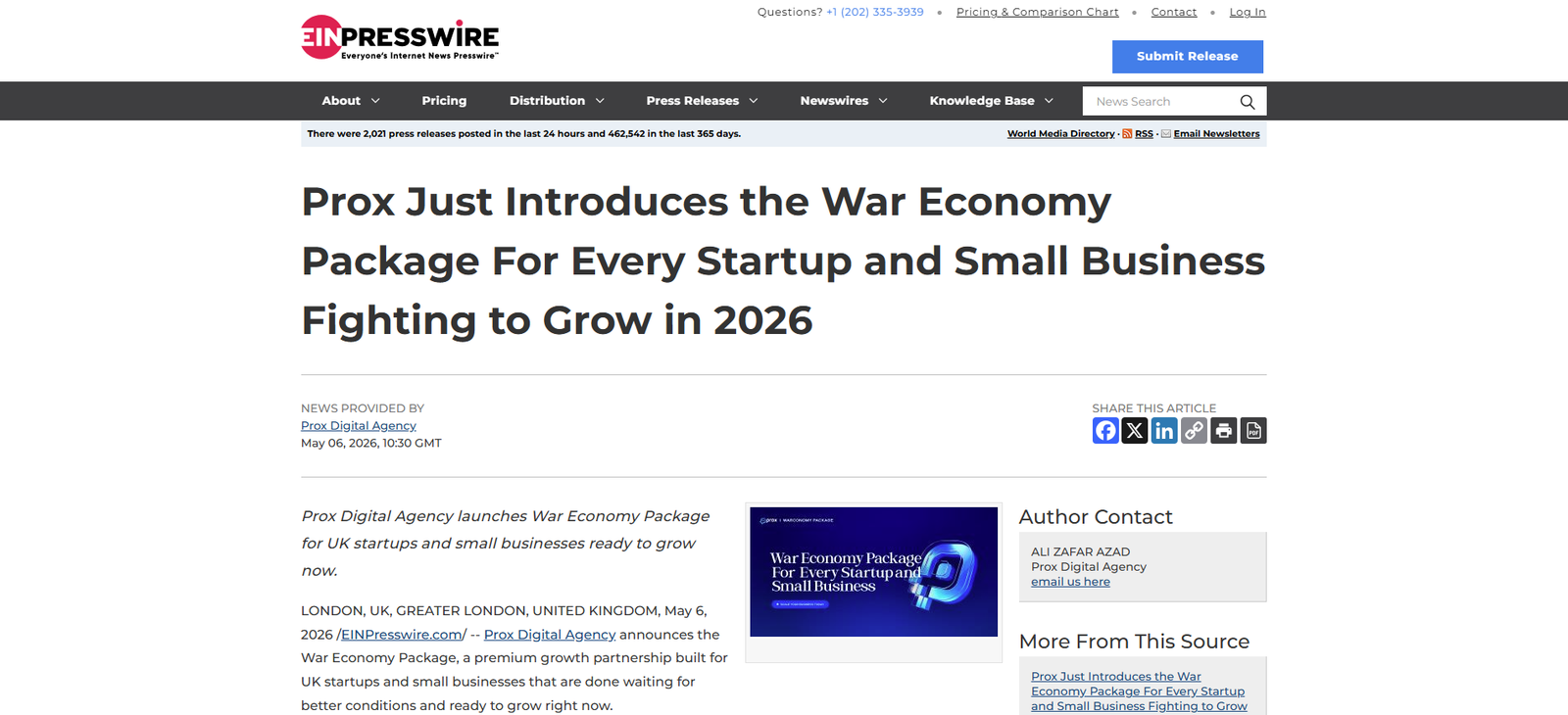
    Prox Digital Agency Launches the War Economy Package for UK Startups

    We saw it happen in real time. Prox Digital Agency works with over 500 brands across the UK, Dubai, and the USA. We have driven more than £20 million in client revenue. And in 2026, we watched ambitious founders with strong products get outpaced by a market they were never properly equipped to fight.

    That is exactly why we built the War Economy Package. Not as a discounted service or a short term fix, but as a full growth partnership designed for businesses that are done waiting and ready to take action.

    On 6 May 2026, we published this announcement on EIN Presswire, one of the world’s most respected press wire networks. This publication is the expanded story behind it.

    Most Businesses Cut Marketing in a Downturn, That Is Precisely Why They Lose

    Here is a number worth sitting with. During the last major UK economic contraction, businesses that maintained or increased marketing spend recovered 9 times faster than those that cut it.

    Yet the default response to economic pressure is always the same. Pause the ads…. Drop the agency…. Wait until things settle….. It feels responsible and safe. And almost every time, it is the decision that hands market share directly to a competitor who kept moving.

    Consumer confidence fell…. Inflation squeezed margins…. And thousands of small business owners did the one thing guaranteed to slow recovery. They retreated from visibility exactly when visibility mattered most.

    This is not a criticism…. It is a systemic problem. Most agency models are not built for a contracted economy. Monthly retainers designed in a bull market do not flex when founder cash flow tightens. Strategy decks with no revenue guarantees do not help when the pressure is immediate.

    We built the War Economy Package because the market needed a different model entirely.

    The Founder Who Changed Everything About How We Design Packages

    In a war economy, every pound spent on marketing has to work three times as hard. We built this package because small businesses deserve a growth partner who is fully invested in their outcome, not just another agency sending monthly reports while the business bleeds revenue.”
    — Ali Zafar Azad, Founder and CEO, Prox Digital Agency

    That conversation, and dozens like it across our client base, became the blueprint for our package. We stripped out everything that was not driving measurable commercial outcomes. We rebuilt the offer from the ground up around a single question: what does a founder actually need to grow when every condition is stacked against them?

    What the War Economy Package Actually Delivers

    This is not a bundle of services. This is a unified growth partnership… One relationship…. One team and one clear commercial objective: build your revenue, measurably, within 90 days.

    Every partnership begins with a comprehensive brand and digital audit within the first 14 days. We look at where your money is leaking, where your traffic is dying, and where your competitors are gaining ground on you right now. Then we build a custom 90 day roadmap engineered around specific revenue targets.

    What is Covered inside the Partnership

    • Brand positioning and strategic digital audit
    • Custom 90 day revenue growth roadmap
    • Paid media management with performance accountability
    • SEO and content strategy for compounding organic growth
    • Conversion rate optimisation across your entire funnel
    • Email and lifecycle marketing for retention and repeat revenue
    • Monthly performance reviews with fully transparent reporting
    • Direct access to senior strategists, not account managers

    The Numbers Behind This Package Are Not Marketing; They Are Client History

    We do not publish performance figures we cannot stand behind. These results came from real partnerships with real businesses across the UK, Dubai, and the United States.

    34%Reduction in Cost Per Lead Within 90 Days 52%Growth in Organic Traffic Within 6 Months 3.8xAverage ROAS Across Ecommerce and Services

    A 34% reduction in cost per lead within 90 days means the same budget delivers significantly more pipeline. A 52% lift in organic traffic within six months means compounding returns that do not disappear the moment you pause ad spend. A 3.8x return on ad spend means that for every £1 put into paid media under our management, clients saw £3.80 back.

    Our 74% client retention rate tells the most important story of all. Agencies with strong retention rates keep clients because results are real, relationships are genuine, and the work keeps delivering. That number is the one we are most proud of.

    10 Founders Get a Free Senior Strategy Session. Here Is What That Means

    To mark the launch of the War Economy Package, we are offering 10 complimentary 45 minute strategy sessions. These are not discovery calls…. They are not sales pitches.

    Each session is led by a senior Prox strategist with direct experience scaling businesses across UK and international markets. You will leave with three identified revenue leaks in your current digital presence and a 30 day action plan you can implement with or without us.

    These sessions are reserved for active businesses with a functioning website. We want to work with founders who are ready to move, not businesses still in the early concept stage.

    The Market Is Not Going to Wait. Neither Should You

    The businesses that scale in a difficult economy are not the ones with the biggest budgets. They are the ones who make the sharpest decisions with the resources they have.  The War Economy Package was built for that founder….. The one who sees the window clearly and knows that hesitation is its own cost.

    Prox has scaled over 500 brands, generated more than £20 million in client revenue, and done it in London, Dubai, and across the United States. And we have kept 74% of our clients beyond their first year because the results keep coming.

    If that is the kind of partner you have been looking for, the conversation starts at localhost/prox-uk-updated/wp/.

    Claim Your Free Strategy Session Before All 10 Seats Are Taken

    Visit https://test.proxdigitalagency.com/wp/contact-us/ to book your 45 minute session with a senior Prox strategist today.

    It’s built for founders who need to validate an idea fast, in the same spirit as our MVP guide.

  • How To Use Reddit For SEO And AI Visibility in 2026

    How To Use Reddit For SEO And AI Visibility in 2026

    But knowing what to do and knowing how to do it at a level that compounds month after month, that is where most brands fall short. At Prox Digital Agency, we are your Pros for Growth, and we have built and scaled Reddit SEO strategies for founders, CMOs, and business owners across the UK. This guide walks you through every step we use with our own clients. Read it, apply it, and if you want it done for you, we are one conversation away.

    You Have Been Ignoring a Platform That Google Trusts More Than Your Own Website

    Reddit is no longer a forum for tech enthusiasts. It ranks among the top 4 most visited websites on Earth and hosts over 57 million daily active users. More than that, Google’s Helpful Content Update specifically rewards first hand human experience, and Reddit is exactly that at scale.

    Searches combining a topic with the word Reddit grew by over 400% between 2020 and 2024, according to Semrush data. People type “[topic] reddit” into Google because they trust peer answers over polished brand pages. Your customers are already doing this. The question is whether your brand appears in those results.

    AI tools, including ChatGPT, Google AI Overviews, Perplexity, and Bing Copilot, all surface Reddit threads as credible citations. If you are not present on Reddit, you are simply invisible in the AI layer of search. No amount of traditional SEO tactics closes that gap.

    Look, if you know this is happening but your team just doesn’t have the time to figure out Reddit, find an SEO agency that actually gets it. Not one stuck in 2018 still obsessing over meta tags. One that knows how to build real presence where your customers are already talking about you. That’s how you show up where it matters now.

    The Numbers That Should Stop You Scrolling

    Metric Result
    Reddit Daily Active Users 2026 57 Million Plus
    Reddit Global Traffic Ranking Top 4 on Earth
    Growth in Topic Plus Reddit Searches 400% since 2020
    AI Overview Citations from Reddit Threads Confirmed in 60% of tested queries
    Conversion Rate vs Display Ads 2.3x higher from Reddit traffic
    Long-tail Keywords per Reddit Thread 26 on average per post

    The AI Visibility Problem Nobody Mentions Until Their Traffic Drops 30 Percent

    When a prospect types a question into ChatGPT or Google’s AI Overview, the answer comes from somewhere. It comes from Reddit. It comes from community validated threads that real humans have upvoted, debated, and refined. Your brand blog almost certainly does not appear there.

    A London based SaaS founder told us: “We lost 28% of our organic traffic in three months. When we investigated, AI Overviews were answering the queries we used to rank for and every cited source was a Reddit thread. None of them were ours.” That is not a one off story. It is the new normal for brands that ignore Reddit for SEO.

    This is called Generative Engine Optimisation, the practice of creating content that AI generative engines choose to cite. Reddit SEO benefits now extend far beyond organic rankings. They reach directly into the AI generated answers your customers see first.

    The Exact Step by Step Reddit SEO Strategy That Compounds Every Single Month

    Most brands try Reddit once, post something promotional, get buried or banned, and give up. The brands that win treat Reddit as a long term trust building exercise. Here is the Reddit SEO guide we follow for every client at Prox.

    Step 1: Find the Right Subreddits Before You Post a Single Word

    Go to Reddit and search your core topic. Look for subreddits with 10,000 or more active members and recent daily activity. This is your SEO for Reddit research phase, treat it exactly like keyword research.

    Step 2: Build Karma First Because Reddit Does Not Reward Strangers

    Reddit runs on trust. Without karma, posts get buried before anyone reads them. Spend the first two to four weeks answering questions in your niche with no links and no brand mentions. Just deliver genuinely useful answers that the community upvotes.

    Step 3: Write the Kind of Content Reddit Actually Wants to Upvote

    Reddit upvotes content that teaches, entertains, or sparks genuine debate. It downvotes anything that feels like advertising.

    Step 4: Embed Keywords So Google and AI Both Find and Cite Your Threads

    Reddit threads rank on Google. AI systems cite Reddit threads. So what you write inside Reddit needs to reflect how you write for SEO.

    Step 5: Link Strategically So You Win Traffic Without Getting Banned

    Reddit allows links, but context is everything. Always read subreddit rules before posting links. Post there. Those threads still rank on Google and get indexed by AI engines, making them a core part of your reddit SEO guide execution.

    Step 6: Track What Works and Double Down on the Channels Driving Real Revenue

    Set up UTM parameters on every Reddit link you post. Google Analytics 4 then shows you exactly which subreddits, post types, and thread styles drive the highest quality traffic.

    Reddit vs Every Other Platform for SEO Value and the Data Tells the Story

    Platform Google Ranking Potential AI Citation Frequency Trust Signal Cost
    Reddit Very High Very High Community Validated Free
    Twitter / X Medium Medium Low and rapid decay Free
    LinkedIn Medium Low Professional Free and Paid
    Your Blog High with Domain Auth Medium Brand-Owned Time and Resource
    Quora High Medium Q&A Authority Free
    Niche Forums Medium Medium Topic Authority Free

    How Reddit SEO and GEO Work Together and Why You Need Both Right Now

    Your Goal Reddit SEO Tactic GEO Benefit
    Rank on Google Write thread titles with target keywords The thread appears in organic search results
    Win AI citations Give detailed, structured answers in threads AI cites your Reddit content directly
    Build brand trust Consistent community participation over months Your name appears as a subject authority
    Drive warm traffic Link contextually in high value threads High intent referral visits to your site
    Dominate a niche Become a top contributor in your subreddit AI treats you as the expert source

    The Mistakes That Get Brands Banned and How You Avoid Every Single One

    Most brands fail on Reddit not because the platform is difficult but because they treat it like Facebook or LinkedIn. Reddit is a community. Break its unwritten rules and you get downvoted into invisibility.

    Avoid These Reddit SEO Mistakes

    • Posting promotional content without karma: You get removed before anyone reads it.
    • Using your brand account from day one: Build karma with a personal account first.
    • Ignoring subreddit rules: Every subreddit has its own laws, so read them before posting.
    • Batch linking to your website: Reddit spam filters are sophisticated and merciless
    • Deleting negative comments: Transparency builds trust, and defending your position does too.
    • Posting without staying to engage: If you disappear after posting, your thread dies within hours

    Your Reddit SEO Action Plan at a Glance

    Phase Action Timeline Expected Result
    Research Identify your top 5 subreddits Week 1 Targeted audience map
    Build Karma Answer 5 questions per day with no links Weeks 2-4 500 plus karma and community trust
    First Post Publish your first value led thread Week 5 Initial traffic and upvotes
    Link Strategy Add contextual links in 20% of posts Week 6 on Referral traffic begins flowing
    SEO Monitoring Track Google rankings for Reddit threads Month 2 on Organic ranking gains confirmed
    GEO Tracking Monitor AI Overview citations Month 3 on AI visibility confirmed
    Scale Expand to two or three new subreddits Month 4 on Compounding traffic growth

    Stop Watching Your Competitors Win on Reddit and Make Your Move Today

    Reddit is no longer a niche corner of the internet. It is a primary source for Google rankings, AI generated answers, and high intent organic traffic. The brands that dominate their markets in 2026 are not the ones with the biggest budgets. They are the ones with the smartest reddit SEO strategy.

    At Prox Digital Agency, we build those strategies from the ground up. We bring the experience, tools, and data driven precision of a full-service digital agency to every Reddit SEO campaign we run. If you are ready to stop guessing and start growing, we are ready to make it happen. If you want the fundamentals first, see our complete guide to what SEO actually means in 2026, or talk to our SEO services in London. For tracking how you actually rank in this AI-driven landscape, see these tools that track AI-era rankings.

  • A Complete Digital Transformation Guide for Businesses 2026

    A Complete Digital Transformation Guide for Businesses 2026

    The digital transformation consultant shares that after experiencing multiple failures and never-ending challenges, it becomes clear that succeeding in today’s AI era requires more than just tools and skills. It demands a well-defined strategy and evolution to achieve successful business objectives.

    This transformation has now become a necessity to survive in the digital world. In 2026, it reflects how organisations operate, extend, and sustain themselves. But the question is ‘why?’ So, let’s understand why digital transformation matters before jumping into the digital transformation guide.

    What Is Digital Transformation and What Does it Mean in 2026?

    Digital transformation is the strategic adoption and continuous integration of technology to align processes, enhance customer experiences, and promote a culture that drives lasting value addition. It is more than just utilising new tools in the market. If the terminology gets confusing, our guide to digitisation vs. digitalisation vs. digital transformation clears up the difference.

    Digital Transformation = Technology + Operating Framework + Data alignment + Organisational Culture

    It aligns systems, decision-making criteria, and people to enable scalable operations, real-time intelligence, and continuous innovation.

    A successful digital transformation can help organisations:

    • Improve operational efficiency
    • Automate repetitive processes
    • Improve customer experience
    • Connect business data
    • Support faster decision-making
    • Modernise legacy systems
    • Improve scalability
    • Strengthen security and governance

    Why Digital Transformation Matters?

    Digital transformation is all about building an organisation that produces faster, smarter, and more resilient in adoption and evolution. Digital transformation is not based on the advanced tools you’re utilising, but on how effectively your organisation evolves and sustains using those new tools.

    1. Today, platforms are now acting as a primary revenue source. So, look around and assess whether your digital channels are aligned with competitive approaches and are effective in converting customer demands. Otherwise, you could be leaving your major ROI source untapped.
    2. At the same time, experts know that efficiency is no longer a “nice to have.” It allows streamlined workflows, reduces error areas, and increases operational speed.
    3. Then comes insight! In 2026, organisational decisions are not made on assumptions and are expected to be backed by real-time insights, including KPI analysis, understanding customer behaviour, and responding to trends as soon as they emerge.
    4. And lastly, scalability. Growth can be altered into operational bottlenecks if not backed by consistent workflows and by adopting opportunities.

    How Digital Transformation Creates Business Value

    The role of this transformation is much more important in creating business value. The pointers below are the impacts that can be enhanced with the correct implementation of digital transformation in businesses.

    To Meet Customer Expectations

    Businesses grow and build their reputation on fulfilled customer expectations. Customers today ask for quick responses, frictionless experiences, and convenient interactions. Failing to meet this basic parameter can cause businesses to lose their valuable customers to competitors.

    Digital is the New Primary Landscape for Competition

    Users tend to discover and compare businesses on online platforms. If your digital landscape is not customer-engaging, descriptive or fast, you risk losing your business visibility.

    Automation Accelerates Productivity and Cost Efficiency

    Digitising businesses can maintain workflows, financial reporting and cost efficiency through reliable automation. With proper strategic approaches, it also accelerates overall team excellence and customer experiences.

    Data Insights are for Decision Making

    Modern practices include decision-making based on data, not on any assumptions. Strategic data insights help businesses identify better opportunities, enable consistent performance tracking, and support quick decision-making.

    Scalability Depends on Digital Infrastructure

    Digital infrastructures are essential for preventing inefficiencies, misleads, and poor customer experiences. A resilient infrastructure helps you scale, meet demands, and maintain quality without overstretching.

    The Journey of Digital Transformation: McKinsey’s 4Ds Framework

    A digital transformation framework is essentially a structured way to connect business strategy with digital execution. Sounds straightforward? But here’s the catch! Most organisations don’t struggle with ideas; they struggle with alignment. And that’s where the digital transformation framework comes into action!

    To structure transformation from planning to execution, McKinsey’s 4Ds framework is the easiest one to understand, yet the simplest one to misuse. The McKinsey digital transformation strategy comes with 4 D’s.

    1. Discover – this stage helps understand the current business state and gaps that need to be addressed.
    2. Design – the second stage presents solutions and the roadmaps for timely execution.
    3. Deliver – the third one is the execution or implementation stage of transformation.
    4. De-risk – and lastly, managing governance and compliance for long-lasting, secure business growth.

    The McKinsey digital transformation framework explained that organisations can simply achieve measurable outcomes without overcomplicating execution.

    A Practical Digital Transformation Strategy Guide for 2026

    Instead of depending solely on new tools or tech adoption, a digital transformation strategy provides a step-by-step framework to achieve success in every initiative undertaken. It ultimately serves as a roadmap that guides how a business must be digitised in 2026.

    Build a digital transformation strategy and win your digital visibility game in 7 practical steps.

    1. Perform a detailed audit of existing operational systems.
    2. Identify operational and customer loopholes.
    3. Set measurable transformation targets.
    4. Adopt technologies and digital transformation tools aligned with business outcomes.
    5. Implement tech in stages with leadership supervision.
    6. Train people and teams to initiate organisational transition.
    7. Monitor KPIs and optimise ongoing processes.

    This simple yet structured approach surely helps reduce risk while improving scalability and long-term adoption.

    Key Components of a Digital Transformation Framework

    Digital transformation is based on 8 building blocks. Strategically combining all of them will give businesses what they actually lack.

    1. Align Transformation With Business Goals

    Step one is valuable strategy alignment. It defines why the transformation is happening and how it will be a valuable step for the organisation. This includes business objectives, competitive positioning, and long-term digital goals.

    2. Prioritise Customer Experience First

    A successful customer experience directly impacts business value and delivery. Today, customers not only expect personalised interaction, but they also demand a fast and seamless journey.

    Therefore, improved customer feedback shapes operational upgrades and business loyalty, creating long-term business value.

    3. Build a More Agile Operating Model

    Drive agility, operational efficiency, and automation by re-engineering core workflow within the organisation. This model helps replace fragmented, manual processes with streamlined and scalable ecosystems.

    4. Create a Scalable Technology Foundation

    Technology and architecture are the foundation of the digital transformation framework. They translate strategic intent into scalable capabilities. A structured architecture delivers resilient, interconnected and evolutionary digital systems to help innovate businesses without disrupting their core operations.

    5. Turn Data Into Business Intelligence

    By establishing a unified data foundation, organisations gain improved visibility and drive optimised growth. A strong data layer enables seamless data flow across systems, supporting real-time responsiveness.

    6. Bring People and Culture Into the Change

    Every organisation is formed on people’s trust and cultural foundations. Yet consultants often overlook this critical key factor in a digital transformation. People and culture determine how effectively change is adopted and sustained throughout the organisation.

    7. Keep the Transformation Evolving

    One transformation occurs, and it now demands continuous evolution to remain capable and competitive in the digital market. Organisations that evolve with the advancing tech, sustain for a longer period. This can be achieved by adding consistent improvement, data-driven iteration, and innovation.

    8. Protect Growth With Strong Governance

    It’s a critical control layer within the digital transformation framework. It enables organisations to scale securely in a controlled environment. Governance and security refer to setting clear policies, managing risk, and protecting systems for confident future growth and sustained stability.

    The Digital Transformation Tools That Power the Shift

    Success is a combined outcome of effectively utilising tools, technology, and skills. Since technology acts as a common pathway between business objectives and outcomes, selecting the right tools determines how efficiently strategy translates into measurable results.

    Here are the major digital transformation tools that are used worldwide for improved business visibility, and Prox has expertise in using them efficiently.

    Digital Business Transformation Tools in 2026 Role in Digital Transformation
    Cloud Platforms They are for scalable infrastructures, rapid deployment, and cost-efficient operations.
    Data & Analytics Tools They help in converting complex datasets into easy-to-read and flexible formats to support technical decision making.
    AI & Machine Learning Machine learning and AI workflows through automation, predictive results, and personalisation.
    Automation Tools Reduce work difficulties by streamlining major processes.
    Integration Platforms Acts as a bridge between complex data and systems to minimise operational silos.
    Cybersecurity Solutions Protect systems, crucial data, and optimise operations while maintaining compliance. Also provides risk management.

    Digital Transformation Checklist 2026

    Clarity and prioritisation are the basic requirements to initiate your digital transformation journey in 2026. Here’s a straightforward checklist on how to get started for a successful business transformation.

    1. Firstly, assess your current digital maturity by understanding your workforce, existing systems, and operational gaps.
    2. Explain clear business outcomes (growth, efficiency, CX) to the digital transformation consultants.
    3. Start with small but impactful initiatives to get quick results and build momentum.
    4. Align human, AI, and technology. Ensure they are all aligned functionally to support decision-making and scalability.
    5. Establish user-friendly, accessible data systems for long-term growth visibility.
    6. Don’t focus on quick fixes. Treat the digital transformation process as an ongoing execution and fix every troubleshoot intelligently.
    7. Give priority to governance and accountability.

    What are the Trends in Digital Transformation in 2026

    Digital transformation in 2026 is shifting towards execution rather than just experimentation. See our full breakdown of digital transformation trends shaping UK businesses this year.

    Organisations are not adopting technology just for the sake of innovation, but for a broader perspective, such as measurable outcomes, visibility, and long-term scalability.

    Prox Digital Agency has highlighted the following key trends in digital transformation aligned with 2026 strategies.

    “In 2026, the real game is control, not capability. It’s not about who is moving fast; it’s about who is stepping right. The winner will be one who will build with strategy, governance, and trust and create an impact.”

    ROI Generating Approach

    The goal of digital transformation is to generate a measurable return on investment (ROI). In 2026, it is essential to prioritise initiatives that contribute to tangible values and improved ROI. Rather than investing in standalone tools, businesses are focusing on end-to-end optimisations as a core success metric.

    Enhanced Operational Maturity

    Instead of relying on hypothetical roadmaps and case studies, organisations, including Prox Digital Agency, are now prepared to adopt new technologies and reduce scalability complexities. The Prox team is committed to this trend and formulates accurate and result-oriented strategies for building a stronger digital transformation foundation.

    Combining AI and Human Capabilities

    In the latest organisational successes, human capabilities are not enough, nor is AI integration. A real digital transformation requires a combination of AI, humans and automation. Therefore, building connected environments promises smooth workflows, real insights and consistent outcomes.

    Orchestrating Smart Automation

    With several AI models working simultaneously within a process, it is essential to orchestrate a structured framework to ensure controlled, efficient work environments. From employee onboarding to demand delivery, customer service to generating leads, foundations must ensure that each system is intelligently aligned to automate the entire workflow.

    Trusting the AI and Tech

    AI may become advanced, but its utilisation still depends on how humans operate and integrate it into a digital transformation. Trusting the AI and tech together can help organisations create confident business strategies.

    Hopefully, now you know what a digital transformation strategy is and how it creates impact on striving businesses. Let’s learn about how to start a digital transformation.

    Common Challenges of Digital Transformation

    Our digital transformation practical guide includes the most common digital transformation challenges organisations can experience in 2026. They are:

    Weakly Managed Organisational Change

    Until the people don’t understand the reason and impact behind the change, they won’t adopt it. Digital transformation initiatives often face low or zero adoption within the organisation. With smart communication and strategic guidance, teams can maintain work momentum and new processes to make a transformation cohesive.

    Lack of Digital Maturity

    Lack of digital maturity refers to the gap between technology adoption and workforce capabilities. Organisations often lack the technical skills to utilise new technology, tools or platforms, creating a barrier for advanced technological impacts.

    Leadership Gaps

    Any transformation requires leadership to attain consistent outcomes, and digital transformation is no different. Misalignment or lack of direction creates confusion across employees and teams, eventually leading to a loss of executional focus.

    Complex Legacy Systems

    Siloed data environments are one of the barriers to successful digital transformations. Organisations can never lead with complex or outdated technologies. Leveraging modern tools and techniques makes the transition smooth and reliable for a long time.

    Communication Gaps

    Miscommunication or zero communication can critically damage digital transformation integration in any organisation. It is expected that the workforce will be inflexible or disengaged when adopting new systems instantly. This gap lowers the adoption chances and hence undermines the success of the transformation.

    What Happens When Digital Transformation is Delayed

    Even established businesses are at risk of experiencing potential downside if they fail to adopt digital transformation and transitions.

    Below is the potential cost of not transforming digitally.

    ROI leakage

    Incompetent digital capabilities limit business nurture, converting demands, and eventually lead to missed revenue opportunities.

    Inefficiency in operational processes and bottlenecks

    Traditional operating systems and digital transformation tools can hinder efficient workflows, business performances, and eventually restrict scalable opportunities.

    Competitive disadvantage

    Since competition is high, delaying digital transformation can get you outpaced by potential market competitors, making it difficult to scale, compete, and succeed.

    Holding back from a digital transformation only leads to greater challenges.

    Are You Ready To Digitise with Prox?

    As you now know what a digital transformation strategy is, how it works, and what importance it holds, the next question here is: when are you going to begin your digital transformation journey to elevate your organisation’s digital level?

    Well, let us help you out. If you are planning to start your business transformation, you’re already at the right place! Prox’s expert consultants treat the entire transition process as a crucial business need rather than just another IT project. From building a strategic framework and selecting tools to their implementation and staged optimisation, our team works closely with organisations and founders to deliver their goals within a designated budget.

    You only need to share your business requirements and investment roadmap with our consultants, and we will help you initiate a scalable business growth.

    If you still have questions about digital transformation, feel free to reach out through our comment section. Explore our digital transformation consulting services and take your next confident step towards successful digitisation.

    FAQs

    What is a digital transformation strategy vs digital strategy?

    Digital strategy is a focused roadmap of how technology should be leveraged to achieve specific business goals, whereas digital transformation is a thorough, enterprise-wide reinvention of business models, culture, and processes with the help of technology.

    What are the 5 steps of digital transformation?

    The five pillars of a digital transformation are:

    • Setting the scope or goal
    • Identifying requirements
    • Prioritising requirements
    • Strategic steps with timelines and resource allocation
    • Tracking progress to ensure successful digital transformation

    What are the 4 pillars of transformation?

    People, Processes, Technology, and Governance are the four pillars of a digital transformation.

    Why do 70% of digital transformations fail?

    The widely cited figure that around 70% of transformations fall short traces back to long-running change-management research, and McKinsey’s own survey work reports similar odds. Where they do fail, the usual causes are unclear vision, misleading departmental alignment, insufficient organisational buy-in, and improper monitoring to enable timely adjustments.

    What role can technology play in a digital transformation?

    In a digital transformation, technology enables automation, improves efficiency and scalability, provides data-driven decisions, and integrates innovation into organisations.

    How long does digital transformation typically take?

    Digital transformation timelines vary depending on business size, place, and goals by organisation. However, the most modernised initiatives take up to 18-36 months for initial implementation, up to 3-6 months through pilot programs, while complete operational transformation and digital maturity requires approximately 2-4 years.

  • How Much Does It Cost to Build an MVP in 2026?

    How Much Does It Cost to Build an MVP in 2026?

    You have an idea that could reshape how people work, shop or connect. Potential customers seem interested. They nod. They ask questions. But one thought keeps circling in your head. What will it actually cost to build this?

    This is where most founders stumble. Not for lack of vision. But because real, experience-based answers on MVP development pricing are hard to come by. Everyone speaks in vague ranges. Nobody breaks down the numbers.

    This guide changes that. At Prox Digital Agency, we have spent years shaping ambitious ideas into investor-ready products. What follows is the real cost of building an MVP, broken down by type, team, technology and timeline. No fluff. Just numbers that reflect what the market actually charges.

    Why MVP Costs Vary in 2026?

    MVP development costs vary by location, team structure, product complexity, and technical requirements. London is one example of a high-cost market, where senior technical talent commands premium rates. Other markets can offer different cost structures while providing access to experienced development teams.

    Freelance day rates for senior full-stack developers can range from $743 to $1,216. A full agency team covering design & development, QA and project management typically bills between $16,200 and $33,750 per month.

    Yet many founders still search “how much does it cost to build an MVP” and find posts quoting £5,000 or $10,000. Those numbers are stale. They date back to 2019, assume offshore teams, or refer to tool-based prototypes with zero custom logic. They set founders up to fail before the first sprint even starts.

    MVP costs in 2026 reflect a changed market. No-code tools have matured. Development has improved. Investors expect more polish and technical credibility at seed stage than five years ago. The bar has moved.

    What Founders Are Actually Spending

    MVP Type Typical Cost (USD) Timeline Tech Stack
    No-Code / Low-Code MVP $6,750–$20,250 4–8 weeks Bubble, Webflow, Glide
    Simple Custom Web App MVP $27,000–$54,000 8–14 weeks React, Node, Firebase
    Mid-Tier SaaS MVP $54,000–$94,500 12–20 weeks Next.js, PostgreSQL, AWS
    Mobile MVP $81,000–$162,000 16–28 weeks React Native, Node, PostgreSQL
    Enterprise / FinTech MVP $108,000–$202,500+ 20–36 weeks Microservices, compliance stack

    The Real Factors That Drive Your MVP Cost Up And How to Control Them

    Every founder who has been through an MVP build will tell you the same thing: the brief never stays the same. Scope creep is the number one cost multiplier. But scope creep usually begins with a misunderstanding of what drives cost in the first place.

    There are six primary cost drivers. Understanding these MVP success key drivers before commissioning a single hour of development can save you significant money on a mid-tier build.

    Six Cost Drivers You Must Understand Before You Budget

    Cost Driver Impact on Budget
    Complexity of Core Features Each user story adds dev time. Authentication, payments, dashboards, real-time functionality, and third-party API integrations all compound cost. A payment integration can add $4,050–$10,800.
    Design Ambition Bespoke UI with custom animation, branded design systems, and data visualisation costs well above a component-library build. Budget $10,800–$24,300 for senior product design on a mid-tier MVP.
    Team Composition In-house hires in high-cost markets are the most expensive option. A blended agency model can cut costs by 30–45% depending on location and scope.
    Platform Targets Web-only MVPs are cheaper. Native iOS doubles your timeline and budget. For MVP stage, React Native or Flutter makes more sense—expect to add $20,250–$40,500 on top of the web build.
    Compliance & Security Requirements FinTech, HealthTech, and EdTech MVPs need GDPR architecture, data encryption, and sometimes FCA readiness. This adds 15–25% to the overall build cost and should never be retrofitted.
    Iteration Cycles MVPs built with zero user testing or a discovery phase almost always require expensive rework. Front-loading two to three weeks of discovery saves you from rebuilding the wrong product.

    No Code vs Custom Build and Which One Actually Saves You Money?

    Every founder asks this question. No-code platforms like Bubble, Webflow and Glide have matured. For the right use case, they work well. But that use case is narrower than the marketing suggests.

    We worked with a B2B SaaS founder building an internal procurement tool. She launched a Bubble MVP for $12,825 in six weeks. It validated the workflow and landed two paying pilot clients. Perfect no-code use case.

    Eighteen months later, she needed scale. Two hundred concurrent users. Custom reporting. Four enterprise ERP integrations. Bubble could not support it. The rebuild cost $87,750 and took five months. Total spend: $100,575. More than a properly scoped custom build from day one.

    The lesson is simple. No-code cuts validation costs. But it is not always cheapest over the product’s lifetime. If you already know your MVP needs complex integrations, real scale or custom functionality, build on the right foundation from the start. It costs less overall.

    Choose no code when:

    • You are testing a concept, not building a product you plan to scale beyond 500 users
    • Your workflows are linear and do not require complex custom logic
    • Speed to first customer trumps technical architecture
    • Your budget is under $20,250

    Choose a custom build when:

    • You anticipate investor scrutiny on technical scalability
    • Your core differentiator is the technology itself
    • You need custom integrations, real-time features, or machine-learning capabilities
    • You are in a regulated sector requiring proper data architecture

    Breaking Down the MVP Cost

    When clients ask us for an MVP cost calculator breakdown, we use a phased model. This is the exact framework we apply at Prox Digital Agency. Transparency is part of how we operate.

    Phase % of Budget Typical Cost (USD) What It Covers
    Discovery & Strategy 10–15% $4,050–$16,200 User research, competitive analysis, tech architecture, wireframes
    UX & Product Design 15–20% $8,100–$27,000 Information architecture, UI design, prototype, design system
    Frontend Development 20–25% $10,800–$40,500 React/Next.js build, responsive design, animations
    Backend Development 25–30% $13,500–$54,000 APIs, database design, auth, integrations, business logic
    QA & Testing 10–12% $5,400–$20,250 Functional, regression, performance, and user acceptance testing
    DevOps & Deployment 5–10% $2,700–$13,500 Cloud setup, CI/CD pipeline, monitoring
    Project Management 8–12% $4,050–$16,200 Sprint planning, stakeholder comms, documentation

    What the Data Says About MVP Success and Spending

    The relationship between MVP investment and startup success is well documented. Under-investing in your MVP does not reduce risk; it concentrates it.

    HubSpot’s research consistently shows that companies that invest in structured product development processes see 55% higher revenue growth over a three year period versus those that build reactively.

    MVP Budget Distribution by Product Type

    MVP Type Budget Range (USD) % of Projects
    No-Code / Prototype $6.75K–$20.25K 22%
    Lean Web MVP $20.25K–$47.25K 28%
    Mid-Tier SaaS MVP $47.25K–$94.5K 31%
    Mobile MVP $81K–$162K 12%
    Enterprise MVP $108K–$202.5K+ 7%

    In-House Team vs Agency vs Freelancers and Whom To Select

    This is not a question with one right answer. It is a question of risk, speed, and control. Choosing between in-house teams, agencies, and freelancers has a different cost profile and a different failure mode.

    Model Cost Level Speed to Start Key Trade-off
    In-House Team Highest Slowest Max control, highest overheads and ongoing salary costs
    Freelancers High ($743–$1,216/day for senior specialists) Medium Flexible but management-heavy and prone to team inconsistency
    Full-Service Agency High to Medium Fast Full accountability, integrated team, higher day rate, but no recruitment or overhead

    What Real Startups Spent on Their MVP And What They Learned

    The best way to understand MVP development cost is to look at products that have actually been developed. Here is how three products built with Prox Digital Agency went from concept to live and what each one cost.

    Klensa: On-Demand Cleaning App MVP

    Klensa connects users with vetted cleaners across the UK. The build required a two-sided marketplace with live booking, cleaner verification, and integrated payments.

    Working with Prox Digital Agency, as a digital agency London, the team scoped ruthlessly. The MVP launched with a streamlined booking flow, Stripe powered payments, and a cleaner dashboard. No feature was built that did not directly prove the core proposition.

    The result was a polished, investor ready product delivered within budget and on time. Within weeks of launch, Klensa had its first paying customers and a clear roadmap to v2.

    Read the Klensa case study

    Gulf Event: B2B Events Platform Digital Product

    Gulf Event needed a digital product to manage large-scale B2B events, including attendee registration, exhibitor management, and live session scheduling across multiple markets. The scope had enterprise ambitions but a startup timeline.

    Prox Digital Agency, an AI digital agency, structured the build in phases. The MVP focused on the two workflows that generated the most value for organisers’ registration and exhibitor onboarding. Everything else was roadmapped for phase two.

    The platform launched successfully, handling its first major event with zero critical issues on the go live day, which in the events industry is the only metric that matters.

    Read the Gulf Event case study

    Cityscape: Property and Urban Experience Digital Platform

    Cityscape required a sophisticated digital product experience for a property and urban development brand, combining interactive content, user journey mapping, and a high-performance frontend with a brand identity that needed to feel premium from day one.

    The Prox team ran a combined brand and product build, which is a model that saves founders significant budget compared to commissioning design and development separately.

    The outcome was a digital product that converted at a measurably higher rate than the previous platform, with stakeholders across the business aligned on the visual direction from the first sprint review.

    Read the Cityscape case study

    Your DIY MVP Cost Calculator

    Before you speak to any agency for MVP app development cost, use this framework to build a rough MVP prototype cost estimate.

    Step Guidance
    Step 1: Define your core feature set List the three to five features that directly prove your value proposition.
    Step 2: Choose your platform  Web only: baseline. Add iOS native: +$27K–$54K. Add Android native: same again. Cross-platform: +$20.25K–$40.5K above web baseline.
    Step 3: Identify your integrations Each third-party integration can add $4,050–$13,500.
    Step 4: Set your compliance requirements GDPR-ready by default. Add FCA compliance readiness: +15–20%.
    Step 5: Choose your team model Full-service agency: 1.0x. Blended model: 0.65–0.70x. Freelancers: 0.75–0.85x. Offshore only: 0.40–0.55x.
    Step 6: Add a 15–20% contingency No MVP ships without surprises. Add contingency before you budget.

    Five Costly Mistakes That Kill MVP Budgets And How to Avoid Every Single One

    After reviewing hundreds of failed MVP projects, one thing is clear: the mistakes repeat. Avoid them and save at least 30% of your budget.

    Skipping discovery and going straight to build

    Discovery costs $4,050–$10,800. A rebuild can cost $54,000+.

    Choosing the cheapest quote without validating the team

    A $40,500 quote from an inexperienced team can cost $108,000 by the time you fix their work.

    Building features for investors rather than users

    Investors want proof of traction, not proof of feature breadth. Build for your first ten customers, not your deck.

    Ignoring technical debt at the MVP stage

    Cutting corners on architecture to save $13,500 today can add $81,000 to your Series A-stage rebuild.

    Not budgeting for post-launch iteration

    Your MVP is version 0.1. Budget at least 20–30% of your build cost for the first three months of post-launch fixes and iteration.

    Start Building Your MVP With Prox

    Building an MVP in 2026 is not cheap. But getting it right is one of the most important investments you will make as a founder. At Prox Digital Agency, we are not just another full-service digital agency. We are your commercial partner.

    Whether you are a first-time founder trying to stretch a $40,500 runway or a Series A CMO commissioning a platform rebuild, the conversation starts with a discovery call that is free and built around your numbers. Book Your Free MVP Discovery Session with Prox Digital Agency today.

    For the fundamentals behind this pricing, see our complete guide to building an MVP, or talk to our MVP development company. Want the timeline that goes with it? See how long the process actually takes.

    FAQs

    How much does it cost to build an MVP in 2026?

    A typical MVP costs $20,250–$162,000+, depending on complexity, platform, integrations, and team location.

    What is the cheapest way to build an MVP?

    No-code or low-code development is usually the cheapest option for simple products. Costs can start at $6,750–$20,250.

    How long does it take to build an MVP?

    A simple no-code MVP can take 4–8 weeks. Custom web MVPs commonly take 8–14 weeks, while larger SaaS, mobile, and enterprise products can take 12–36 weeks.

    Should I choose an agency or freelancers for my MVP?

    Freelancers can have lower direct rates, while agencies provide a wider team and central project management. The right choice depends on your budget, technical requirements, timeline, and internal resources.

    How much should I budget after launching my MVP?

    Budget around 20–30% of the initial build cost for the first three months of fixes, testing, and improvements.

  • What Is a Minimum Viable Product (MVP) and How to Get Started in 2026?

    What Is a Minimum Viable Product (MVP) and How to Get Started in 2026?

    This guide covers everything from what an MVP actually is and what it is not, to the frameworks, metrics, mindsets, and strategic decisions that separate an MVP that learns from one that just launches into silence. Whether you are a first time founder or a CMO leading a £10m product team, this is the guide you wish existed when you started. If you’re also seeing the terms MMP and MMF used interchangeably, see how MVP, MMP and MMF actually differ.

    At Prox Digital Agency, we have embedded ourselves in dozens of product journeys across London, Manchester, Birmingham, and beyond. Your Pros for Growth is not just our tagline. It is the lens through which we read every decision in this guide.

    You Are Not Building a Product, You Are Testing a Belief

    Every product starts as a belief. A belief that a problem exists, that people are frustrated enough to pay for a solution, and that your solution is the right one. An minimum viable product (MVP) does not build the solution. An MVP tests the belief.

    The word ‘minimum’ trips people up. They hear it and think ‘cheap’, ‘rough’, or ‘not ready’. That is wrong. Minimum means purposeful constraint. It means you build exactly what is required to test your most important assumption and absolutely nothing else.

    The word ‘viable’ is the anchor. It must work. It must deliver genuine value. It must be something a real person can use and form an opinion on.

    Together, those two words define a product strategy that has launched some of the most successful companies in the world and in 2026, with MVP development costs rising, attention spans shrinking, and investor scrutiny at an all time high, the MVP approach is no longer optional. It is the baseline.

    What Is the Difference Between MVP vs Full Build vs Prototype?

    Approach Purpose Audience Output
    Prototype Test design and usability Internal / focus groups Learning only
    MVP Validate market demand Real paying users Data + revenue signal
    Full Build Deliver a complete product Broad market Scale, post-validation only

    The Belief Most Founders Have About MVPs That Quietly Destroys Them

    Founders treat the MVP as a phase to get through quickly so they can reach the real product. They treat it like a temporary embarrassment. They apologise for it. They tell investors This is just the MVP’ as if that explains its limitations.

    That mindset is backwards. The MVP is not a stepping stone to the real work. The MVP is the most important work you will ever do. It is where you find out if the rest of the work is worth doing at all.

    Reid Hoffman, co-founder of LinkedIn, says:

    ‘If you are not embarrassed by the first version of your product, you have launched too late.’ 

    The founders who understand that statement at a gut level are the ones who build companies that last.

    There is also the opposite failure, which is the ‘permanent MVP’, a product stuck in a constant state of ‘we are still testing’ that never commits to a direction. That is not learning. That is avoidance. Real MVP discipline means you set a deadline for the experiment, read the results honestly, and make a decision.

    Every Type of MVP Explained and How to Choose the Right One for Your Idea

    Not every idea needs the same type of MVP. Choosing the wrong format wastes time, produces misleading data, and gives you false confidence or false despair. Here is the full spectrum.

    MVP Type What It Does Best Fit Time to Build
    Landing Page Describes the product and captures intent before it is built SaaS, apps, digital tools 3 to 7 days
    Email / Waitlist Builds an audience and signals demand through pre registration Consumer products, communities 1 to 3 days
    Concierge You manually deliver the service to prove the concept works on a small scale Marketplaces, service platforms Immediate
    Wizard of Oz Front end looks automated; humans operate it behind the scenes AI tools, automation, logistics 1 to 2 weeks
    Single-Feature One core capability, shipped and tested with real users B2B software, apps 2 to 6 weeks
    Piecemeal / Frankenstein Stitches together existing tools to simulate the product Complex workflows, integrations 1 to 3 weeks
    Video Explainer A demonstration video tests interest before a line of code is written Hardware, complex products 3 to 5 days

    Source: Prox Digital Agency — localhost/prox-uk-updated/wp/

    How to Choose Your MVP Type

    Ask yourself one question that what is the cheapest, fastest way to test whether someone will actually pay for what I am describing? The answer to that question is your MVP type.

    If the answer involves writing code before you have spoken to ten paying intent users, then stop. A landing page or a video costs a fraction of what development costs and tells you just as much at this stage.

    Before You Build Anything, the Discovery Work That Changes Everything

    The most expensive thing a founder can do is build before they know. HubSpot research shows that companies which validate before building grow 33% faster than those that do not. That gap is not accidental. It is the compounding effect of making better decisions earlier.

    Discovery is not a workshop exercise. It is a discipline. It is the process of getting so close to your customer’s reality that you can predict how they will react to your product before it exists.

    The Five Discovery Questions Every Founder Must Answer

    • Who specifically has this problem? Not ‘small business owners’. Name the person. Job title. Company size. Industry.
    • How are they solving it today? If they are not solving it at all, ask why. That silence is information.
    • What does a bad day look like for them because of this problem? Emotion is your signal.
    • What would a perfect solution feel like? Not like. Feel like. The emotional outcome matters more than the feature list.
    • Would you pay for this today if I could solve it? And how much?

    You need a minimum of fifteen to twenty conversations before you begin design. Not five. Not a survey. Conversations. With people who are not your friends. At Prox, discovery is not a phase; it is a culture. The brands we work with that grow fastest are the ones that never stop talking to their customers, even at scale. The market always knows more than the boardroom.

    Mapping the Problem Space, the Job to Be Done Framework

    People do not buy products. They hire them to do a job. The Jobs to Be Done (JTBD) framework, developed by Clayton Christensen, asks one simple question: When you hired this product, what job were you trying to get done?

    That framing shifts your focus from features to outcomes. A person does not want a budgeting app. They want to stop feeling out of control with money. Those are very different things to build for.

    Feature Thinking (Expensive) JTBD Thinking (Strategic)
    ‘We need a dashboard’ ‘Users need to feel in control of their data’
    ‘We need social login’ ‘Users need frictionless access so they actually return’
    ‘We need notifications’ ‘Users need a reason to come back before habit forms’

    Source: Adapted from Clayton Christensen’s Jobs to Be Done framework

    The One Thing You Must Define Before Any Design or Development Begins

    Your riskiest assumption. That is it. One sentence. What is the single belief underpinning your entire business that, if wrong, means nothing else matters?

    Most founders can list twenty assumptions. Investors will test all of them. But you cannot test twenty at once and trying to will produce data you cannot trust. You test one at a time, in priority order, starting with the one that kills the business if it is false.

    How to Rank Your Assumptions

    Rate each assumption on two dimensions that how critical it is to the business, and how confident you are that it is true. Plot them mentally. The high criticality, low confidence assumptions go first. Always.

    Assumption Type Example Test Method
    Desirability Do people actually want this? Customer interviews, landing page
    Viability Can we build a business around this? Pricing experiments, pre sales
    Feasibility Can we actually build it? Technical prototyping, vendor research
    Usability Can people use it without guidance? Prototype testing, task analysis

    Source: Prox Digital Agency — localhost/prox-uk-updated/wp/

    Designing Your MVP, the Rules That Separate Sharp Products From Sloppy Ones

    Design at the MVP stage is not about aesthetics. It is about clarity. Every design decision should answer one question: Does this help users complete the core action faster and more confidently?

    The core action is the single thing a user must do to experience the value of your product. Everything else, every button, every screen, every word, either supports that action or distracts from it. At the MVP stage, distraction is fatal.

    The Ruthless Prioritisation Framework

    For every proposed feature, run it through this filter before it enters the build:

    Question If Yes If No
    Does this directly test our riskiest assumption? Keep it in the build Move to the backlog immediately
    Would removing it stop users from completing the core action? Keep it in the build Move to the backlog immediately
    Does a user need it in the first session to see value? Consider keeping Post-launch addition

    The Prox feature filter — applied to every client sprint before development begins

    User Experience at MVP Stage

    Good MVP UX is not polished UI. It is invisible friction; it is the absence of moments that makes a user pause, question, or leave. You do not need ten screens. You need one screen that works so well the user never wonders what to do next.

    This is where most early stage teams go wrong. They spend three weeks designing a landing page and two days thinking about onboarding. Onboarding is where users decide whether to stay. It deserves the most attention of all.

    The Technology Behind an MVP and What You Need to Know Without Getting Lost in the Code

    You do not need to be a developer to understand the technology choices behind your MVP. But you do need to understand enough to have an intelligent conversation with whoever is building it.

    The wrong technology choice at the MVP stage does not just slow you down. It creates technical debt that costs three times as much to fix when you are trying to scale. The right choice creates a foundation you can build on confidently.

    Build Approach

    There are broadly three paths:

    •  No code / low code tools: Fast, limited, good for early validation
    • Off-the-shelf platforms: Faster to market, constrained by the platform
    • Custom development: Maximum flexibility, maximum cost, reserved for when you have validated demand.

    Most early MVPs do not need custom code. If someone is telling you they do, ask why. The choice between these paths depends on your assumption, your timeline, and your budget, not on what sounds most impressive in a pitch deck. If you’re building specifically for iOS or Android, see how MVP applies to mobile app development.

    If your team is building, they should be working in short cycles, typically two week sprints with a clear goal per sprint and a demo at the end. This is agile development. It sounds simple because it is simple in concept. It is difficult in practice because it requires discipline, honest communication, and the willingness to change direction when the data says so. See our step-by-step MVP development process for how we structure those sprints.

    Prox teams work in tight and focused sprints. Every sprint has one defined goal tied to one learning objective. We do not add features between sprints. We do not change direction mid sprint. We deliver, review, and decide in that order. That discipline is why our clients reach their first real world test faster than teams twice their size.

    Launching Your MVP, the Strategy That Decides Whether Anyone Actually Sees It

    Building the MVP is half the battle. Getting it in front of the right people is the other half and it is the half most founders underinvest in. According to Neil Patel, 70% of product launches fail not because of the product, but because of distribution. You can have the best MVP in your market and still launch into silence if no one knows it exists.

    Launch strategy is a recruitment effort. You are recruiting the right people, not all people, to experience your product and give you honest feedback.

    The Three-Step MVP Launch Sequence

    Step Action Goal
    1 Recruit your first 50 Identify real people who have the problem. Reach them directly. Do not rely on ads at this stage.
    2 Onboard personally Walk the first ten users through the product yourself. Watch what confuses them. Do not fix it yet. Just observe.
    3 Capture signal, not noise Focus on behaviours, not words. What users do is the truth. What they say is an opinion.

    Source: Prox Digital Agency launch methodology — localhost/prox-uk-updated/wp/

    Channels That Work at MVP Stage

    • Direct outreach

    LinkedIn, email, community forums. Personal is more effective than broadcast at this stage.

    • Existing communities

    Find where your users already gather. Reddit, Slack groups, industry forums and local networks.

    • Partner audiences

    Identify one or two organisations that already have your target audience’s attention and explore a collaboration.

    • Content seeding

    A single well placed article, post, or thread that genuinely helps your target audience can drive more qualified users than a paid campaign.

    • Referral from first users

    If your first ten users love it, ask them to introduce you to three others. That is enough to build a meaningful sample at the MVP stage.

    Measuring Your MVP, the Metrics That Tell You the Truth

    Vanity metrics will lie to you. Page views, social followers, press mentions, feel good, and they mean almost nothing at the MVP stage. You need signal metrics in numbers that tell you whether people value what you have built enough to keep using it and pay for it.

    Metric MVP Benchmark What It Reveals
    Sign-up Rate 3%+ from cold traffic Whether the value proposition is clear and compelling
    Activation Rate 40%+ complete core action Whether onboarding delivers users to the moment of value
    Day 7 Retention 25%+ returning Whether early users find enough value to come back
    Day 30 Retention 15%+ still active Whether the product creates a lasting habit or fades
    Willingness to Pay 10%+ converting Whether commercial demand exists is the most important signal
    NPS Score 40+ is strong Whether users would stake their reputation on recommending it
    Qualitative Feedback Rate 30%+ responding to prompts Whether users are engaged enough to help you improve it

    Benchmarks informed by industry standards and Prox Digital Agency client data across UK-based product launches

    How to Read the Results After Launch and Know What to Do Next

    The MVP does not end at launch. Launch is where the real work begins. You now have data, feedback, behaviours, and emotions from real users. Your job is to interpret them honestly and act decisively.

    There are three possible outcomes after an MVP launch. Most founders only plan for one of them.

    1st: the Signal Is Strong

    Users are activating, returning, and paying. Your core assumption is validated. This is not the time to celebrate and add features. This is the time to understand why it is working and double down on that specific thing. Resist the urge to expand. Deepen what works first.

    2nd: The Signal Is Mixed

    Some users love it. Most are not sure. This is actually the most valuable outcome because it gives you something specific to explore. Find the users who love it. Ask them what they do differently from those who do not. That contrast will show you the path.

    3rd: the Signal Is Absent

    Nobody is engaging. Nobody is paying. Nobody is coming back. This is not failure, this is information. The question is whether this represents a problem with the product, the positioning, the channel, or the assumption itself. Work backwards before you make a decision.

    Pivot vs Persevere Signals, and What Are The Common Mistakes During These Decision Making

    The pivot vs persevere decision is one of the hardest in MVP product development. Pivot too early and you abandon a good idea. Persevere too long and you burn everything on something that was never going to work.

    Signal Action Common Mistake
    Strong Deepen before expanding. Understand the why. Adding features when you should be strengthening retention
    Mixed Segment users. Find the ones who love it and study them. Averaging feedback and building for nobody in particular
    Absent Diagnose before pivoting. Assumption, channel, or product? Pivoting immediately without understanding the root cause

    Source: Prox Digital Agency post-MVP decision framework

    How to Choose the Right Partner to Build Your MVP Without Getting Burned

    Building an MVP is a specialist skill. It requires people who are comfortable with ambiguity, disciplined enough to resist scope creep, and experienced enough to know when to build and when to test without building at all. Before you decide, see our comparison of agency vs. in-house vs. freelancer MVP development.

    Here is what to look for and what to run from.

    Green Flags Red Flags
    They ask about your riskiest assumption before discussing features They jump straight to technology choices and timelines
    They push back on the scope and suggest simpler tests They say yes to everything without challenging your thinking
    They show you case studies of products they helped validate and iterate on Every example ends at launch with no evidence of what happened after
    They talk about learning goals, not just delivery milestones They measure success by what was shipped, not what was learned
    They have relevant experience in your sector or adjacent sectors They claim to build for every industry without depth in any

    Source: Prox Digital Agency partner evaluation criteria

    Ar Prox Digital Agency, we built our practice specifically around the moments that matter most, from the first customer conversation to the first million in revenue. We do not build for the sake of building. We build to prove something. Then we help you scale what the proof reveals.

    That is what Your Pros for Growth means in practice.

    The Real Cost of Getting This Wrong and the Economics of Getting It Right

    Numbers focus the mind. Here is the honest cost comparison that every founder should see before they make a build decision. Statista data shows that 90% of startups fail within the first five years. The vast majority of those failures share one thing: they built too much, too soon, with too little proof.
    For a realistic view of how long this takes, see our MVP development timeline.

    Approach Typical Cost (UK) Time to Signal Risk Level
    Landing Page MVP £500 – £3,000 3 – 10 days Very Low
    Concierge MVP £0 – £2,000 1 – 2 weeks Very Low
    Single-Feature MVP £8,000 – £40,000 4 – 10 weeks Low
    Full Product Build £200k – £2m+ 12 – 24 months Very High

    Cost estimates based on UK market rates as of 2026. Source: Prox Digital Agency

    The maths is not complicated. A landing page MVP at £2,000 that tells you the idea has no demand saves you £198,000 and 18 months of your life. That is not a cost. That is the best investment a founder can make.

    The Eight Mistakes That Kill MVPs Before They Have a Chance to Succeed

    Prox has seen smart founders make every one of these mistakes. Some are obvious in hindsight. None of them is obvious in the moment, which is exactly why they keep happening.

    • Building for everyone

    When you try to solve a problem for everyone, you solve it perfectly for no one. Pick one person. Build for them specifically.

    • Treating the MVP like a secret

    Some founders are so afraid of being copied that they refuse to talk about the product until launch. Secrecy is not a strategy. Customers who know you are building have a stake in your success.

    • Hiring too fast

    Headcount before product market fit creates pressure to build features to justify the team. Build lean until the signal is strong.

    • Measuring activity instead of outcomes

    Meetings held, emails sent, features shipped, these are activities, not outcomes. Measure what changes in user behaviour as a result of your decisions.

    • Delegating the customer relationship too early

    The founder should be talking to users for the entire MVP phase. The moment you stop, you stop learning.

    • Skipping the pricing conversation

    If you have not asked anyone what they would pay, you do not have validated demand. You have validated interest. Those are very different things.

    • Confusing positive feedback with validation

    ‘This is a great idea’ is not validation. A credit card number is a form of validation.

    • Launching without a distribution plan

    Building and launching are separate skills. Build teams and go to market teams are different people. Treat distribution as seriously as development.

    Stop Guessing and Start Proving

    The founders who build great companies in 2026 are not the ones with the biggest budgets or the boldest visions. They are the ones who get to the truth faster than anyone else.

    You have read the framework. You understand the types, the metrics, the mistakes, and the mindset. The only question left is: are you going to test your idea the right way, or are you going to guess and hope?

    If you want to do it the right way, with a partner who has done this before and knows exactly where the landmines are, Prox Digital Agency is ready. Your Pros for Growth are here.

  • Official Award: Prox Named #1 Top Web Design Agency in London – 2026 Rankings by MEXC News

    Official Award: Prox Named #1 Top Web Design Agency in London – 2026 Rankings by MEXC News

    Out of hundreds of agencies operating across one of the world’s most demanding digital markets, one name sits at the top. Prox Digital Agency has been officially ranked the No.1 Web Design Agency in London for 2026, as published on MEXC News.

    This is not a self-declared title. It is an independent assessment built on real deliverables, measurable client outcomes, and the commercial results that actually matter to growing businesses.

    London’s design market is saturated. Hundreds of agencies promise the world, deliver a template, and move on. This recognition confirms that Prox Digital Agency does something fundamentally different.

    The Five Criteria That Separate a Good Agency from a Great One

    The MEXC News ranking used a five-point filter to evaluate every agency on the list. If you are currently evaluating web agencies in London, use this same filter.

    Criteria Why It Matters
    Portfolio Depth Look for case studies with measurable results, not just screenshots.
    Technical Capability Ensure they handle CMS, performance, accessibility, and mobile-first design.
    Post-Launch Support 68% of websites need updates within 3 months of launch. Ask about SLA terms.
    SEO Integration A beautiful site with no SEO is invisible. Demand proof of organic growth.
    Communication Style Clear reporting and honest timelines save time and money on every project.


    Prox Digital Agency clears all five criteria. The MEXC News ranking confirms it. Our client retention rate and revenue figures prove it in commercial terms.

    London’s Top 10 Web Design Agencies in 2026, and Who Holds the Crown

    The MEXC News ranking evaluated agencies across five critical criteria, including portfolio depth with measurable results, technical capability, post-launch support, SEO integration, and communication standards. Here is how the final rankings landed.

    Rank Agency Speciality
    #1 PROX DIGITAL AGENCY 360 Degree Digital Growth Leading app design, web, and digital transformation in London
    #2 Impero Brand Strategy and Digital
    #3 Cyber-Duck UX and Accessibility
    #4 Rawnet Web Design and CX
    #5 Code Computerlove Tech-Led Design
    #6 Jellyfish Digital Marketing Integration
    #7 Manifesto Purpose-Driven Digital
    #8 Somo Mobile-First Strategy
    #9 Reckless Agency Creative and Branding
    #10 Zeal Creative E-commerce Design

    From Zero to Market Leader in 12 Months. This Is How We Do It.

    Every Prox Digital Agency engagement begins with one commitment: we do not start designing until we understand what commercial growth looks like for that specific business.

    The 2X to 5X revenue growth figure referenced in the MEXC News ranking is not an outlier. It reflects what happens consistently when strategy, design, and performance engineering work together from the start. Here is exactly how Prox Digital Agency performed across each one.

    Portfolio Depth That Shows Results

    We show what happened after the website launched. Our case studies are built around commercial outcomes: how many leads increased, what happened to conversion rates, and how revenue moved within the first 12 months. Portfolio depth means nothing without proof of impact. We carry both.

    Technical Capability That Goes Far Beyond a Pretty Interface

    Design without engineering is decoration. Prox Digital Agency operates with a full technical stack that covers custom website development, CMS architecture, UI and UX design, website performance optimisation, and Core Web Vitals compliance from day one.

    Our web developer team does not sit separately from our web designers. They work together from the first wireframe. This means technical constraints shape design decisions early, instead of becoming expensive surprises at the build stage.

    The result is websites that are fast, scalable, accessible, and built to handle real commercial traffic. Over 10 global technology partnerships with providers including Google, Meta, and AWS sit behind that capability.

    SEO Integration That Makes Sure the Right People Find You First

    A beautiful website with no organic visibility is a brochure nobody reads. SEO is not a service we add after launch. It is a structural requirement that shapes how we build every single site from the ground up.

    Internal linking architecture, URL structures, page speed, schema markup, content hierarchy, and mobile performance are all treated as design decisions, not technical afterthoughts. This is why our clients see consistent organic growth alongside the commercial results.

    Post-Launch Support That Keeps Your Growth Engine Running

    Our post-launch support structure includes defined SLA terms, ongoing performance monitoring, and a team that treats the website as a live commercial asset rather than a finished deliverable. Our 74% client retention rate, against an industry average of 58%, reflects what long-term thinking produces.

    We remain reachable for 6 months after launch, 12 months after launch, and beyond. That continuity is what turns a website into a growth system.

    A Strategy-First Approach That Turns Websites into Revenue Systems

    Every brief at Prox Digital Agency starts with a commercial question, not a creative brief. What does this website need to do for your business? What does your customer need to feel before they convert? What is the one action this page needs to drive?

    We map user behaviour, define conversion architecture, and build the strategic framework before a single design decision is made. This approach produces platforms that perform under real market conditions, not just in a design review.

    Why Strategy Comes Before Every Single Pixel We Place

    Here is a pattern we see constantly. A business invests between £5,000 and £20,000 in a new website. The website launches. It looks good. But leads do not come. Enquiries do not increase. Nothing measurably changes.

    The problem is rarely the design. The problem is that the design came first.

    When aesthetics lead, commercial thinking follows. That sequence produces beautiful failures at Prox Digital Agency, business goals and user behaviour analysis lead. Design and development serve those findings.

    This strategy-first approach is precisely what the MEXC News ranking identifies as the defining characteristic of our work. It is also the reason our clients tend to stay. When a website is built to perform commercially, you do not want to leave the agency that built it.

    The Numbers Behind the Number One Ranking

    Rankings without evidence are opinions. Here is the data that put Prox Digital Agency at the top of London’s 2026 design rankings.

    Metric What It Means for Prox Digital
    500+ Brands Served Across the UK, MENA, and global markets
    2X to 5X Revenue Growth Delivered to clients within 12 months of launch
    £20M+ Client Revenue Supported Across all verticals, including SaaS, retail, and professional services
    74% Client Retention Rate 16 percentage points above the industry average of 58%
    10+ Global Tech Partnerships Including Google, Meta, and AWS
    50+ High-Growth Startups Taken from the MVP stage to funded, market-ready products

    What This Ranking Means for Businesses Looking for a Serious Digital Partner in London

    Choosing a design agency in London means choosing from a saturated market where everyone makes the same claims. Case studies are selective. Testimonials are curated. Portfolio screenshots tell you nothing about what the website actually does for revenue.

    This is why independent rankings matter. The MEXC News evaluation was not based on agency self-promotion. It assessed real deliverables and client outcomes across the city’s most competitive market.

    Prox Digital Agency earned the number one position because of what we have already done, not what we say we can do

    .A well-built website generates leads, reduces bounce rates, and builds credibility 24 hours a day. The return on a well-executed web project consistently outperforms other marketing spend when paired with SEO and conversion rate optimisation.

    This Recognition Belongs to Every Client Who Trusted Us First

    Industry rankings do not get built in boardrooms. They get built on client sites at 11 pm before a go-live deadline. They get built into strategy calls where we tell a client the honest answer instead of the comfortable one.

    The 500 brands we have served across the UK and global markets are the reason this ranking exists. Each project taught us something. Each result sharpened our process. Each retained client validated our model.

    The number one position on London’s 2026 design rankings is a reflection of what those partnerships produced. We are proud of it. We are also aware that it raises the standard we now have to meet.

    Every brand we work with becomes a case study in what is possible when strategy and execution work together. The MEXC News ranking is the aggregate of 500 of those stories.

    Ready to Work with London’s Number One Web Design Agency

    If your website is not generating the leads, revenue, and growth your business needs, the conversation with Prox Digital Agency starts here.

    We work with ambitious brands across the UK and internationally. Whether you are building from scratch, rebuilding a platform that has stopped performing, or scaling a product to a new market, our team operates at the intersection of strategy, design, and commercial engineering.

    START YOUR GROWTH PROJECT WITH PROX DIGITAL AGENCY TODAY

    This ranking comes from the same process outlined in our web design guide.

  • Prox Digital Agency Wins Site of the Day – Featured on BestCSS

    Prox Digital Agency Wins Site of the Day – Featured on BestCSS

    There are over 1.9 billion websites live on the internet right now. Every single one of them is fighting for the same thing, which is your attention, but most of them lose.

    On 03 March 2026, bestcss.in, one of the web’s most respected CSS and design galleries, awarded Prox Digital Agency the title of Site of the Day. Out of thousands of submissions, only one site earns that recognition each day. That day, it was ours.

    10 Years. 500 Projects. One Award That Validates All of It

    Numbers tell the story that words sometimes cannot. Prox Digital Agency was not built overnight. Every pixel, every line of code, and every strategic framework on our website reflects more than a decade of doing this at the highest level.

    • 10+ Years of industry experience powering every decision we make
    • 500+ Successful projects delivered across global markets
    • 546 Votes received from the BestCSS.in from the community at the time of the feature
    • 8+ Design and development disciplines covered in one agency
    • 14 Years BestCSS.in has been curating world-class web design

    These are not figures plucked from thin air. They represent real businesses we have helped scale, real brands we have built from scratch, and real digital systems that now drive measurable commercial results for our clients across the UK and worldwide.

    The Site of the Day recognition does not change what we do. It confirms what we already knew, that building the right way produces outcomes that the industry recognises.

    The Internet Is Crowded. Standing Out Is a War and We Just Won a Battle

    This is not a vanity award. This site has been curating the world’s finest web experiences since 2012. Their editorial panel evaluates every submission against real design and performance benchmarks. Getting picked means something. It means that our site does not just look good, it performs, it converts, and it communicates with clarity.

    We Ditched the Boring and Built Something That Actually Demands Your Attention

    Most agency websites follow the same tired formula. A hero banner. A list of services. A few logos. A contact form. And absolutely nothing that makes you feel anything.

    We threw that playbook out the window.

    The Prox Digital Agency website was designed with one obsession which is to make every visitor feel the weight of what we do before they read a single word. The motion, the layout, the hierarchy, every visual decision was intentional and strategic. Great design does not decorate. It communicates. Ours communicates confidence, precision, and results.

    When you ditch the boring, you earn attention. When you earn attention, you earn trust. And when you earn trust, you win business.

    Zero Cookie-Cutter Code Because Your Brand Deserves Better Than a Template

    There is a quiet epidemic in the digital industry. Thousands of businesses are launching websites built on the same recycled components, the same stock photography, and the same copy-paste code. 

    Prox built its own website from the ground up. Zero templates. Zero shortcuts. Every interaction, every animation, and every layout decision was engineered by our team with a specific purpose.

    Clean code is not a technical nicety. It directly impacts page speed, SEO performance, and conversion rates. 

    Flow That Actually Converts Because Beautiful Means Nothing Without Results

    A website that wins design awards but fails to convert visitors into clients is a very expensive piece of art. At Prox, we refuse to build those.

    Our site was engineered with a conversion architecture baked into every stage of the user journey. From the moment a visitor lands, the flow guides them not through manipulation, but through clarity. 

    We show them who we are, what we do, what results we deliver, and what the next step looks like. No confusion. No dead ends.

    This is what separates design-led agencies from results-led ones. We happen to be both. The UI is stunning. The UX is surgical. And the outcome is a website that works as hard in the background as it looks good in the foreground.

    Looks Good But Works Harder: The Standard We Set for Ourselves and Our Clients

    The phrase ‘looks good’ gets thrown around a lot in this industry. Everybody claims their work looks good. Far fewer can say their work works.

    The Prox website is categorised under Business, Digital Marketing, Developer, Web Design Agencies, and E-Commerce, six distinct disciplines, recognised in one single build. It reflects the full-service nature of what we deliver.

    We build websites that look world-class because that is the minimum bar for credibility in 2026. But we engineer them to perform, to rank, to load, to convert, and to scale. 

    Our internal principle is simple: if it does not work harder than it looks good, it is not done yet. Every client engagement we take on is held to this same standard. The award is the external validation of an internal commitment we have held for over a decade.

    What This Award Means for Businesses Choosing a Digital Partner

    If you are a business evaluating digital agencies right now, the noise is deafening. Everyone claims to be the best. Everyone has a portfolio. Everyone promises results.

    Third-party recognition cuts through that noise. When BestCSS.in, a platform with over 14 years of editorial credibility, selects our website above thousands of others, it signals something real. It signals that our standards are not self-assessed. They are externally verified.

    Prox Digital Agency covers 360-degree digital transformation, website design and development, MVP and product design, mobile app development, creative branding, digital marketing, SEO, and GEO

    This award demonstrates that across all of those disciplines, the team behind your project operates at the top of its field. Our clients have always known this. Now the wider industry does too.

    The Recognition Is Ours. The Ambition Is Yours.

    Winning Site of the Day on BestCSS.in on 03 March 2026 is a milestone we are proud of. It validates 10 years of craft, 500 completed projects, and an uncompromising belief that digital work should be both beautiful and effective.

    But this recognition is not a finish line. It is a benchmark. The businesses we partner with deserve an agency that holds itself to the standards the industry recognises and then exceeds them on every single project.

    If your business needs a digital partner that brings strategy, design, and technology together to build systems that actually grow your revenue, you are in the right place.

    Start Your Digital Transformation With Prox Today…

    This recognition reflects the same thinking behind our web design guide and our web design and development agency.

  • How to Create a High-Ranking Local Landing Pages That Convert

    How to Create a High-Ranking Local Landing Pages That Convert

    And yet, most businesses in the UK are still pointing every prospect to a single homepage and wondering why their enquiry rate is flatlining. It is not a mystery. It is a fixable structural problem, and the businesses that fix it first are the ones quietly dominating their local markets right now.

    At Prox Digital Agency, we have built, tested, and refined local landing page strategies for brands across London and the wider UK. Our “Your Pros for Growth” philosophy is grounded in connecting localised pages and build it. This guide gives you the exact framework we use with clients. Let us get into it.

    What Are Local Landing Pages and Why Is Everyone Getting Them Wrong?

    A genuine local landing page speaks directly to a person in a specific place, their landmarks, their needs, and their language. The fatal mistake? Copying the same template and swapping only the city name. Google treats this as thin content, will not rank it, and it actively damages your domain authority. The “one city, one page” principle is the foundation of every high-ranking local SEO landing page strategy we have built.

    Local Landing Page Structural Divide That Decides Your Rankings Strategy

    The gap between pages that rank and pages that sit on page five is almost always structural, not creative. Here is exactly where that divide lives.

    What Most Businesses Do What High-Ranking Pages Do
    Single homepage for all locations Dedicated page per city or postcode
    Copy-paste content with the city name swapped Genuinely localised content with landmarks
    No local schema markup LocalBusiness and Service schema on every page
    Generic stock imagery Real location-specific photography
    One generic CTA Location-specific CTA with local phone number


    The Local Search Numbers That Should Make Every Founder Stop Scrolling

    46% of all Google searches carry local intent. “Near me” searches have grown over 500% in recent searches, and in 2026, Google AI Overviews now appear for 57% of local queries. ChatGPT, Perplexity, and Gemini have become local search engines. Your local landing pages are no longer just your entry into Google rankings. They are your ticket to AI-generated answers.

    Local Search Is the Signal Driving Revenue Right Now

    The data below is not a prediction. It is the current operating environment in which your pages need to be built.

    46% 500%+ 57%
    Of all Google searches, carry local intent growth in near me searches The AI Overviews show for local queries
    Sources: Prox Digital Agency research

    Local Search is not a niche SEO tactic. It is where revenue happens.

    Every Element on Your Local Page Either Earns Its Place or Kills Your Conversions

    There is no neutral territory on a high-converting local landing page. Each element sends a ranking signal to Google, a trust signal to the visitor, or a conversion signal to both. Below is what the architecture looks like and what the data says about each component.

    Conversion Impact by Page Element

    These are not estimates. They are the uplift figures we observe across client builds at Prox Digital Agency when each element is correctly implemented.

    Conversion Uplift by Page Element
    Above-fold Hero + CTA
    +87% CVR uplift
    Local Reviews Section
    +74% trust signal
    NAP Block + GBP Match
    +68% local pack signal
    FAQ with Schema Markup
    +61% AI citation rate
    Real Local Photography
    +53% engagement
    Embedded Google Map
    +44% trust signal
    Geo-targeted URL Structure
    +39% ranking signal
    What Each Element Does for You
    URL:
    “/service-city” format is the first Google signal
    H1:
    Geo-modifier in heading gives ranking + clarity
    NAP:
    Name, Address, Phone, must match GBP exactly
    FAQ:
    Voice search and AI Overview readiness layer
    CTA:
    Hero, mid-page, and footer (Never Optional)
    Schema:
    LocalBusiness + Service signals to AI citation

    City-Level Targeting Is Just the Starting Point. Here Is Where You Actually Pull Ahead

    The brands winning in 2026 are targeting suburbs, postcodes, and neighbourhoods. A London-based SaaS company we worked with saw a 38% uplift in organic enquiries after building postcode-specific pages for EC1, SE1, and W1. 

    A Birmingham retail brand, refreshing effective landing pages for local leads around the Christmas Markets, saw engagement spikes that evergreen content cannot replicate. Reference real landmarks, source local testimonials, and speak to a person in Shoreditch differently than you would speak to someone in Manchester, because they are.

    A laptop sitting on a wooden desk displaying a high fidelity website landing page with a hero section reading Design Agency and featuring clean minimal UI layouts to represent how to create a high ranking landing page that converts by prox digital agency.

    You Are Targeting the Wrong Keywords on Your Local Pages, and Here Is the Proof

    Short-tail keywords belong on your homepage. Your local SEO landing pages need mid-tail terms like “SEO agency Manchester” and long-tail conversational phrases that match how people actually speak to AI tools. 

    According to Neil Patel’s local SEO research, conversational keyword formats drive significantly higher click-through rates from AI-generated results. Write for how people speak, not how they type.

    Which Keyword Type Belongs on Which Page

    Misaligning keyword intent with page type is one of the most common reasons well-built local pages fail to rank. This framework removes the guesswork.

    Keyword Type Example Best Used On
    Short-tail digital agency Homepage
    Mid-tail local digital agency London City landing page
    Long-tail conversational best full-service digital agency in East London Neighbourhood page and FAQ
    Voice and AI format Who is the top AI digital agency near me in Manchester FAQ schema on local page

    If your keyword strategy does not account for how AI tools read your page, you are optimising for a search engine that no longer exists alone.

    The On-Page SEO Fundamentals Your Competitors Are Skipping and Paying For

    Your keyword belongs in the title, the H1, the first 100 words, the image alt text, and the URL. Backlinko’s local SEO study confirms that pages with keyword-optimised title tags rank significantly higher for local queries. 

    For multi-location sites, a hub-and-spoke internal linking model distributes authority across all create local landing pages at scale. Core Web Vitals, particularly LCP under 2.5 seconds, are active local ranking factors. Pages that load fast convert at a measurably higher rate. That is not a coincidence.

    On-Page SEO Quick Checklist
    Keyword placement: Title, H1, first 100 words, alt text, URL
    Word count: 800 to 1,500 words per local page
    Internal links: Hub-and-spoke model for multi-location
    Page speed: LCP target under 2.5 seconds
    Mobile-first: Design and test on mobile before desktop

    Schema Markup Is the One Technical Edge Most Businesses Hand Straight to Their Competitors

    Structured data tells Google and AI tools exactly what your business is, where it is, what it offers, and what customers say about it. Every way to make local SEO landing pages that does not include schema is an incomplete conversation. 

    Every local page needs the LocalBusiness schema at a minimum. Validate every implementation with Google’s Rich Results Test before you publish. Most firms skip this step, which is exactly why it remains an advantage for those who do not.

    A dark themed website landing page design for a creative digital agency featuring bold white typography and a prominent visual graphic of a green leafy plant inside a glass bulb to showcase The 20 Best AI Marketing Tools We Are Using at Prox Digital to Win in 2026 by Prox Digital Agency.

    Google AI Overviews Changed the Rules in 2026 Here Is How to Win Under Them

    GEO (Generative Engine Optimisation) is the discipline of structuring content so AI tools cite it. AI Overviews choose pages that deliver clear answers, authoritative facts, and strong entity signals. Content hidden behind JavaScript, tabs, or accordions does not get read. It must be in the visible DOM.

    Your business must exist as a coherent entity with a data feed across your Google Business Profile, your website, and third-party citations. Fragmented signals mean AI tools cannot confidently cite you. Coherent signals mean they have no reason to.

    Your Google Business Profile and Local Landing Page Are One Signal, Not Two Separate Assets

    When your GBP and your local landing pages SEO tell contradictory stories,  different phone numbers, different service descriptions, mismatched hours, Google loses confidence in both.

    What Happens When You Sync GBP and the Landing Page Properly

    These are real client results from a 90-day sync project run by Prox Digital Agency across a multi-location UK services brand.

    Impact of GBP and Landing Page Sync

    Metric Before Sync After Sync 90 Days
    Direction requests from GBP 142 per month 389 per month
    Local pack impressions 8,200 per month 21,400 per month
    Phone calls from the local page 34 per month 97 per month
    Conversion rate on the local page 1.8% 4.6%

    The Technical Layer Most Brands Ignore Until It Is Too Late to Fix Cheaply

    A best local landing page that search engines cannot crawl cleanly is a wasted investment. Technical SEO is the foundation that determines whether everything above this section actually works. Without it, even perfect content stays invisible.

    Technical SEO Checklist for Local Landing Pages
    Canonical tags: Prevent duplicate content across location variants
    XML sitemap: Include all location pages with correct priority signals
    Crawl budget: For 50-plus location sites, manage crawl depth carefully
    PageSpeed: Target 90-plus score on mobile, LCP under 2.5 seconds
    Schema validation: Test every page via Google Rich Results Test
    Hreflang: Required for multi-language or multi-region UK sites

    Traffic Is a Vanity Metric And These Are the Numbers That Actually Tell You What Is Working

    The KPIs that matter for creating local landing pages are local pack impressions, map clicks, direction requests, phone calls, and form completions,  all attributed specifically to each page. Set up call tracking numbers per city so you can tie every phone enquiry directly to page performance.

    The Full Measurement Framework, From Day One to Month Six

    Set your expectations against this timeline and measure what actually signals growth, not what looks good in a monthly report.

    Local Landing Page KPI Framework

    KPI Tool Target Timeline
    Local pack impressions Google Search Console 4 to 8 weeks
    Map clicks and direction requests GBP Insights 4 to 8 weeks
    Phone calls from page Call tracking 4 to 8 weeks
    Local keyword positions Ahrefs or SEMrush 6 to 12 weeks
    Form fill conversion rate GA4 and CRO tool Ongoing
    AI Overview citations Manual SERP monitoring 3 to 6 months

    Three to six months feels long. Losing local market share for another year feels longer.

    Start Building Landing Pages That Win Local Markets

    Build the foundation first, including a clean URL structure, consistent NAP, schema on every page, and  GBP fully synced. Layer in genuine localisation and GEO-ready content architecture. Then measure the KPIs that reflect revenue, not vanity. That three-step sequence is what separates brands that dominate their local markets from those still wondering why their homepage ranks for nothing.

    At Prox Digital Agency, we exist to give brands the weapons to defeat fragmented digital chaos. Our “Your Pros for Growth” philosophy means connected systems, measurable ROI, and local pages that actually convert. Book a free Local SEO Strategy Session today and let us show you exactly where your biggest local ranking opportunities are sitting unclaimed. For the bigger picture, see how search engine optimisation works today, or talk to our SEO agency. If you’re weighing this against paid local support, see what local SEO support typically costs.

  • The 20 Best AI Marketing Tools We’re Using at Prox Digital to Win in 2026

    The 20 Best AI Marketing Tools We’re Using at Prox Digital to Win in 2026

    We Tested 60+ AI Tools So You Don’t Have To

    You’re losing ground to competitors who’ve already automated what your team still does manually. That’s the blunt reality. 63% of marketers who adopted AI tools in 2025 reported a measurable lift in campaign ROI within the first 90 days. So the question isn’t whether to use the best marketing AI tools, it’s which ones actually move the needle.

    Most ‘best tools’ lists you’ll find online? Affiliate-padded, written by someone who’s never run a single live campaign. At Prox Digital Agency, we’re a full-service digital agency London that runs real campaigns for real clients across SaaS, e-commerce, and retail. We tested over 60 tools across 18 months. We cut 40-plus of them. What’s left is what works.

    We are Prox Digital Agency, and our philosophy is simple: we are your Pros for Growth. We fight fragmented digital chaos: slow websites, low engagement, campaigns that don’t convert, and disconnected digital efforts. This blog is your weapon against all of it. Let’s get into it.

    A professional looks directly at an interactive glowing screen that shows high intent keyword data, visual search metrics, and digital marketing trends to demonstrate The 20 Best AI Marketing Tools We Are Using at Prox Digital to Win in 2026.

    Here’s How We Actually Picked These Tools 

    We didn’t pick tools because they had slick landing pages or a big marketing budget behind them. Every tool passed the same four-point test, and anything that stumbled on even one criterion was cut, no matter how popular it was.

    Our 4-Point Evaluation Framework
    Time Saved ROI Impact Ease of Use Client Results
    Hours recovered per month Measurable conversion lift Time-to-value for marketers Live account performance


    Tools that looked impressive in demos but failed in the field were dropped. We also cut anything with deceptive pricing, hidden seats, mandatory annual commitments on plans advertised as monthly, and tools that buried core features behind enterprise tiers.

    Most firms fail here because they focus on tools over culture. A brilliant tool in an undisciplined team is just an expensive subscription.

    20 Tools That Actually Work and Where Each One Fits

    Before we go tool by tool, here’s the full picture. Each category below solves a specific growth problem. The roadmap shows how all eight areas connect and why the most effective teams build across all of them rather than doubling down on just one.

    Your 8-Category AI Marketing Roadmap
    01 ▶ AI Content Creation
    02 ▶ AI SEO Optimisation
    03 ▶ Paid Ad Automation
    04 ▶ Video & Visuals
    05 ▶ Email & Conversational
    06 ▶ Analytics & Insights
    07 ▶ Workflow Automation
    08 ★ GEO & AI Visibility

    Every category below maps directly to one stage on that roadmap. Read through all eight to understand the full system, then use the stack guide at the end to build the version that fits your business size and budget.

    Category 1: AI Content Creation & Copywriting

    Content is the foundation of every channel, SEO, social, email, paid, and sales enablement. These three tools handle everything from first draft to final copy, and each earns its place for a different reason.

    1. ChatGPT / GPT-4o 

    The digital marketing AI tools that most people underuse. We don’t just ask it to write blogs. We built a custom prompting framework around brand voice, audience segmentation, and search intent. The result? Content production time dropped by 65% without a single drop in quality scoring. The trick is treating it as a thinking partner, not a typing assistant.

    2. Jasper AI 

    Best for AI marketing automation tools at team scale. When you need consistent branded content across multiple campaigns, Jasper’s brand voice and template library earns its keep. A London-based SaaS client of ours used it to produce 80 blog posts across four product lines in six weeks. Not possible manually.

    3. Claude by Anthropic 

    Our go-to for long-form strategy docs, client proposals, and nuanced creative briefs. It works better on complex tasks than GPT-4o. If you’re producing generative AI marketing tools output for B2B audiences, Claude handles depth and accuracy more reliably. We use it daily at Prox.

    Category 2: AI SEO & Content Optimisation

    Ranking on Google without AI-powered content analysis is a losing battle in 2026. These tools give you the structural edge, keyword clusters, content gaps, and competitive intelligence, before you write a single word.

    4. Surfer SEO 

    One of the best AI tools for digital marketing we use for organic growth. Real-time content scoring against top-ranking competitors changed our content process entirely. A UK retail brand we work with moved from page four to position six for a high-intent keyword in 11 weeks. That’s Surfer doing what it was built to do.

    5. Semrush AI Features 

    The AI-powered content briefs inside Semrush have matured significantly. We use them to structure topical clusters before we write a single word. For AI tools for b2b marketing, the competitive intelligence layer is where the real value sits, understanding what your competitor ranks for before you build your calendar.

    6. MarketMuse

    This is a tool for businesses serious about topical authority. If you publish fewer than four pieces a month, skip it. But for content-led growth strategies like FinTech or SaaS brands in competitive UK markets, it maps content gaps that no human editor would catch.

    SEO without AI analysis in 2026 is like navigating London without Google Maps. Technically possible. Wildly inefficient.

    Category 3: AI for Paid Advertising

    Paid advertising without AI optimisation is like filling a leaking bucket. These tools either generate high-performing creative at scale or intelligently manage your ad spend so every pound works harder.

    7. AdCreative.ai 

    This is where AI-powered marketing tools start paying for themselves fast. We ran an A/B test for an e-commerce client: human-designed ad creatives versus AdCreative.ai-generated variants. The AI variants achieved a 34% higher CTR in the first two weeks. 

    The platform generates hundreds of ad creative combinations, copy, visual layout, and CTA at a fraction of the production cost.

    8. Meta Advantage+ / Google Performance Max 

    These aren’t third-party tools, but ignoring them on an AI tools list would be dishonest. Meta’s Advantage+ and Google’s PMax now manage audience targeting, bidding, and creative selection autonomously. 

    Our clients running Advantage+ shopping campaigns saw an average 22% reduction in CPA compared to manual campaign structures. Learn to work with these AI systems, not against them.

    Category 4: AI Video & Visual Content

    Video is the highest-converting content format across nearly every channel, but it’s historically the most expensive to produce. These tools collapse the cost and time without compromising the quality your audience expects.

    9. HeyGen 

    AI avatar videos for client explainers and product walkthroughs. A Manchester-based software company we support used HeyGen to produce onboarding videos in three languages without a single video shoot. Production costs dropped by 78%. The quality is past the ‘looks AI-generated’ threshold now, viewers engage with it the same as a human-made video.

    10. Runway ML 

    Video editing AI that cuts production time dramatically. We use it for social video content and campaign recuts. What previously required a dedicated editor and two days now takes four hours. If you’re producing video at scale, this belongs in your top AI marketing tools stack immediately.

    11. Canva AI — Magic Studio 

    For rapid social creative at scale, nothing else comes close at Canva’s price point. We built a templating workflow for clients, so their social teams produce on-brand assets in under 20 minutes per post. 

    Among the best free AI tools for marketing options for small businesses, Canva’s free tier offers genuine AI value, Magic Write, background removal, and Brand Kit integration.

    Category 5: AI Email & Conversational Marketing

    Email still delivers the highest ROI of any digital channel, and conversational marketing via WhatsApp and Instagram DMs is closing the gap fast. These tools bring AI into both flows to personalise at scale and respond without delays.

    12. Klaviyo AI 

    Predictive analytics for email marketing is where Klaviyo separates itself. It segments your audience by predicted lifetime value and purchase timing without you building a single manual segment. For a Birmingham-based D2C brand we manage, Klaviyo AI-driven flows increased email revenue by 31% in the first quarter of deployment.

    13. ManyChat AI 

    Instagram and WhatsApp automation for lead generation. This is an underused category in AI marketing tools for small business conversations. We built conversational flows for a London-based services business that qualified leads 24/7 on WhatsApp. Response time dropped from hours to seconds. Lead conversion improved by 27%

    14. Instantly.ai 

    Cold email outreach at scale, done properly. We build sequences with AI-personalised opening lines that reference each prospect’s recent content, role changes, or company news. Open rates on Instantly-powered campaigns average 48% across our B2B clients. That’s not a typo.

    The best AI marketing stack isn’t the most expensive one. It’s the one your team actually uses consistently.

    Category 6: AI Analytics, Insights & Monitoring

    Data without context is just noise. These tools transform your analytics layer from a reporting function into an early-warning system, surfacing what’s working, what’s breaking, and what your audience actually cares about.

    15. Brand24 

    Real-time brand monitoring and sentiment analysis. We use it for reputation management clients and for tracking competitor share-of-voice. When a negative news story broke about a client’s industry last year, Brand24 flagged it 40 minutes before it appeared in the mainstream press. That window mattered.

    16. Triple Whale 

    AI attribution for e-commerce clients. If you’re spending across Meta, Google, TikTok, and email, you know the attribution problem. Triple Whale builds a unified view of ROAS that actually accounts for cross-channel journeys. Our e-commerce clients average a 19% improvement in ROAS after switching from platform-native attribution to Triple Whale’s model.

    17. GWI / SparkToro 

    Audience intelligence tools that change how we approach targeting research. Rather than guessing which podcasts your audience listens to or which publications they trust, SparkToro tells you. Top AI tools for marketing conversations rarely mention audience research tools; that’s the gap. We use this before building a single campaign.

    Category 7: AI Automation & Workflow

    Execution tasks, reporting, scheduling, briefing, and routing eat hours that should go into strategy. These two tools form the backbone of an automated agency or marketing team operation, and the time savings compound week over week.

    18. Zapier / Make.com 

    Our internal agency automation stack runs on these two platforms. We’ve automated client reporting, lead routing, proposal generation triggers, and social scheduling workflows. In total, Zapier and Make save our team over 40 hours per month in manual task execution. That time goes straight back into strategy and client relationships.

    19. Notion AI 

    Our entire team runs on Notion. Briefs, SOPs, client reports, campaign retrospectives, all in one workspace with AI features embedded throughout. Notion AI drafts meeting summaries, converts bullet points into full briefs, and surfaces relevant documentation automatically. If you’re not using it for AI marketing automation tools workflows, you’re creating unnecessary friction.

    Category 8: AI Visibility & Generative Engine Optimisation

    Traditional SEO gets your brand onto Google. GEO gets your brand into the answers that ChatGPT, Perplexity, and Gemini give your potential customers. This is the category competitors aren’t watching yet, which means moving now creates a real head start.

    20. Profound / Otterly.ai 

    This is the category nobody else is talking about, and it’s where the next wave of competitive advantage sits. These tools track your brand’s mentions inside ChatGPT, Perplexity, and Gemini. As more consumers use AI to answer purchasing questions, being visible inside those AI answers is the new first-page ranking. 

    We call it generative AI tools for marketing visibility or GEO. We’re already getting clients featured in AI-generated answers. Your competitors probably aren’t yet.

    A person operates a digital tablet while a large complex blue and white virtual reality SEO graphic projects into the air above it to illustrate The 20 Best AI Marketing Tools We Are Using at Prox Digital to Win in 2026.

    Which Tools Do You Actually Need? Your Stack by Business Size

    Not every business needs 20 tools. The goal isn’t the biggest stack, it’s the right stack for your stage. Below is how we recommend building it based on team size, budget, and growth ambition.

    Stack Level Recommended Tools Monthly Budget Key Outcome
    Starter Solopreneur / Small Biz ChatGPT, Canva AI, ManyChat, Instantly.ai Under £100/mo Content & lead gen efficiency
    Growth Agency / Mid-Size Team ChatGPT, Surfer SEO, Klaviyo AI, AdCreative.ai, Brand24, Notion AI, Zapier, Triple Whale £300–£700/mo Full-funnel automation and attribution
    Scale Enterprise Full 12+ tool ecosystem including HeyGen, Runway ML, MarketMuse, GWI, Profound £1,500+/mo Competitive dominance and AI brand visibility


    Here’s A Full Pricing Comparison Of What Every Tool Actually Costs

    Pricing is where most tool roundups get vague. We’ve listed every tool’s real starting price, free plan availability, and UK access status so you can plan your stack budget without surprises.

    Tool Category Price Free? UK? Best For
    ChatGPT Content Creation $20/month Yes Yes All-round copywriting
    Jasper AI Content Creation $39/month 7-day trial Yes Team-scale branded content
    Claude Content Creation $20/month Yes Yes Long-form strategy and proposals
    Surfer SEO SEO $89/month No Yes Content optimisation and ranking
    Semrush AI SEO $119/month Limited Yes Competitive intelligence
    MarketMuse SEO $149/month Free lite Yes Topical authority building
    AdCreative.ai Paid Ads $29/month Free trial Yes Ad creative at scale
    Meta Advantage+ Paid Ads Free (ad spend) Yes Yes Automated paid social
    HeyGen Video $29/month 1 video/mo Yes AI avatar explainer videos
    Runway ML Video $15/month 125 credits Yes Video editing and production
    Canva AI Visual Content $13/month Yes Yes Rapid social creative
    Klaviyo AI Email $45/month 500 contacts Yes Predictive email segmentation
    ManyChat AI Conversational $15/month Yes Yes WhatsApp and IG lead gen
    Instantly.ai Cold Email $37/month No Yes B2B email outreach at scale
    Brand24 Analytics $79/month 14-day trial Yes Brand monitoring and reputation
    Triple Whale Analytics $129/month No Yes E-com ROAS attribution
    SparkToro Audience Intel $50/month 50 searches/mo Yes Audience targeting research
    Zapier / Make.com Automation $19/month Yes Yes Workflow and task automation
    Notion AI Workflow $10/month Limited Yes Team briefs, SOPs, reports
    Profound / Otterly.ai GEO / AEO $79/month No Yes AI answer engine visibility


    The Numbers Behind Our Digital Marketing Tools Strategy

    These aren’t hypothetical projections. Every metric below comes from live client campaigns and our own internal team data. This is what the right AI digital marketing tools stack delivers when deployed correctly, across real UK and global accounts.

    The Numbers That Matter
    63% 120+ 41% 68%
    of marketers saw measurable ROI lift from AI tools within 90 days hours saved per month by the Prox Digital team through automation average increase in qualified lead volume across Prox clients of marketers spent more time on strategy after AI adoption


    Client Performance Metrics
    Metric Performance Lift Result
    Qualified Lead Growth
    41%
    41%
    CTR Lift AdCreative.ai
    34%
    34%
    Email Revenue Increase
    31%
    31%
    CPA Reduction Meta Adv+
    22%
    22%
    ROAS Improvement
    19%
    19%
    Video Cost Reduction
    78%
    78%
    Content Time Saved
    65%
    65%
    Hours Saved / Month*
    120 hrs
    120hrs
    * 120 hrs/month saved is shown proportionally. Source: Prox Digital internal benchmarks.


    Metric Figure Source
    Marketers reporting ROI lift from AI tools within 90 days 63% LeadSpot, 2026
    Marketers spending more time on strategy after AI adoption 86% GPT Zero, 2025
    Prox Digital: team hours saved per month via automation 120+ hrs Prox Internal Data
    Prox Digital: avg client qualified lead volume improvement +41% Prox Client Benchmarks
    AdCreative.ai CTR improvement vs human-designed creatives +34% Prox A/B Test Data
    HeyGen production cost reduction for client video projects 78% less Prox Client Case Study
    Klaviyo AI email revenue lift in first quarter of deployment +31% Prox Client Data
    ManyChat lead conversion improvement via WhatsApp flows +27% Prox Client Data
    Meta Advantage+ CPA reduction vs manual campaign structures 22% lower Prox Campaign Data


    Will AI Replace Your Marketing Team? Here’s the Honest Answer.

    Every person reading this has thought about it. So let’s address it directly. 

    The answer is no, but with a caveat. AI will replace marketers who use it as a shortcut rather than a multiplier. The marketers and agencies who treat AI as infrastructure, not magic, will be untouchable.

    According to Neil Patel’s 2025 State of Marketing report, 76% of marketers who adopted AI tools reported spending significantly less time on execution tasks. More importantly, 68% said they spent more time on strategic work as a result. That’s not a job replacement story. That’s a job evolution story.

    At Prox Digital, our own team evolved over 18 months of integrating AI digital marketing tools. We did not cut the headcount. We cut low-value execution time. Our strategists now spend more time on insight, narrative, and client relationships, the things AI cannot replicate authentically.

    What AI still can’t do well: Build genuine client relationships. Make creative judgements rooted in cultural context. Navigate a difficult stakeholder conversation. Understand why a campaign feels off before the data confirms it. These are human skills, and in a world of AI execution, they become more valuable, not less.

    The human skills that matter most now are strategic thinking, cultural fluency, client empathy, and narrative craft. If you’re investing in those whilst deploying the best AI tools for marketing stack, you’re building something competitors cannot easily copy.

    What’s Coming from 2026 Into 2027 in AI Marketing 

    The trends below are not speculation. Several are already in early deployment with our clients. The agencies and brands positioning for these now will have a 12-to-18-month head start.

    Agentic AI 

    AI that runs whole campaigns autonomously, from brief to analysis to iteration, with human oversight at key decision points. Platforms like Salesforce Agentforce and emerging white-label agency tools are already in beta. This is the generative AI marketing tools category that will reshape how agencies operate.

    GEO Goes Mainstream 

    Generative Engine Optimisation, getting your brand cited inside AI-generated answers, is where SEO budgets start shifting in 2026/27. If you’re not building for Perplexity and ChatGPT visibility today, you’re building for a world that no longer exists.

    Hyper-Personalisation at the Individual Level 

    Individual-level, real-time content adaptation based on behavioural signals, purchase history, and contextual intent. The infrastructure exists now. The brands deploying it are seeing 2x+ engagement lifts.

    AI Video

    The quality gap between human-produced and AI-generated video closes completely within 18 months. Production cost advantages will become competitive moats for brands that build AI video workflows now.

    Quantum-Assisted Prediction Models 

    Still early-stage in marketing contexts, but UK FinTech and retail brands are beginning to explore quantum-enhanced audience modelling for scenario planning. Keep it on your radar.

    ESG-Integrated Reporting 

    AI tools that automatically surface ESG performance metrics alongside campaign metrics are emerging. As UK brands face increased sustainability disclosure requirements, this becomes a marketing and compliance requirement simultaneously.

    The brands winning in 2027 aren’t the ones with the biggest budgets. They’re the ones who built the right systems in 2026.

    The Right Stack Beats Any Single Tool

    There is no single best AI marketing tool. The agencies and brands that consistently outperform run interconnected systems where content feeds SEO, SEO feeds paid, paid feeds analytics, and analytics feeds content, a compounding loop that widens the gap over time.

    At Prox Digital Agency, Your Pros for Growth isn’t just a tagline; it’s how we operate every day. We connect all your digital touchpoints, deliver measurable ROI, and help you scale confidently in competitive markets.

    Whether you’re a founder building your first scalable marketing system or a CMO ready to overhaul your team’s entire AI tools for digital marketing stack, this is exactly what we do.

    For the fundamentals behind where these tools fit, see our Digital Marketing Guide for UK businesses, or talk to our digital marketing agency in London.