Category: Digital Transformation

  • Digitisation vs. Digitalisation vs. Digital Transformation: What’s the Difference?

    Digitisation vs. Digitalisation vs. Digital Transformation: What’s the Difference?

    Thinking about transforming your business presence into more digital? Congratulations! You’re making the right move. But wait. Have you analysed what level of transformation your business’s current state requires? Probably not!

    Let’s help you out quickly. You must be familiar with these terms: Digitisation, Digitalisation, and Digital Transformation. Now, from here the confusion begins, ‘are they different concepts, or are they just fancy buzzwords for the same thing?

    A quick answer is ‘no, they all are different stages of a transformation journey and have different impacts on your digital transformation journey. Later, you can also go through our digital transformation guide and learn the basics of the complete process. But, first thing first!

    Digitisation: The ‘Scan and Store’ Phase

    Converting your business’s operations or analog data from manual to digital format is Digitisation. Or in simpler explaination, digitisation is like moving your records from a filing cabinet to a hard drive. It’s neater and safer, but nothing has truly changed yet.

    Digitisation can occur in any section of your business, i.e., on physical documents, audio files, texts, images, and videos.

    Digitisation is limited to transforming the data format only, it doesn’t apply on how you use that data while you digitally transform your business. So, don’t pile up digital copies of your paper-based system, revolve the process via digitalisation.

    Digitalisation: Optimising the Workflow

    Here’s the real deal! Digitalisation is now the stage where you can use your digitised data to acheive tangible benefits. Digitalisation fixes the engine of business operations, workflows, models, and customer experiences while Digital Transformation changes the destination.

    Remember when banking sectors digitise your account data and transform into an automated form to let you check your balance on a screen? That’s digitalisation.

    Digital Transformation: Total Business Reinvention

    Here comes the final stage! Digital Transformation is the reinvention or optimisation of entire business processes, including workflow, data delivery, data storage, security, and the outcomes. It’s the fundamental integration of technology with the help of digital transformation tools into every corner of the organisation.

    Digital transformation enhances customer experience, work efficiencies, organisational culture and business ROI all at once. It requires multiple tools, advanced tech, digital transformation strategies like GEO & SEO, and more importantly, AI integration and other operational elements to acheive businesses’ digital objectives.

    Real-Life Example: Think of Adobe vs. the Software Box

    1. Digitisation was converting physical software CDs into downloadable installation files.
    2. Digitalisation was allowing customers to download updates automatically instead of mailing disks.
    3. Digital Transformation happened when Adobe transitioned to Adobe Creative Cloud, i.e., they introduced a monthly subscription-based model and stopped selling perpetual software licenses. With this type of digital transformation framework, their entire organisation’s operations evolved. Adobe introduced recurring monthly billing, released upgraded features, and enhanced its customer support.

    The following rethinking of strategic fix, rebranding, customer support and cultural shift is what a true digital transformation looks like. It basically reinvents how organisations deliver measurable growth value and operate efficiently without stretching out the processes.

    How Digitisation, Digitalisation, and Digital Transformation Are Interconnected?

    It’s a three layered transformation journey, Digitisation → Digitalisation → Digital Transformation. Any missed layer can remove the possibility of achieving true digital transformation of an organisation.

    Transformation Stage Transformation Role Relationship to the Next Stage Features
    Stage 1
    Digitisation
    Provide transformation foundation Enables digitalisation Digitisation converts physical data into digital format.
    Stage 2
    Digitalisation
    Allow optimisation of processes Enables digital transformation Helps automate workflows utilising digitised data.
    Stage 3
    Digital Transformation
    Reinvent businesses for digitalised outcomes Final layer of the transformation journey Transform businesses into digital models using transformation strategies. Improve business growth, ROI, and customer retention rate.

    Why Does Digital Transformation Actually Matter in 2026?

    I hear you asking: “Who cares what we call it?”

    Well, because budgets and strategy depend on it. If your leadership thinks you’re doing digital transformation, but you’re actually just digitising old records, you’re going to miss the target entirely. Conflating these leads to “missed opportunities and misaligned strategies.”

    • If you only digitise: You save paper and storage space, but your workflows remain slow and manual.
    • If you only digitalise: You have efficient processes for a business model that might be becoming outdated within a few months or in a year.
    • Now, absorb this. Upon completing a digital transformation, you secure a digital presence of your business that is not just adaptable to the next quarter but to the next decade.

    Security Compliance and Digital Transformation

    Prox Digital Agency, a well-known digital transformation agency in London, highlights that this journey comes with security risks and challenges. Digitising and digitalising allow businesses to create valuable datasets that require strong cyber protection and compliance, or else businesses are left with nothing but digital dust.

    Prox utilises advanced digital transformation trends to strengthen these data security barriers and provides end to end encrypted data and secure operational workflows, enabling businesses to grow safely and rapidly in a digital ecosystem.

    Go Digital With Prox

    Here’s the truth. Scanning every document in sight won’t save broken processes. Automating a bad workflow just makes you fail faster.

    A quick fix! what is digital transformation? Digital transformation is a digital operating model that defines how businesses operate in the present and future without relying on legacy or manual processes. Prox Digital Agency in UK designs the best transformation strategies both SMEs and established businesses and drive impactful growth outcomes with the right utilisation of AI, tools, and strategic framework.

    So, go ahead. Digitise your data with Prox. Digitalise your processes. But don’t settle until you’ve transformed your business. Your customers are waiting. Your competitors aren’t standing still. And honestly? Neither should you.

    What is the difference between digitization, digitalization and digital transformation in 2026?

    While not a strictly linear process, digitization and digitalization act as foundations for a digital transformation. At its highest level, digital transformation begins with encoding data into systems (digitization), which is then used to enable or improve processes through digitalization within an organisation.

    Is there any advantage of digital transformation in the UK?

    Yes, digitalization benefits in solving challenges of cybersecurity risks, Workflow inefficiencies, and resistance to alterations. Moreover, digital transformation helps businesses boost annual revenues and cut deployment costs.

    What is another name for digital transformation?

    There’s no other name for digital transformation but the terms digitization, digitalization, and digital transformation often used interchangeably. Although, each terminology has a different meaning in a transformation process.

    What is the ROI of digitalization?

    ROI of digitization represents the quantifiable benefits your organization and can be assessed via increased business revenue, overall cost savings, and improved operational productivity.

    What are the 4 stages of digital transformation?

    Four Stages of the Digital Transformation Journey are stabilisation, continuation, modernisation, and innovation. These stages help organisations transition from initial digital readiness to long-term digital maturity.

    For the fundamentals behind these terms, see what digital transformation really involves, or talk to our digital transformation agency in London. See also what businesses must change in 2026.

  • 5 Digital Transformation Challenges UK Businesses Must Overcome in 2026

    5 Digital Transformation Challenges UK Businesses Must Overcome in 2026

    Yet despite billions invested across banking, education, healthcare and enterprise sectors, most organisations are still stuck in pilot mode.

    According to Deloitte UK research, over 70% of digital transformation initiatives fail to achieve their intended outcomes due to execution.

    The truth is simple.

    UK businesses are not struggling to adopt technology. They are struggling to change how they operate.

    Structural, cultural and financial barriers block the road to transformation. They force organizations to navigate legacy infrastructure and heavy cybersecurity pressure under UK GDPR.

    Here are the challenges of digital transformation that UK organisations must overcome in 2026.

    The 4 Key Challenges of Digital Transformation

    Every transformation failure in the UK can be traced back to four core issues:

    • Legacy systems that cannot scale
    • Skills gaps in digital talent
    • Resistance to organisational change
    • Unclear ROI and budget constraints

    Don’t ask ‘what are the 4 key challenges of digital transformation’ because these 4 realities most businesses repeatedly underestimate.

    WBS (Warwick Business School) research highlights that transformation success is less about technology and more about leadership alignment and capability maturity.

    Technology is not the problem. Execution is.

    1- Legacy Systems & Technical Debt

    Legacy infrastructure remains one of the biggest challenges of digital transformation in the UK.

    Many enterprises still rely on outdated systems built decades ago. These systems:

    • Do not integrate with modern platforms
    • Increase operational risk
    • Limit scalability
    • Slow down innovation cycles

    – Legacy System Challenges Digital Transformation UK

    In the UK financial sector, legacy banking systems often sit alongside modern fintech APIs, creating fragile hybrid environments.

    This is why institutions like Barclays have invested heavily in cloud migration and API-first architecture to reduce technical debt and improve agility.

    But modernisation is not simple. It requires time, cost and risk tolerance.

    2- Talent & Skills Gaps in the UK

    The UK faces a growing digital skills shortage.

    According to UK Finance reports, over 50% of financial institutions cite lack of digital talent as a major transformation barrier.

    – Challenges of Digital Transformation in Business

    The issue is not just hiring developers.

    It is hiring:

    • Data engineers
    • Cybersecurity specialists
    • Cloud architects
    • AI and automation experts

    Without these capabilities, transformation efforts stall at the proof-of-concept stage.

    Organisations often end up outsourcing innovation instead of building internal capability.

    3- Digital Transformation Change Management Challenges

    Technology changes fast. People do not.

    – Digital Transformation Change Management Challenges

    This is where most projects fail silently.

    Employees resist:

    • New workflows
    • Automation tools
    • AI-driven systems
    • Data-first decision models

    Change creates uncertainty, and uncertainty creates resistance.

    At institutions like University College London, digital transformation programs show that adoption improves significantly when training and stakeholder alignment are prioritised early.

    Without cultural alignment, even the best technology fails.

    4- Budget Constraints & ROI Justification

    Transformation is expensive.

    And leadership teams increasingly demand proof before investment.

    This creates a cycle:

    • No investment without ROI
    • No ROI without implementation
    • No implementation without investment

    – Digital Transformation Budget Constraints & ROI Challenge

    Many UK SMEs struggle to move beyond planning due to uncertainty around return on investment.

    The solution is incremental transformation:
    start small, validate value, then scale.

    5- Cybersecurity & UK GDPR Compliance

    Cybersecurity is no longer a technical issue. It is a business risk.

    – Cybersecurity Challenges Digital Transformation

    As digital systems expand, so does the attack surface.

    UK organisations must comply with:

    • UK GDPR regulations
    • Data protection frameworks
    • Industry-specific compliance rules

    Healthcare is especially sensitive.

    The NHS has faced ongoing pressure to modernise systems while ensuring patient data security and compliance integrity.

    A single breach can destroy trust instantly.

    Sector Spotlight For Banking, Education, Healthcare Challenges

    Digital transformation does not fail in the same way across every industry. The barriers shift depending on regulation, infrastructure maturity, funding models and risk tolerance. In the UK, three sectors consistently face the most complex transformation challenges: banking, education, and healthcare. Each operates under completely different constraints, yet all share one common reality. The legacy systems and cultural resistance slow everything down.

    1- Banking

    The banking sector sits at the centre of the UK’s digital transformation pressure.

    On one side, customers demand instant, seamless, mobile-first experiences. On the other, banks must operate under some of the strictest regulatory frameworks in the world.

    Key challenges include:

    • deeply embedded legacy core banking systems that are expensive and risky to replace
    • increasing regulatory pressure from UK financial authorities
    • growing sophistication of fraud prevention and cyber threats
    • strict compliance requirements that slow down innovation cycles
    • integration challenges between old infrastructure and modern fintech APIs

    Even leading institutions like Barclays have had to adopt gradual modernisation strategies instead of full system overhauls, because replacing core banking architecture is a systemic risk decision.

    Balancing innovation with compliance is not optional in banking. It is the entire game.

    2- Education

    The education sector in the UK faces a different kind of challenge including fragmentation and inconsistency.

    Unlike banking, the issue is not always regulatory pressure, but infrastructure gaps and uneven digital maturity across institutions.

    Key challenges include:

    • outdated digital infrastructure across many universities and colleges
    • fragmented learning platforms that do not integrate smoothly
    • inconsistent digital adoption across departments and faculty
    • funding limitations that restrict large-scale transformation initiatives
    • lack of unified digital learning ecosystems

    Institutions such as University College London are actively investing in hybrid and digitally enabled learning environments. However, the transition is uneven. Some departments adopt rapidly, while others remain tied to traditional teaching models.

    This creates a hybrid friction state where innovation exists, but is not consistently applied across the system.

    Education transformation is less about technology availability and more about organisational alignment.

    3- Healthcare

    Healthcare represents the most sensitive and operationally complex transformation environment in the UK.

    The stakes are higher because every system directly impacts patient outcomes, data privacy and critical care delivery.

    Key challenges include:

    • extremely sensitive patient data requiring strict compliance under UK GDPR
    • outdated legacy patient record systems that are difficult to migrate
    • operational overload across hospitals and administrative systems
    • lack of interoperability between healthcare platforms
    • pressure to modernise without disrupting frontline services

    The NHS remains one of the largest and most complex healthcare systems in Europe. Its digital transformation journey involves not just upgrading technology, but re-architecting how patient data flows across thousands of services and departments.

    Unlike other sectors, healthcare cannot afford downtime, failed deployments or experimentation at scale. Every transformation step must be carefully staged to avoid operational disruption. This makes healthcare transformation slower but also more strategically critical.

    Across all three sectors, one pattern is clear. Technology is not the bottleneck. Systems, people and processes are.

    How UK Businesses Are Overcoming These Obstacles

    Despite challenges, transformation is accelerating.

    Successful organisations are adopting:

    • Cloud-native architectures
    • Agile delivery models
    • AI-driven automation
    • API-first ecosystems
    • Continuous feedback loops

    They are also prioritising strategy over tools.

    For deeper insight into execution frameworks, explore our internal resources on:

    • Digital Transformation Strategy
    • Digital Transformation Framework

    Digital Transformation Risk Assessment Checklist

    Before starting any transformation initiative, UK businesses should evaluate:

    • Do we still rely on legacy systems?
    • Do we have in-house digital talent?
    • Is leadership aligned on transformation goals?
    • Can we measure ROI clearly?
    • Are we compliant with UK GDPR requirements?
    • Do we have a change management strategy?

    If more than two answers are ‘no’, the transformation is already at risk.

    FAQs

    What are the biggest challenges of digital transformation?

    Legacy systems, skills shortages, cultural resistance, cybersecurity risks and unclear ROI.

    Why do digital transformation projects fail in the UK?

    Most fail due to poor execution, lack of leadership alignment and resistance to change.

    What are the challenges of digital transformation in banking?

    Legacy infrastructure, strict regulations, cybersecurity risks and integration complexity.

    What are the challenges of digital transformation in education?

    Funding limitations, outdated systems and inconsistent adoption of digital tools.

    How can UK businesses overcome digital transformation barriers?

    By adopting phased implementation, cloud-native systems, agile methods and strong change management strategies.

    Digital Transformation Is Not a Technology Problem

    It is a leadership problem, a culture problem and an execution problem.

    The companies dominating 2026 will not be the ones with the biggest budgets or the fanciest tools.

    They will be the ones that move faster, adapt smarter and transform before the market forces them to.

    Connect with Prox Digital Agency and build a digital transformation strategy powerful enough to turn your business from outdated to unstoppable.

    Because the future will not wait for slow companies to catch up.

    For the fundamentals behind why these come up, see our complete Digital Transformation Guide, or talk to our digital transformation consulting team.

  • Digital Transformation Trends for UK Businesses 2026

    Digital Transformation Trends for UK Businesses 2026

    In the UK, businesses are transforming their operating processes into AI native operating models, where automation and intelligence are embedded into each functional layer.

    At the same time, customer expectations are evolving rapidly. Today, customers are not focused on what they buy, but on how and why they should buy from any industry. Majorly, this is why personalisation and automation play a critical role in delivering a continuous user experience. This requires a more optimised digital transformation guide to upscale customer engagement and retention in this digital environment.

    To meet the customer expectations and business goals, organisations must follow digital trends to improve their online visibility. Prox Digital Agency is offering a smooth digital shift via its digital transformation consultancy services for UK organisations, effortlessly. If you’re searching for a trusted consultancy, our case studies are here to follow.

    Follow this guide as it breaks down the most effective digital transformation trends in 2026 across different UK industries and how they create value for UK business owners.

    What are the Top Digital Transformation Trends in 2026

    Across the public and private UK sectors, six major digital transformation trends are remodelling the entire organisational landscape.

    • AI is being integrated into every core business operation.
    • The data architecture is unified and operates in real time.
    • Automation is becoming end-to-end intelligent orchestration.
    • Cybersecurity is not just a control layer, it’s now a foundational design principle.
    • Cloud infrastructure and hybrid environments are the basic enterprise requirements.
    • Competitive advantage is increasingly defined by execution speed, not innovation intent
    • Execution speed is a driving factor in achieving competitive advantage.

    All these AI and digital transformation trends are already creating positive business impact in UK sectors, including the NHS, UK banking, retail, and industrial production businesses.

    Digital Transformation Trends in Banking & Financial Services

    Trends are setting new records, especially in UK banking and finance sectors. They shape how banking institutions deliver services to consumers and customers. Adopting the latest digital transformation trends in financial services improves data security, payment processes, compliance, automation and obviously customer experiences.

    Trends

    • Intelligent decisioning across credit, risk, and fraud.
    • Embedded finance ecosystems across non financial systems.
    • Continuous regulatory and compliance automation.
    • Digital and programmable payment systems.
    • Conversational AI agents for customer engagement.

    Trends Overview

    # Trends Impact UK Examples
    1 Predictive AI risk modelling Faster approval of credits, decisions with reduced defaults. Tier 1 UK banks are leveraging AI credit scoring models.
    2 Embedded finance Financial services are embedded across digital platforms. Fintech integration enabled by open banking.
    3 Automated compliance systems Advanced regulatory responses and operational risk reduction. FCA aligned automated reporting systems.

    Digital Transformation Trends in Healthcare & UK NHS Digital

    Healthcare transformation in the UK is being shaped by pressure on patient capacity, ageing populations, and systemic fragmentation. The NHS and private healthcare providers are adopting AI and digital transformation tools to enable predictive healthcare frameworks, i.e., digitisation of records to connected clinical ecosystems.

    Trends

    • AI diagnostics in clinical workflows.
    • Predictive analytics for risks and early intervention.
    • Scaling remote patient monitoring across populations.
    • Interoperable NHS digital infrastructure.
    • Automation of administrative and scheduling systems.

    Trends Overview

    # Trends Impact UK Examples
    1 AI diagnostic solutions Faster detection of diseased conditions. NHS pilot projects using AI imaging tools.
    2 Remote monitoring Promote reduced hospital admissions. Chronic care monitoring using wearables.
    3 Data interoperability Enhanced cross NHS collaboration and coordination. Shared patient record initiatives

    Digital Transformation Trends in Retail & E-commerce Sectors in UK

    AI digital transformation trends UK 2026 in retail sectors are rapidly digitising by leveraging AI within their ecosystems. This improves their customer journey, helps analyse customer patterns, and enhances earlier support/demand monitoring.

    Today, customers require immediate responses, smooth shopping interactions and personalised experiences and digital transformation trends are highly impactful in this regard.

    Trends

    • Personalised AI assisted shopping journeys.
    • AR/VR  immersive commerce.
    • Agentic AI for search, comparison, and purchase.
    • Real-time inventory and demand predictions.
    • Digitally transparent of sustainable supply chains.

    Trends Overview

    # Trends Impact UK Examples
    1 Smart AI personalisation Greater conversions and retention outcomes UK fashion retailers are relying on recommendation engines
    2 Omnichannel integration Seamless customer experiences Retailers are creating a centralised in-store and online data
    3 Predictive inventory Reduced stock inefficiency hassles Demand forecasting in supermarkets through AI

    Digital Transformation Trends in Manufacturing & Industry

    The top digital transformation trends in manufacturing industries are working at a different level, where physical production environments are integrated with streamlined AI layers. The goal is to achieve continuous automation with its quick adaptability across industries.

    Trends

    • IoT integrated smart factories with real-time tracking.
    • Digital twin technology for production simulation and optimisation.
    • AI enabled predictive maintenance systems.
    • Supply chain visibility via automated data systems.
    • Robotics and automation in production lines.

    Trends Overview

    # Trends Impact UK Examples
    1 Predictive maintenance Increased the lifespan of the assets and products Automotive production plants
    2 Smart factories Higher production efficiency Industrial IoT deployments in the UK
    3 Digital twins Reduced downtime and cost. Allow predictive maintenance. Aerospace manufacturing simulation systems

    Digital Transformation Trends in Automotive Industry

    The automotive sector in the UK in 2026 is critically performing a dual transformation strategy. One is Automotive electrification, and the other is complete digital transformation. The combined goal is to transform vehicles into machines that are connected with digital platforms.

    Trends

    • Software defined vehicles for continuous upgrades.
    • AI autonomous driving systems.
    • Connected V2X ecosystems.
    • Electrification supported by smart charging protocols.
    • Predictive automotive analytics.

    Trends Overview

    # Trends Impact UK Examples
    1 Connected ecosystems Improved traffic and safety systems Smart mobility pilots in London
    2 Software-defined vehicles Continuous feature upgrades EV manufacturers are adopting OTA to reset software remotely
    3 Proactive maintenance systems Cost efficient asset lifecycle Fleet management AI systems

    Digital Transformation Trends Complete 2026 Overview

    Digital transformation is not simply an isolated, standalone technology shift. It’s a combination of interconnected trends that reshape how organisations operate, compete and grow successfully in an increasingly optimised digital environment.

    Research indicates that organisations that have adopted digital transformation trends earlier are already more visible within AI discovery systems. Trends including Cloud automation, cybersecurity, and hybrid working models priortise industry specific needs and align companies with long term business objectives.

    Below is the complete overview of key digital transformation trends and the sectors where they are best suited. Business owners in the UK can identify capability gaps and implement suitable digital transformation strategies for their companies.

    # Digital Transformation Trends What it Works Best For Industries to Implement
    1 Cloud Computing Scalable and flexible infrastructure & operations, reduced IT overhead. Relevant for all industries, especially financial services, SaaS, UK retail, and Healthcare systems.
    2 Automation It eliminates manual workloads, optimising operational efficiency and lowering expenditure. Manufacturing Industries, Logistics, Retail, UK Banking, and Healthcare.
    3 Cybersecurity Strengthening security systems, protecting data, and reducing mitigation breach risks. UK Banking, Government, Healthcare, Fintech, and Defence.
    4 Low-code / No-code Development Faster application development, citizen development, reduced IT dependency, and development cost. Industries in all sectors, especially in startups.
    5 Edge Computing & IoT It offers real time data analytics, smart connectivity across devices/channels and of course, predictive maintenance. Industry for Manufacturing, Automotive, Logistics, Smart Cities
    6 Hybrid Framework Distributed workforce enablement, secure remote collaboration within teams. IT, Consultation firms, Finance, Education, and Professional Services.

    Future Proof Your Organisation via Digital Transformation Trends in the UK

    Digital transformation in the UK has moved beyond just adopting technology. It is now more focused on remodelling operational systems and processes, embedding AI within their environments.

    This is where the importance of digital transformation emerges. So, are you ready to transform your UK business in 2026 via digital transformation UK trends? If you’re reading this, you’re already halfway there.

    Follow the 5 simple strategic steps.

    • Build AI into your core industrial workflows, not into single or separate systems.
    • Design architectures and frameworks for monitoring real time data.
    • Invest in CRM systems, inventory software, analytics tools and digital payment platforms.
    • Prioritise cybersecurity solutions within the organisation to secure your valuable assets.
    • Focus on execution capability, speed, efficiency, and predictable future engagement.

    Congratulations! Your organisation is now positioned for the next phase of digital transformation.

    What are the top 3 trends of digital transformation in UK?

    The top 3 digital transformation trends in the UK are Cloud computing, cyber resilience, and automation. Other significant trends include Low-code or No-code Development, IoT, and remote working models. All these trends, combined, transform a business for digital first environments.

    What are the top 5 future trends in digital transformation in 2026?

    The 5 leading future digital transformation trends for 2026 are

    • Work Transformation in the Digital Era.
    • Digital Cities and Connected Infrastructure.
    • The Metaverse and Digital Realities.
    • Personalised Healthcare.
    • Expanding Blockchain Use Beyond Crypto.

    What are the top 8 latest technology trends in 2026?

    Top 8 digital technology trends for 2026 are

    • AI, Trust, Risk and Security Management
    • AI Governance Platforms.
    • Cryptography.
    • Agentic AI.
    • Hybrid Computing.
    • Multifunctional Bots.
    • Intelligent Automation.
    • Disinformation Security.

    What are the green digital transformation trends in 2026?

    Green digital transformation trends in 2026 are the models that reduce carbon energy discharge while improving operational efficiency in UK organisations.

    What are the IoT trends in UK manufacturing in 2026?

    IoT trends in manufacturing UK 2026 are the smart adoption of technologies that improve operational efficiency, enhance supply chain visibility, and increase production accuracy.

    For the fundamentals behind this shift, see our digital transformation guide for UK businesses, or talk to working with a digital transformation consultancy.

  • Top Digital Transformation Tools for UK Businesses in 2026

    Top Digital Transformation Tools for UK Businesses in 2026

    However, the biggest challenge is to pick the right tech stack that is impactful for your business yet market competitive. Advanced digital technologies are complex and deliver different types of value. Some provide productivity, some provide streamlined workflows, while others simply add unnecessary expenses and increase complexity. That’s where the selection process becomes critical.

    Especially for UK organisations, GDPR, ICO compliance, and UK data residency requirements post-Brexit add another layer of complexity. The wrong tools can lead to compliance risks and data inaccuracies.

    But, wait! Here’s a catch. You don’t have to struggle with choosing the right tools for your organisation. Prox Digital Agency has designed a digital transformation guide featuring professional tools for digital transformation for UK businesses in 2026. Prox is already using these tools to transform business in the UK, so you don’t have to worry about compliance risk as well.

    What Tools Do You Need for Digital Transformation in UK in 2026?

    Avoid purchasing every new digital transformation tool that is introduced to the market. Evaluate if they can genuinely solve operational problems, reduce workload hassles and support scalability.

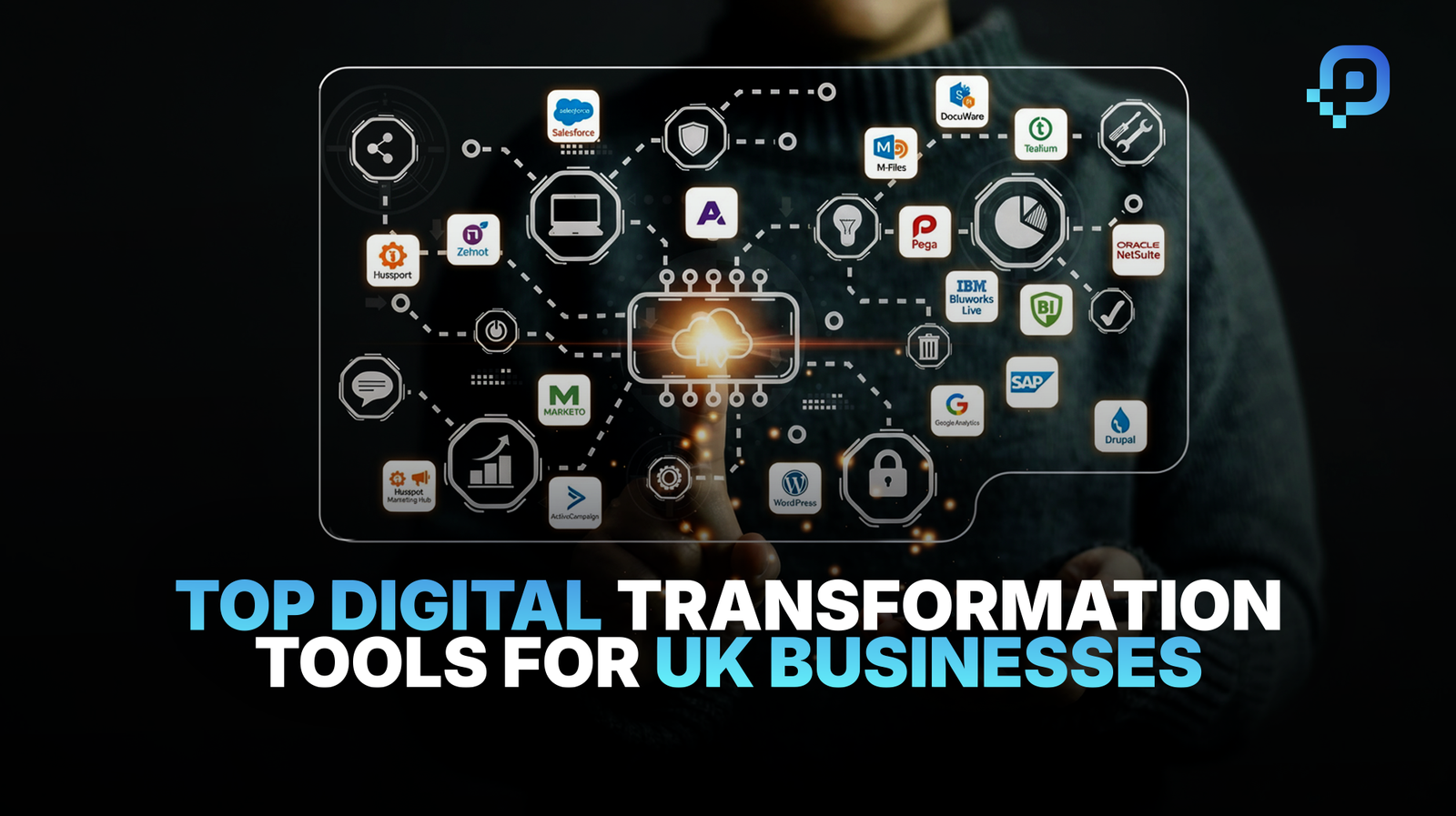
    Most UK businesses require the following professional tools for digital transformation across these key areas:

    • Cloud computing & infrastructure platforms
    • CRM & experience management tools
    • HR & workforce operations systems
    • Data intelligence & analytics platforms
    • AI tools for UK SME digital transformation
    • Team collaboration and productivity
    • Cybersecurity and compliance

    Let’s go through the digital transformation tools list in detail.

    Cloud & Infrastructure Tools

    Cloud infrastructure works as the foundation of modern digital transformation. The best cloud tools for digital transformation in the UK are helping businesses shift towards cloud integrated setups and hybrid working models to improve scalability, flexibility, and remote accessibility.

    • Amazon Web Services (AWS)
      The most trusted and globally used digital transformation tool is ‘Amazon Web Services.’ From supporting and securing data storage and AI tools to providing cybersecurity and analytics, it helps businesses in every aspect and stays aligned with GDPR and data residency requirements.
    • Best for:
      AWS is best suited for cloud migration, improving scalability, AI infrastructure and app and web hosting.
    • Microsoft Azure
      Consultancy firms that are already familiar with Microsoft tools should adopt Azure as their new digital transformation tool in 2026. It enables connectivity with existing systems and secure operational processes across the organisation.
    • Best for:
      Microsoft Azure is best suited for hybrid cloud setups, IT systems, and Microsoft integrations.
    • Google Cloud Platform
      Google Cloud Platforms are widely known for their expertise in data analytics and AI driven workflows. Digital transformation consultants leverage Cloud platforms to streamline complex data processes and integrate machine learning.
    • Best for:
      Cloud platforms are best suited for data engineering, AI development, analytics and cloud-native applications

    CRM & Customer Experience Tools

    CRM and customer experience tools are now essential for sales pipelines, customer engagement, and, of course, for managing customer experiences. Modern versions also utilise AI and automation for improved customer engagement across the digital platform.

    • HubSpot
      HubSpot is quite popular among UK SMEs as it combines the brand’s marketing, CRM, and customer service in one place. This digital transformation tool is user friendly and scales as a business grows.
    • Best for: HubSpot is best suited for inbound marketing, customer engagement and sales automation.
    • Salesforce
      Salesforce is commonly implemented by established organisations in the UK as it offers advanced reporting processes, automation and AI supported insights using its Einstein AI system.
    • Best for: It is best suited for businesses’ customer management, automation services and interdepartmental operations.

    HR Digital Transformation Tools

    HR digital transformation tools and techniques are especially designed to manage an organisation’s employment, payroll, and recruitment processes. It enhances overall human resource performance in hybrid and other environments.

    • Workday
      The Workday platform manages HR and finance departments simultaneously. Strong reporting and workforce analytics can be done utilising Workday.
    • Best for: aligning workforce plans, HR analytics and business level HR systems.
    • BambooHR
      BambooHR is a streamlined HR platform, widely utilised by SMEs. It maintains employee records and helps with onboarding and performance tracking.
    • Best for: This tool is user-friendly and used for basic HR automation, employee management and smooth onboarding processes.

    Data & Analytics Platforms

    Data and analytics are the core drivers of digital transformation, a key component in transforming raw data into business generating insights. When used strategically, they also improve performance and decision-making.

    • Microsoft Power BI
      Power BI is a Microsoft business analytics platform that provides you with a 360-degree view of your professional dashboards. Also, allows you to create and maintain digital reports.
    • Best for: It is best for gaining business intelligence, actionable insights and interactive data visualisation.
    • Tableau
      Tableau is a user-friendly visual analytics tool, owned by Salesforce, widely utilised for advanced analytics and business intelligence. It also delivers AI powered insights through email and Slack. Organisations with vast databases often use Tableau for efficient data analysis and reporting.
    • Best for: Tableau works best for advanced reporting, enterprise analytics, and interactive dashboards.
    • Data Studio (Formerly Looker Studio)
      The Looker Studio is now called Data Studio, is an analytics tool powered by Google. It is widely used for marketing analytics and transforming data into performance reports through configurable visualisation metrics.
    • Best for: Data Studio is best suited for designing marketing dashboards, flexible customisation, creating shareable reports, data visualisation and analysis.

    AI & Automation Tools

    Artificial intelligence AI is rapidly evolving and restructuring how organisations operate in 2026. These AI tools are improving work efficiency, reducing manual effort and accelerating cross platform processes.

    • ChatGPT (OpenAI)
      Who is not familiar with the GPT in 2026? None, right! The smartest and simplest open AI platform, ChatGPT, is an AI chatbot widely used for ideas, writing, creating, customer support and daily productivity tasks.
    • Best for: This AI automation platform is best suited for content creation, enhancing productivity and customer assistance.
    • Microsoft Copilot
      Microsoft Copilot is built into Microsoft 365 apps such as Word, PowerPoint, Excel, Outlook, and Teams. This digital transformation tool provides AI powered assistance to inform, inspire, and entertain. It helps analyse data, draft content and summarise meetings efficiently.
    • Best for: Copilot is integrated for document automation, workplace productivity and project management.
    • Zapier
      Zaper is an AI automation tool for digital transformation that connects 8000+ everyday apps and automates repetitive tasks without coding. It enables teams to build workflows fast with speed, control and security, all under one roof.
    • Best for: Improving workflow automation, app integration and task automation.

    Collaboration & Productivity Tools

    Digital transformation tools and techniques used for collaborative communications in hybrid or remote based setups fall under collaboration and productivity tools. They include

    • Microsoft 365
      subscription service
      Microsoft 365 is a productivity subscription service that includes Word, Excel, OneDrive, Teams and Outlook. It’s an app’s admin centre utilised by IT administrators for securing, monitoring and managing apps within the organisation
    • Best for: It is best suited for delivering seamless day-to-day operations, document collaboration, communication and enterprise productivity.
    • Slack
      Slack is a flexible, open platform for team collaboration and communication. It allows businesses to integrate tools, insights and organise conversations to improve workflow efficiency.
    • Best for: Slack is utilised for secure team communications, project collaboration and works as a bridge between remote teams or employees.

    Understanding the importance of digital transformation in UK organisations is crucial when evaluating tools and selecting them for your organisation. Let’s have a look at our tool comparison checklist below.

    Digital Transformation Tools Comparison Checklist

    Before investing in any digital transformation tool or platform, UK business founders must evaluate those tools against practical operational criteria. Our team at Prox Digital Agency has designed a key question list within the digital transformation framework for UK to consider before investing in any tech tool.

    Here’s a simple checklist:

    # Evaluation Area Key Questions To Consider
    1 Business Fit Does the tool solve a real operational problem? Is it a value addition to your business and its growth?
    2 Integration Capability Does it integrate with your existing systems (CRM, ERP, cloud tools)? Will it minimise work silos or add complexity?
    3 Scalability What’s the evolving capability of the tool? Will it remain effective long-term?
    4 ROI & Value Does the pricing justify the productivity and efficiency tool provided? Are the results measurable?
    5 User Adoption Is it user-friendly? Will employees adopt it in daily operations?
    6 Automation & Efficiency Does it reduce manual effort and improve workflow efficiency?
    7 Compliance & Security Is it aligned with ICO guidelines and is GDPR compliant? Does it also support UK data residency requirements?

    A Tip:

    If you’re not ready to invest in any digital transformation strategy tools yet, you can explore free digital transformation tools in 2026 and test your preferred technologies without any upfront payments.

    How to Choose the Right Stack for Your UK Business

    The fact is that none of the above-mentioned top digital transformation tools provides all the solutions on its own. Organisations must utilise a combination of transformation tools to manage operations and complex compliance requirements.

    The most intelligent approach is to focus on your business’s

    • Operational bottlenecks
    • Workflow inefficiencies
    • Scalability requirements
    • Reporting limitations
    • And customer experience gaps

    Then select tools that integrate naturally into a connected ecosystem.

    And remember:

    “In 2026, Digital transformation does not rely on using every tool.

    Instead, it’s about using the right tools in a strategic combination that delivers efficiency, scalability, and performance.”

    What are digital transformation tools?

    Digital transformation tools are systems that help businesses augment the latest technology to improve processes, create greater value, facilitate communication, collaboration and compliance within the organisation.

    What are five digital tools in the UK in 2026?

    There are 5 essential digital transformation tools to use in UK organisations in 2026.

    • Project Management Software.
    • Email Marketing Tools.
    • Customer Relationship Management (CRM) Software.
    • Analytics Tools.
    • Social Media Management Platforms.

    Are digital transformation tools secure?

    Yes, digital transformation tools are safe and secure to use as long as you choose tools that offer cybersecurity and compliance management to protect your digital assets.

    For the fundamentals behind why these tools matter, see what digital transformation really involves, or talk to our digital transformation agency in London.

  • A Complete Digital Transformation Guide for Businesses 2026

    A Complete Digital Transformation Guide for Businesses 2026

    The digital transformation consultant shares that after experiencing multiple failures and never-ending challenges, it becomes clear that succeeding in today’s AI era requires more than just tools and skills. It demands a well-defined strategy and evolution to achieve successful business objectives.

    This transformation has now become a necessity to survive in the digital world. In 2026, it reflects how organisations operate, extend, and sustain themselves. But the question is ‘why?’ So, let’s understand why digital transformation matters before jumping into the digital transformation guide.

    What Is Digital Transformation and What Does it Mean in 2026?

    Digital transformation is the strategic adoption and continuous integration of technology to align processes, enhance customer experiences, and promote a culture that drives lasting value addition. It is more than just utilising new tools in the market. If the terminology gets confusing, our guide to digitisation vs. digitalisation vs. digital transformation clears up the difference.

    Digital Transformation = Technology + Operating Framework + Data alignment + Organisational Culture

    It aligns systems, decision-making criteria, and people to enable scalable operations, real-time intelligence, and continuous innovation.

    A successful digital transformation can help organisations:

    • Improve operational efficiency
    • Automate repetitive processes
    • Improve customer experience
    • Connect business data
    • Support faster decision-making
    • Modernise legacy systems
    • Improve scalability
    • Strengthen security and governance

    Why Digital Transformation Matters?

    Digital transformation is all about building an organisation that produces faster, smarter, and more resilient in adoption and evolution. Digital transformation is not based on the advanced tools you’re utilising, but on how effectively your organisation evolves and sustains using those new tools.

    1. Today, platforms are now acting as a primary revenue source. So, look around and assess whether your digital channels are aligned with competitive approaches and are effective in converting customer demands. Otherwise, you could be leaving your major ROI source untapped.
    2. At the same time, experts know that efficiency is no longer a “nice to have.” It allows streamlined workflows, reduces error areas, and increases operational speed.
    3. Then comes insight! In 2026, organisational decisions are not made on assumptions and are expected to be backed by real-time insights, including KPI analysis, understanding customer behaviour, and responding to trends as soon as they emerge.
    4. And lastly, scalability. Growth can be altered into operational bottlenecks if not backed by consistent workflows and by adopting opportunities.

    How Digital Transformation Creates Business Value

    The role of this transformation is much more important in creating business value. The pointers below are the impacts that can be enhanced with the correct implementation of digital transformation in businesses.

    To Meet Customer Expectations

    Businesses grow and build their reputation on fulfilled customer expectations. Customers today ask for quick responses, frictionless experiences, and convenient interactions. Failing to meet this basic parameter can cause businesses to lose their valuable customers to competitors.

    Digital is the New Primary Landscape for Competition

    Users tend to discover and compare businesses on online platforms. If your digital landscape is not customer-engaging, descriptive or fast, you risk losing your business visibility.

    Automation Accelerates Productivity and Cost Efficiency

    Digitising businesses can maintain workflows, financial reporting and cost efficiency through reliable automation. With proper strategic approaches, it also accelerates overall team excellence and customer experiences.

    Data Insights are for Decision Making

    Modern practices include decision-making based on data, not on any assumptions. Strategic data insights help businesses identify better opportunities, enable consistent performance tracking, and support quick decision-making.

    Scalability Depends on Digital Infrastructure

    Digital infrastructures are essential for preventing inefficiencies, misleads, and poor customer experiences. A resilient infrastructure helps you scale, meet demands, and maintain quality without overstretching.

    The Journey of Digital Transformation: McKinsey’s 4Ds Framework

    A digital transformation framework is essentially a structured way to connect business strategy with digital execution. Sounds straightforward? But here’s the catch! Most organisations don’t struggle with ideas; they struggle with alignment. And that’s where the digital transformation framework comes into action!

    To structure transformation from planning to execution, McKinsey’s 4Ds framework is the easiest one to understand, yet the simplest one to misuse. The McKinsey digital transformation strategy comes with 4 D’s.

    1. Discover – this stage helps understand the current business state and gaps that need to be addressed.
    2. Design – the second stage presents solutions and the roadmaps for timely execution.
    3. Deliver – the third one is the execution or implementation stage of transformation.
    4. De-risk – and lastly, managing governance and compliance for long-lasting, secure business growth.

    The McKinsey digital transformation framework explained that organisations can simply achieve measurable outcomes without overcomplicating execution.

    A Practical Digital Transformation Strategy Guide for 2026

    Instead of depending solely on new tools or tech adoption, a digital transformation strategy provides a step-by-step framework to achieve success in every initiative undertaken. It ultimately serves as a roadmap that guides how a business must be digitised in 2026.

    Build a digital transformation strategy and win your digital visibility game in 7 practical steps.

    1. Perform a detailed audit of existing operational systems.
    2. Identify operational and customer loopholes.
    3. Set measurable transformation targets.
    4. Adopt technologies and digital transformation tools aligned with business outcomes.
    5. Implement tech in stages with leadership supervision.
    6. Train people and teams to initiate organisational transition.
    7. Monitor KPIs and optimise ongoing processes.

    This simple yet structured approach surely helps reduce risk while improving scalability and long-term adoption.

    Key Components of a Digital Transformation Framework

    Digital transformation is based on 8 building blocks. Strategically combining all of them will give businesses what they actually lack.

    1. Align Transformation With Business Goals

    Step one is valuable strategy alignment. It defines why the transformation is happening and how it will be a valuable step for the organisation. This includes business objectives, competitive positioning, and long-term digital goals.

    2. Prioritise Customer Experience First

    A successful customer experience directly impacts business value and delivery. Today, customers not only expect personalised interaction, but they also demand a fast and seamless journey.

    Therefore, improved customer feedback shapes operational upgrades and business loyalty, creating long-term business value.

    3. Build a More Agile Operating Model

    Drive agility, operational efficiency, and automation by re-engineering core workflow within the organisation. This model helps replace fragmented, manual processes with streamlined and scalable ecosystems.

    4. Create a Scalable Technology Foundation

    Technology and architecture are the foundation of the digital transformation framework. They translate strategic intent into scalable capabilities. A structured architecture delivers resilient, interconnected and evolutionary digital systems to help innovate businesses without disrupting their core operations.

    5. Turn Data Into Business Intelligence

    By establishing a unified data foundation, organisations gain improved visibility and drive optimised growth. A strong data layer enables seamless data flow across systems, supporting real-time responsiveness.

    6. Bring People and Culture Into the Change

    Every organisation is formed on people’s trust and cultural foundations. Yet consultants often overlook this critical key factor in a digital transformation. People and culture determine how effectively change is adopted and sustained throughout the organisation.

    7. Keep the Transformation Evolving

    One transformation occurs, and it now demands continuous evolution to remain capable and competitive in the digital market. Organisations that evolve with the advancing tech, sustain for a longer period. This can be achieved by adding consistent improvement, data-driven iteration, and innovation.

    8. Protect Growth With Strong Governance

    It’s a critical control layer within the digital transformation framework. It enables organisations to scale securely in a controlled environment. Governance and security refer to setting clear policies, managing risk, and protecting systems for confident future growth and sustained stability.

    The Digital Transformation Tools That Power the Shift

    Success is a combined outcome of effectively utilising tools, technology, and skills. Since technology acts as a common pathway between business objectives and outcomes, selecting the right tools determines how efficiently strategy translates into measurable results.

    Here are the major digital transformation tools that are used worldwide for improved business visibility, and Prox has expertise in using them efficiently.

    Digital Business Transformation Tools in 2026 Role in Digital Transformation
    Cloud Platforms They are for scalable infrastructures, rapid deployment, and cost-efficient operations.
    Data & Analytics Tools They help in converting complex datasets into easy-to-read and flexible formats to support technical decision making.
    AI & Machine Learning Machine learning and AI workflows through automation, predictive results, and personalisation.
    Automation Tools Reduce work difficulties by streamlining major processes.
    Integration Platforms Acts as a bridge between complex data and systems to minimise operational silos.
    Cybersecurity Solutions Protect systems, crucial data, and optimise operations while maintaining compliance. Also provides risk management.

    Digital Transformation Checklist 2026

    Clarity and prioritisation are the basic requirements to initiate your digital transformation journey in 2026. Here’s a straightforward checklist on how to get started for a successful business transformation.

    1. Firstly, assess your current digital maturity by understanding your workforce, existing systems, and operational gaps.
    2. Explain clear business outcomes (growth, efficiency, CX) to the digital transformation consultants.
    3. Start with small but impactful initiatives to get quick results and build momentum.
    4. Align human, AI, and technology. Ensure they are all aligned functionally to support decision-making and scalability.
    5. Establish user-friendly, accessible data systems for long-term growth visibility.
    6. Don’t focus on quick fixes. Treat the digital transformation process as an ongoing execution and fix every troubleshoot intelligently.
    7. Give priority to governance and accountability.

    What are the Trends in Digital Transformation in 2026

    Digital transformation in 2026 is shifting towards execution rather than just experimentation. See our full breakdown of digital transformation trends shaping UK businesses this year.

    Organisations are not adopting technology just for the sake of innovation, but for a broader perspective, such as measurable outcomes, visibility, and long-term scalability.

    Prox Digital Agency has highlighted the following key trends in digital transformation aligned with 2026 strategies.

    “In 2026, the real game is control, not capability. It’s not about who is moving fast; it’s about who is stepping right. The winner will be one who will build with strategy, governance, and trust and create an impact.”

    ROI Generating Approach

    The goal of digital transformation is to generate a measurable return on investment (ROI). In 2026, it is essential to prioritise initiatives that contribute to tangible values and improved ROI. Rather than investing in standalone tools, businesses are focusing on end-to-end optimisations as a core success metric.

    Enhanced Operational Maturity

    Instead of relying on hypothetical roadmaps and case studies, organisations, including Prox Digital Agency, are now prepared to adopt new technologies and reduce scalability complexities. The Prox team is committed to this trend and formulates accurate and result-oriented strategies for building a stronger digital transformation foundation.

    Combining AI and Human Capabilities

    In the latest organisational successes, human capabilities are not enough, nor is AI integration. A real digital transformation requires a combination of AI, humans and automation. Therefore, building connected environments promises smooth workflows, real insights and consistent outcomes.

    Orchestrating Smart Automation

    With several AI models working simultaneously within a process, it is essential to orchestrate a structured framework to ensure controlled, efficient work environments. From employee onboarding to demand delivery, customer service to generating leads, foundations must ensure that each system is intelligently aligned to automate the entire workflow.

    Trusting the AI and Tech

    AI may become advanced, but its utilisation still depends on how humans operate and integrate it into a digital transformation. Trusting the AI and tech together can help organisations create confident business strategies.

    Hopefully, now you know what a digital transformation strategy is and how it creates impact on striving businesses. Let’s learn about how to start a digital transformation.

    Common Challenges of Digital Transformation

    Our digital transformation practical guide includes the most common digital transformation challenges organisations can experience in 2026. They are:

    Weakly Managed Organisational Change

    Until the people don’t understand the reason and impact behind the change, they won’t adopt it. Digital transformation initiatives often face low or zero adoption within the organisation. With smart communication and strategic guidance, teams can maintain work momentum and new processes to make a transformation cohesive.

    Lack of Digital Maturity

    Lack of digital maturity refers to the gap between technology adoption and workforce capabilities. Organisations often lack the technical skills to utilise new technology, tools or platforms, creating a barrier for advanced technological impacts.

    Leadership Gaps

    Any transformation requires leadership to attain consistent outcomes, and digital transformation is no different. Misalignment or lack of direction creates confusion across employees and teams, eventually leading to a loss of executional focus.

    Complex Legacy Systems

    Siloed data environments are one of the barriers to successful digital transformations. Organisations can never lead with complex or outdated technologies. Leveraging modern tools and techniques makes the transition smooth and reliable for a long time.

    Communication Gaps

    Miscommunication or zero communication can critically damage digital transformation integration in any organisation. It is expected that the workforce will be inflexible or disengaged when adopting new systems instantly. This gap lowers the adoption chances and hence undermines the success of the transformation.

    What Happens When Digital Transformation is Delayed

    Even established businesses are at risk of experiencing potential downside if they fail to adopt digital transformation and transitions.

    Below is the potential cost of not transforming digitally.

    ROI leakage

    Incompetent digital capabilities limit business nurture, converting demands, and eventually lead to missed revenue opportunities.

    Inefficiency in operational processes and bottlenecks

    Traditional operating systems and digital transformation tools can hinder efficient workflows, business performances, and eventually restrict scalable opportunities.

    Competitive disadvantage

    Since competition is high, delaying digital transformation can get you outpaced by potential market competitors, making it difficult to scale, compete, and succeed.

    Holding back from a digital transformation only leads to greater challenges.

    Are You Ready To Digitise with Prox?

    As you now know what a digital transformation strategy is, how it works, and what importance it holds, the next question here is: when are you going to begin your digital transformation journey to elevate your organisation’s digital level?

    Well, let us help you out. If you are planning to start your business transformation, you’re already at the right place! Prox’s expert consultants treat the entire transition process as a crucial business need rather than just another IT project. From building a strategic framework and selecting tools to their implementation and staged optimisation, our team works closely with organisations and founders to deliver their goals within a designated budget.

    You only need to share your business requirements and investment roadmap with our consultants, and we will help you initiate a scalable business growth.

    If you still have questions about digital transformation, feel free to reach out through our comment section. Explore our digital transformation consulting services and take your next confident step towards successful digitisation.

    FAQs

    What is a digital transformation strategy vs digital strategy?

    Digital strategy is a focused roadmap of how technology should be leveraged to achieve specific business goals, whereas digital transformation is a thorough, enterprise-wide reinvention of business models, culture, and processes with the help of technology.

    What are the 5 steps of digital transformation?

    The five pillars of a digital transformation are:

    • Setting the scope or goal
    • Identifying requirements
    • Prioritising requirements
    • Strategic steps with timelines and resource allocation
    • Tracking progress to ensure successful digital transformation

    What are the 4 pillars of transformation?

    People, Processes, Technology, and Governance are the four pillars of a digital transformation.

    Why do 70% of digital transformations fail?

    The widely cited figure that around 70% of transformations fall short traces back to long-running change-management research, and McKinsey’s own survey work reports similar odds. Where they do fail, the usual causes are unclear vision, misleading departmental alignment, insufficient organisational buy-in, and improper monitoring to enable timely adjustments.

    What role can technology play in a digital transformation?

    In a digital transformation, technology enables automation, improves efficiency and scalability, provides data-driven decisions, and integrates innovation into organisations.

    How long does digital transformation typically take?

    Digital transformation timelines vary depending on business size, place, and goals by organisation. However, the most modernised initiatives take up to 18-36 months for initial implementation, up to 3-6 months through pilot programs, while complete operational transformation and digital maturity requires approximately 2-4 years.

  • Digital Transformation in 2026: What Businesses Must Change to Stay Relevant

    Digital Transformation in 2026: What Businesses Must Change to Stay Relevant

    The digital transformation market is projected to reach £2.7 trillion across the world by 2026, yet a staggering reality persists: 65% of these initiatives fail to deliver their promised value. Nevertheless, 90% of organisations are now moving forward, spending heavily on artificial intelligence, cloud computing, and data analytics as they rethink how they work and relate to their customers.

    Understanding what digital transformation truly means and how to execute it successfully has become important for business survival and growth. After transforming 500+ businesses, we’ve seen what works and what wastes time and money. Prox Digital Agency builds and delivers digital transformation that drives real growth and measurable ROI. This guide captures our proven frameworks and industry insight to help you outperform the market because we are your Pros for Growth.

    Key Takeaways

    In this guide, we shall closely examine what makes certain transformations successful and others not. You will see the stories of actual businesses, find out what kind of tools and trends are building the 2026 world, and get some useful ideas on how to address the issues that tend to confuse people.

    Towards the conclusion, you will have definite ideas of how to measure success, develop digital skills within your team, and provide your business with the best opportunity to establish itself in a digitalising economy, because transformation without expert guidance often means joining the 70% failure statistic rather than the 35% success rate.

    Digital transformation concept showing a futuristic human silhouette made of glowing data and code, facing a stream of digital panels and information flowing toward a bright light. The scene represents technology integration, AI, and data-driven evolution from Prox Digital Agency

    What Does Digital Transformation Mean Beyond Technology Updates

    Our analysis at Prox Digital Agency includes that organizations beginning transformation in 2024-2025 gain 3-5 year competitive advantages to fundamentally change how an organisation creates value. It is not about adding new tools on top of old ways of working. It is about rethinking processes, culture, decision-making, and customer experience from the ground up.

    To understand this clearly, it helps to distinguish between three related concepts:

    • Digitisation: converting analogue information into digital form
    • Digitalisation: improving existing processes using digital tools
    • Transformation: redesigning the business itself around digital capability

    The deeper importance lies not in technology itself but in what it enables:

    Customer Expectations Have Permanently Shifted

    The 2024 State of Marketing Report by HubSpot states that 73% of consumers want their individual needs and expectations to be recognised by companies, and 76 percent of them become frustrated when this doesn’t happen. It is through digital transformation that a data infrastructure, analytics, and process integration are offered to provide these personalised experiences at a large scale.

    Operational Efficiency Drives Profitability

    Successful transformations enable the 40-60% operational efficiency improvement due to process automation, AI-based decision support, and real-time visibility of data. These are not margins of improvement; it is basic cost-based redesign that forms sustainable competitive moats.

    Talent Attraction and Retention

    Current workers, especially those younger than 40, demand to work in digital-first, cloud-based, mobile-commerce and AI-enhanced work environments. Companies trapped behind legacy systems are experiencing the rising cost of talent acquisition and retention challenges.

    Regulatory and Compliance Requirements

    With GDPR to ESG reporting, the complexity of regulations requires digital systems to govern data, assist in compliance tracking, and report transparently. Manual methods cannot stand when the needs grow.

    Innovation Velocity

    Digital infrastructure facilitates fast experimentation, A/B testing, and product processes that cannot be done in the traditional setup. This rate of innovation is progressively widening the gap between the market leaders and the followers. The organisations that will understand this holistic perspective will invest accordingly, and they will enjoy a corresponding reward.

    Why Is Digital Transformation Important For Business Success

    Companies successfully executing transformation strategies report 26% higher profitability compared to industry peers, whilst organisations that resist change increasingly struggle to maintain market relevance as customer expectations evolve. 

    Why digital transformation matters becomes evident when considering the ways in which the pandemic condensed a decade of potential digital transformation into eighteen months, permanently dividing organisations with solid digital bases and those still reliant on traditional business models.

    Digital Transformation Statistics and Market Trends for 2026

    These are the six major technological categories that are fundamentally reshaping how organisations operate, compete, and deliver value in 2026

    Generative AI

    The use of generative AI has increased dramatically, and 80 percent of businesses are currently using it for creating content, writing code, managing customer care, designing products, and supporting decisions. The companies target the maximisation of ROI by focusing on the high-value use cases, data quality, IP management, and internal expertise as the basis for more advanced autonomous systems.

    Agentic AI

    The agentic AI is used in various fields, and complex decisions are made without human supervision. It is estimated to be projected to be 75 billion by the year 2032, helping to guide adaptive supply chains, manufacturing, and strategic planning. Its use has found applications in predicting inventory, quality control, and real-time detection of fraud to enhance efficiency, response to decisions, and scalability without correspondingly increasing human resources.

    Quantum Computing

    Quantum computing allows solving problems that classical models cannot, including portfolio optimisation, large-scale fraud detection, and rapid drug discovery. By 2030, it will transform cryptography, logistics, and materials science. The ability to make rapid increases in qubit stability and error rates is potentially shifting practical quantum applications into mainstream business applications.

    Cloud Computing

    Cloud computing is balancing out the simplistic infrastructure to industry-based multi-cloud computing with built-in compliance and domain understanding. Edge computing is the complement to this and provides decisions in split seconds in manufacturing, retail, autonomous vehicles, and smart cities, making available new business models and operational capabilities.

    IoT and Edge Computing

    IoT and edge computing develop a connected environment in real time. Manufacturing sensors predict failure in manufacturing, customer behaviour in retailing systems, and optimising transport, energy, and emergency services in smart cities. In cases where there is limited central connectivity, edge processing minimises the latency and promotes privacy as well as autonomous decision-making.

    Blockchain and Web3

    Web3 and blockchain bring more trust and transparency. Prox believes that Nations can make payments across borders immediately, supply chains can be made immutable, 60% smarter contracts can be achieved, and so on. They establish connected digital identities, protect intellectual property, and decentralise organisations that lie behind a connected digital economic structure beyond finance.

    The 4 Core Pillars of Strategic Digital Transformation 

    Digital transformation combines technology, individuals, procedures, and information into a single platform to improve the advantage of a competitive viewpoint, rather than running isolated departmental initiatives.

    Technology Pillar

    Modern IT is not confined to the classic systems, but rather incorporates cloud, AI, IoT, data pipelines, and analytics into existing ecosystems. Interoperability, security, compliance, and flexibility, treating technology as a strategic capability, not standalone tools.

    People & Culture Pillar

    Cultural alignment is important. 38% of organisations have issues with change management, and 54% of workers require reskilling. Successful transformations create psychological safety, encourage experimentation, compensate teamwork, and embed life-long learning.

    Process Optimisation

    Transformation rethinks workflows, not just automates them. AI has helped the insurers submit claims 75 times quicker and retailers with a higher 35 % conversion following real-time personalisation. 

    Data Foundation

    Managing data as a strategic asset enhances customer satisfaction, efficiency and innovation. Strong governance, security, compliance, and built-in access are necessary, but were listed by 64% of companies as poor data quality.

    Real-World Digital Business Transformation Across Industries

    Digital technologies are giving organisations in various industries new ways to think through how operations are conducted, how customers experience them, and how organisations can have sustained competitive advantages.

    Healthcare

    The adoption of telehealth increased by 76 % to 11% in the midst of the pandemic, providing convenient care. Electronic health records enhance coordination, minimise duplicate tests, and diagnose conditions earlier and more accurately with AI diagnostics. Remote patient monitoring with wearables lowers hospital readmissions by 25% and makes it possible to address problems proactively.

    Financial Services

    Digital banking users have grown 200% since 2020, favouring mobile apps, instant transactions, and personalised tools. AI handles 25% of insurance underwriting, improving speed and consistency. Mobile payments process £1.2 trillion annually in the UK, while blockchain enables real-time cross-border settlements, cutting costs and improving transparency.

    Retail & E-Commerce

    Omnichannel experiences integrate online and in-store shopping, while personalisation drives engagement and sales. AR lets customers visualise products, reducing returns, and AI recommendations account for 35% of Amazon’s revenue. The retail digital transformation market reached £115 billion in 2020 and grew 18.2% annually.

    Manufacturing

    The market grew from £211 billion in 2020 to £615 billion in 2026, as IoT sensors, predictive maintenance, and digital twins optimise production. Real-time monitoring reduces downtime by 50%, while virtual simulations accelerate innovation and reduce errors.

    Education

    Digital platforms expand access to education, with adaptive learning adjusting content to each student’s needs. Virtual labs allow safe, flexible experimentation, improving outcomes and reducing educator workload. Remote learning, accelerated during the pandemic, continues to provide cost-effective, personalised education.

    Real Estate & Construction

    Smart buildings use IoT to optimise energy, lighting, and space, cutting costs by 30%. Drones, 3D modelling, and AI project management accelerate construction and reduce budgets. Predictive maintenance prevents expensive failures, and virtual reality lets stakeholders experience buildings before construction, minimising costly design changes.

    Navigating Common Digital Transformation Challenges & Solutions

    Understanding obstacles that consistently derail transformation initiatives enables proactive planning and mitigation strategies that significantly improve success probability across organisations of all sizes and industries.

    Overwhelming Complexity

    When it comes to trying to implement simultaneous changes in too many areas at once, it paralyses the decision-making process, overwhelms organisations, consumes budgets without value, and causes change-fatigue, creating cynicism about future efforts.

    Technical Expertise Shortage

    The limited availability of digital talent attracts high compensation, which most organisations are unable to pay, and external hiring is ineffective when demand vastly exceeds supply across all markets and geographies.

    Budget Constraints and Hidden Costs

    The original transformation budgets seldom consider the complexity of integration, training, continuous optimisation requirements, and adjustments that are bound to occur due to unforeseen challenges as the implementation proceeds and may necessitate further investment.

    Cybersecurity Concerns

    Digital transformation widens the scope of attacks, introduces vulnerabilities, and exposes organisations to cyber attacks as organisations migrate to the cloud, link systems that were thought to be isolated, and implement remote connections.

    The Digital Transformation Maturity Model: Where Do You Stand?

    The analysis of the current state of maturity in your organisation is one of the key steps that helps develop practical roadmaps to continue the way to achieving a new stage of digital capability.

    Stage 1: Resistant

    Organisations resist change and insist on traditional processes despite increased evidence of the inability of current approaches to produce competitive outcomes in current trends.

    Stage 2: Aware

    Leadership identifies the need for transformation but is not truly committed, hence no action or resource allocation is applied in the boardrooms.

    Stage 3: Active

    Departments experiment with different technologies and initiatives in isolation without being strategic or naming them as one of the goals of the organisation.

    Stage 4: Strategic

    The organisation executes a highly coordinated change that implements leadership, dedicated resources, striking road maps, and governance frameworks that promote steady development towards defined targets.

    Stage 5: Transformative

    Digital thinking becomes the default mode of operation, continuous innovation, instant adoption of technology, and cultural norms that have become embracive of experimentation and adaptation.

    Your Roadmap to Successful Digital Transformation Implementation

    There are strategies that keep distinguishing successful changes and costly disappointments, and this fact provides hands-on recommendations to organisations that expedite their digital paths to sustainable competitive edge.

    A futuristic, glowing blue digital interface displaying a holographic world map and concentric data rings for digital transformation. A mechanical robotic hand points toward the center of the display represents Prox Digital Agency.

    Start With Genuine Customer Needs

    Instead of just trying to get internal efficiency gains, start by defining customer pain points, unmet needs, and areas of meaningful experience improvement instead of emphasising internal efficiency gains.

    Build Strong Data Foundations First

    Make sure that there is strong data management, data quality, security measures, and integration models and structures in place before advancing analytics or AI-type systems that rely on clean, consistent, and well-structured data to achieve the value promises.

    Start Small and Scale Successes Quickly

    Introduce limited-scale pilot projects which provide easy wins that prove the value, develop expertise, create momentum, and quickly double proven strategies and drop unsuccessful ones without blame or recrimination.

    Make Security Foundational, Not Optional

    Standardise end-to-end measurement systems on customer experience, operational effectiveness, employee productivity, and innovation measures on the basis of data-based knowledge to guide the continuous refinements and optimisations.

    Embrace Agile Methodologies

    Implement agile strategies that can speed up the process of repeating, learning, and adjusting to evolving needs as they occur, instead of strict planning that will become outdated as the conditions change during the implementation process.

    Communicate With Complete Transparency

    Be straightforward about progress updates, talk openly about the challenges, and maintain clear, consistent communication, which creates trust within organisations to navigate difficulties successfully together.

    The Future of Digital Transformation: 2030 and Beyond

    By 2030, the amount of digital transformation will amount to 3.6 trillion as AI, quantum computing, and autonomous systems become the new norm. Almost half of businesses have ESG priorities that are influenced by regulators, shareholders, and consumers. Industries are becoming more digital and physical. The man no longer needed is assigned to strategy and complex problem solution under AI-driven automation, setting the new competitive baseline.

    Bringing It All Together

    Digital transformation is not a luxury any longer. People spend 2.7 trillion worldwide, proving it is not only necessary to be competitive and survive, but 81 % of executives consider it necessary. Organisations that are adaptable to change enjoy an advantage and can take advantage of the opportunities emerging as the slow-moving organisations lag behind. Start your change process with a team of professionals at Prox Digital Agency and transform your strategic vision into actionable outcomes.

    Frequently Asked Questions

    How long does digital transformation actually take?

    Overall changes usually require 3-5 years, whereas small-scale projects can show quantifiable outputs within 6-18 months.

    What should we realistically budget for transformation?

    Small companies cost 50,000-250,000 on targeted projects, and companies can invest 5-50 million to produce an ROI of around 300 percent within five years.

    What are the absolute biggest challenges we will face?

    The primary barriers are complexity, skills gaps, integrating an old system, problematic data quality, and cultural opposition, which must be planned in advance and managed constantly.

    For the fundamentals behind this shift, see our complete Digital Transformation Guide, or talk to our digital transformation consulting team. See also how this differs from digitisation and digitalisation.